.png)
Every company in the logistics chain faces growing pressure to disclose its environmental, social, and governance (ESG) impact. If you've been asked to produce or contribute to a sustainability report, or simply need to understand what one involves, you're not alone. So, what is sustainability reporting, and why does it matter to freight forwarders and supply chain professionals?
At its core, sustainability reporting is a structured way for organisations to measure, disclose, and be accountable for their ESG performance. For anyone arranging air cargo charters, that includes carbon emissions per shipment, fuel consumption data, and the social governance standards of your supply chain partners. These aren't abstract metrics, they're figures that clients, regulators, and investors increasingly expect to see documented.
At CharterSync, we built our platform around transparency and data accuracy in air cargo chartering. The same principles that drive reliable quoting and real-time shipment tracking also support better sustainability disclosures: clean data, full audit trails, and operational visibility from inquiry through to delivery.
This article breaks down the key frameworks, benefits, and ESG categories behind sustainability reporting, giving you a clear, practical foundation to understand what's required, what's optional, and where to start.
Understanding what is sustainability reporting starts with understanding why businesses bother doing it at all. The short answer is that stakeholder expectations have shifted dramatically over the last decade. Clients, investors, and regulators no longer treat environmental and social disclosures as a bonus. They treat them as a baseline requirement, and businesses that ignore them face real commercial and legal consequences.
Across the UK and the EU, mandatory disclosure requirements are expanding rapidly. The UK government has aligned with the Task Force on Climate-related Financial Disclosures (TCFD), requiring large companies to report on climate risk. The EU's Corporate Sustainability Reporting Directive (CSRD) now applies to thousands of businesses operating in Europe, including non-EU companies with significant EU revenue. If your supply chain includes European clients or partners, their reporting obligations flow directly to you.
Failing to provide accurate ESG data to a key client can now cost you the contract, not just the relationship.
Freight forwarders and logistics managers often sit in the middle of complex multi-tier supply chains, which means you may face reporting requests from multiple directions at once. Your shipping partners want your emissions data. Your clients want your governance records. Your insurers and lenders are starting to ask the same questions.
Reporting your sustainability performance builds measurable trust with clients who are under their own disclosure pressure. When a large manufacturer needs to report scope 3 emissions, which are the emissions generated across their supply chain, they rely on data from companies like yours. If you can supply verified, structured ESG data quickly, you become easier to work with and harder to replace.
Procurement teams are increasingly scoring suppliers on ESG performance during tender processes. In competitive freight markets, a clear and credible sustainability report can differentiate you from a rival who offers similar rates but weaker data. This commercial advantage compounds over time as client reporting requirements become stricter, not looser.
Sustainability reporting forces you to look closely at how your operations actually run, which often uncovers inefficiencies you had not previously quantified. Tracking fuel use, route efficiency, and carbon output per shipment gives you actionable data rather than estimates. Many logistics businesses find that building a report surfaces real opportunities to cut costs and reduce waste at the same time.
There is also a financing angle. ESG-linked lending products and green bonds are increasingly available to businesses that can demonstrate credible sustainability data. Banks and investors use these reports to assess long-term operational risk, and companies with strong disclosures tend to access capital on better terms. Sustainability reporting is not just a compliance exercise. It is a tool for running a more resilient, better-documented business that clients and partners actively want to work with.
When people ask what is sustainability reporting, they often assume it means a vague statement of environmental intent. In practice, a well-structured report is a detailed factual document that covers three distinct categories of performance data: environmental, social, and governance. Each category carries its own metrics, and the data you include depends on your industry, your size, and the framework you choose to report against.

The environmental section is typically where logistics businesses carry the most exposure, because transport operations generate significant carbon emissions. This section covers your total greenhouse gas output, broken down by scope 1 (direct emissions from owned assets), scope 2 (emissions from purchased energy), and scope 3 (indirect emissions across your supply chain). For air cargo specifically, scope 3 is often the most material figure, since the emissions from the flights you arrange sit outside your direct operations but remain your reporting responsibility.
Clients arranging their own scope 3 disclosures will request this data from you directly, so having it structured and verified in advance saves time and prevents delays.
Beyond carbon, this section also covers energy consumption, fuel efficiency, waste generation, and any progress made against reduction targets from previous reporting periods.
The social component of your report covers how your business treats people, including employees, contractors, and communities in your supply chain. Typical metrics include staff turnover rates, training hours per employee, health and safety incident rates, and diversity statistics across your workforce. For freight forwarders managing complex international chains, this section may also address labour standards and due diligence checks applied to overseas partners.
Governance disclosures address the structures that keep your business accountable and ethical. This includes board composition, anti-corruption policies, data security practices, and any whistleblowing mechanisms you have in place. Governance is often underweighted in early sustainability reports, but it is the section that regulators and institutional clients scrutinise most carefully, because it signals whether the environmental and social data you have reported can actually be trusted.
Together, these three categories give stakeholders a complete picture of how your business operates beyond its financial results.
Understanding what is sustainability reporting fully requires knowing which frameworks actually govern how you structure and present your ESG data. Several competing standards exist, and choosing the right one depends on your size, your client base, and where you operate. Getting familiar with the major options early saves you from having to retrofit your data collection later.
The Global Reporting Initiative (GRI) is the most widely used framework globally. GRI Standards give you a modular structure built around three layers: universal disclosures covering your organisation and governance, topic-specific environmental standards, and dedicated social impact standards. Because GRI is sector-neutral, it works well for logistics businesses of almost any size and gives clients a recognised benchmark for comparing your ESG data against other suppliers. Common disclosures under GRI for freight operations include:
The Task Force on Climate-related Financial Disclosures (TCFD) focuses specifically on how climate risk affects your business financially. Large UK corporates and listed companies are already required to report against TCFD, and they will expect your operational data to align with those categories when building their own disclosures. The EU's Corporate Sustainability Reporting Directive (CSRD) goes further, requiring detailed disclosures across all ESG categories for companies meeting certain size or revenue thresholds in European markets.
If you operate within EU supply chains or serve clients subject to CSRD, your data will need to meet the same level of rigour that their auditors apply.
The International Sustainability Standards Board (ISSB) published its first two standards, IFRS S1 and IFRS S2, in 2023. IFRS S1 covers general sustainability-related financial disclosures, while IFRS S2 focuses specifically on climate. These standards are designed to work alongside financial reporting, which makes them particularly relevant if your business has institutional investors or lenders who already use IFRS accounting standards. Several countries are adopting ISSB standards as their domestic baseline, so early familiarity gives you a practical head start.
The question of what is sustainability reporting is increasingly being answered by legislation rather than choice. For UK businesses and those operating across international supply chains, the timeline for mandatory disclosure is moving faster than many expect. Knowing which rules apply to your business now, and which are approaching, lets you build compliant data infrastructure before a deadline forces you to.
The UK government has introduced climate-related financial disclosure requirements that apply in stages based on company size. Large UK-registered companies and LLPs with more than 500 employees and either a turnover exceeding £500 million or assets over £500 million must already report in line with TCFD recommendations as part of their annual filings. Smaller companies are not yet in scope, but the trajectory is clearly toward broader coverage, and several consultations are underway to extend requirements further down the size threshold.
If a large client or investor already operates under mandatory TCFD reporting, they will push those data requirements directly to you through their scope 3 disclosure obligations, even if you are not legally required to report yourself.
The EU's Corporate Sustainability Reporting Directive (CSRD) applies to non-EU companies that generate more than €150 million in annual EU net turnover and have at least one subsidiary or branch in the EU meeting certain size criteria. If your freight operations involve EU-based entities or significant EU revenue, CSRD may apply directly to your business regardless of your UK registration. The first wave of non-EU companies covered by CSRD begins reporting on financial years from 2028, which sounds distant but requires data collection systems to be in place well beforehand.
Beyond the UK and EU, countries including Australia, Canada, Singapore, and Japan are introducing or consulting on mandatory climate and ESG disclosure frameworks aligned with the ISSB standards published in 2023. For logistics businesses working across multiple jurisdictions, this global convergence means the core data you collect for one regime will increasingly satisfy the requirements of others. Building a single, well-structured dataset now reduces the duplication of effort as new mandates come into force across the markets where you operate.
Understanding what is sustainability reporting in practice starts with having a structured process. The project becomes manageable when you break it into clear, sequential stages rather than attempting everything at once. Starting with scope and working forward to publication ensures the data you collect actually answers the questions your stakeholders are asking.
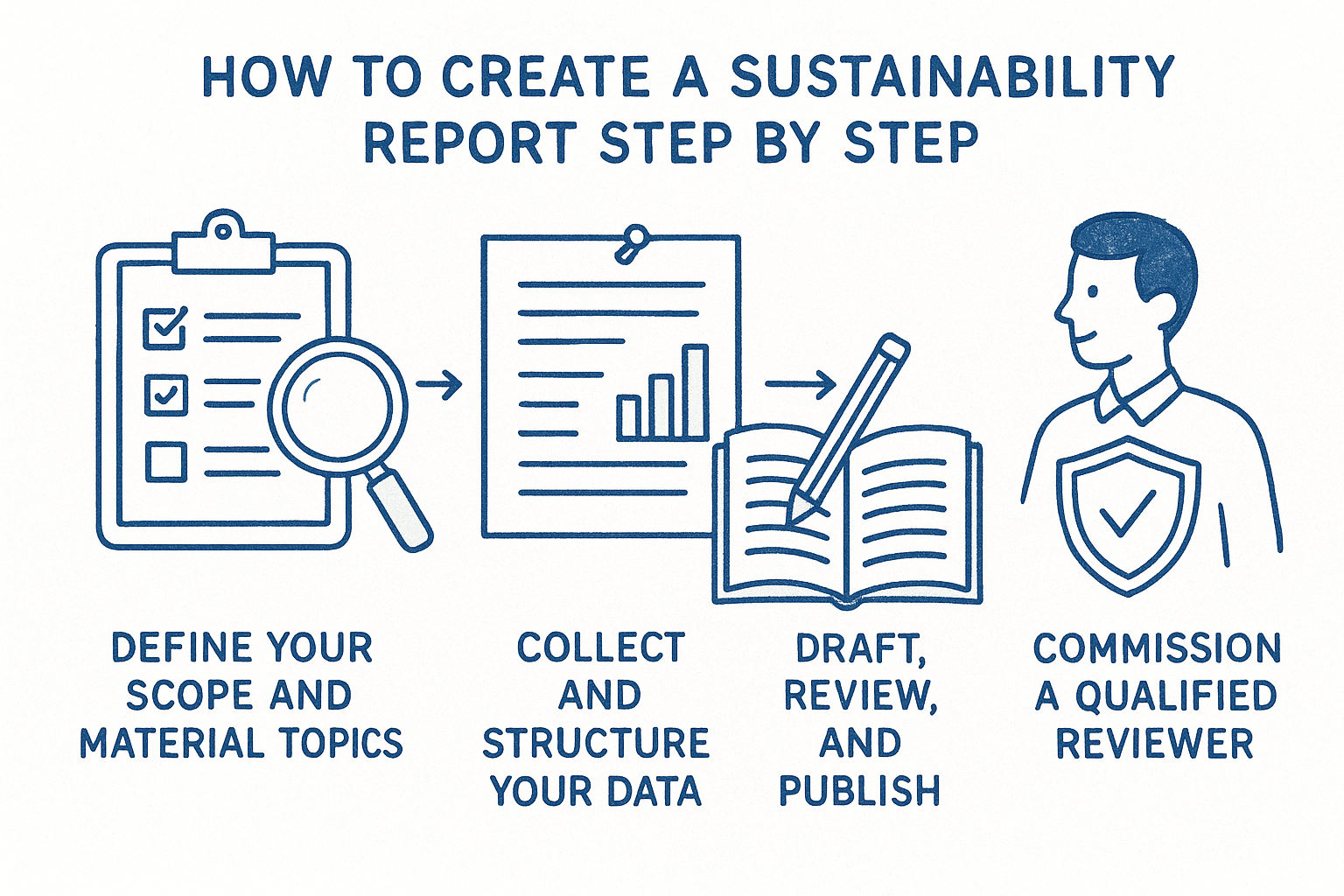
Your first task is to establish which ESG topics are genuinely material to your operations. Materiality means the issues that carry a significant impact for your business or for those affected by it. For a freight forwarder or logistics manager, carbon emissions, fuel consumption, and labour standards in your supply chain are almost always material. Conduct a structured stakeholder survey covering clients, employees, and investors to confirm which topics they expect you to address. Common material topics for logistics operations include:
Once you know what to report on, assign clear ownership within your team for each data category: someone tracking emissions figures, someone managing workforce statistics, and someone responsible for governance records. The data you gather must be traceable back to a verifiable source, whether that is a fuel log, an invoice, or a payroll system, because auditors and clients will ask for that evidence.
Establish your data tracking systems before the reporting period begins, not after it ends, because reconstructed estimates rarely survive scrutiny from clients or third-party reviewers.
Retrofitting data collection after the fact is one of the most common reasons early sustainability reports fail to hold up under review. Capturing flight-level fuel and routing data at the point of operation, rather than estimating it later, is especially important for air cargo businesses where per-shipment emissions are a core client requirement.
With your data in place, map your findings against your chosen framework and build the narrative around what the numbers actually show. Write in plain terms: state what improved, what did not, and what your targets are for the next reporting period.
Before publishing, commission a qualified reviewer with ESG assurance experience to check factual accuracy and confirm your framework disclosures are complete. This step protects your credibility with clients and regulators and catches errors that are far harder to correct once a report is in circulation.
Understanding what is sustainability reporting is one thing; keeping your published disclosures credible under scrutiny is another. A report that cannot be traced back to verified source data will damage your reputation with clients and regulators far more than publishing no report at all. Credibility depends on two things: independent assurance and a robust internal evidence trail built before the reporting period closes.
Third-party assurance means engaging a qualified external reviewer to verify that your ESG data is accurate, complete, and reported in line with your chosen framework. This is not the same as a financial audit, but many major accounting firms now offer dedicated ESG assurance services. The assurer checks that your figures match the underlying records, that your methodology is consistent, and that your disclosures meet the disclosure requirements of GRI, TCFD, or whichever standard you have applied.
Clients subject to mandatory disclosure requirements will increasingly expect your data to carry third-party assurance before they include it in their own regulatory filings.
Assurance comes in two levels: limited assurance, which provides a moderate level of confidence, and reasonable assurance, which is more rigorous and closer in depth to a financial audit. Most organisations start with limited assurance and move to reasonable assurance as their data systems mature and stakeholder expectations grow.
Your internal evidence trail is what makes assurance possible in the first place. For every figure in your report, there must be a source document you can retrieve on request. Fuel logs, invoices, carrier certificates, payroll records, and safety incident reports all need to be stored systematically and linked to the specific metric they support. This is particularly important for air cargo operations, where per-shipment emissions data must be traceable to individual flights rather than annual estimates.
Practical steps to keep your evidence organised include:
Consistent, well-labelled documentation reduces the time your assurer spends chasing records and makes the entire review process faster and cheaper.
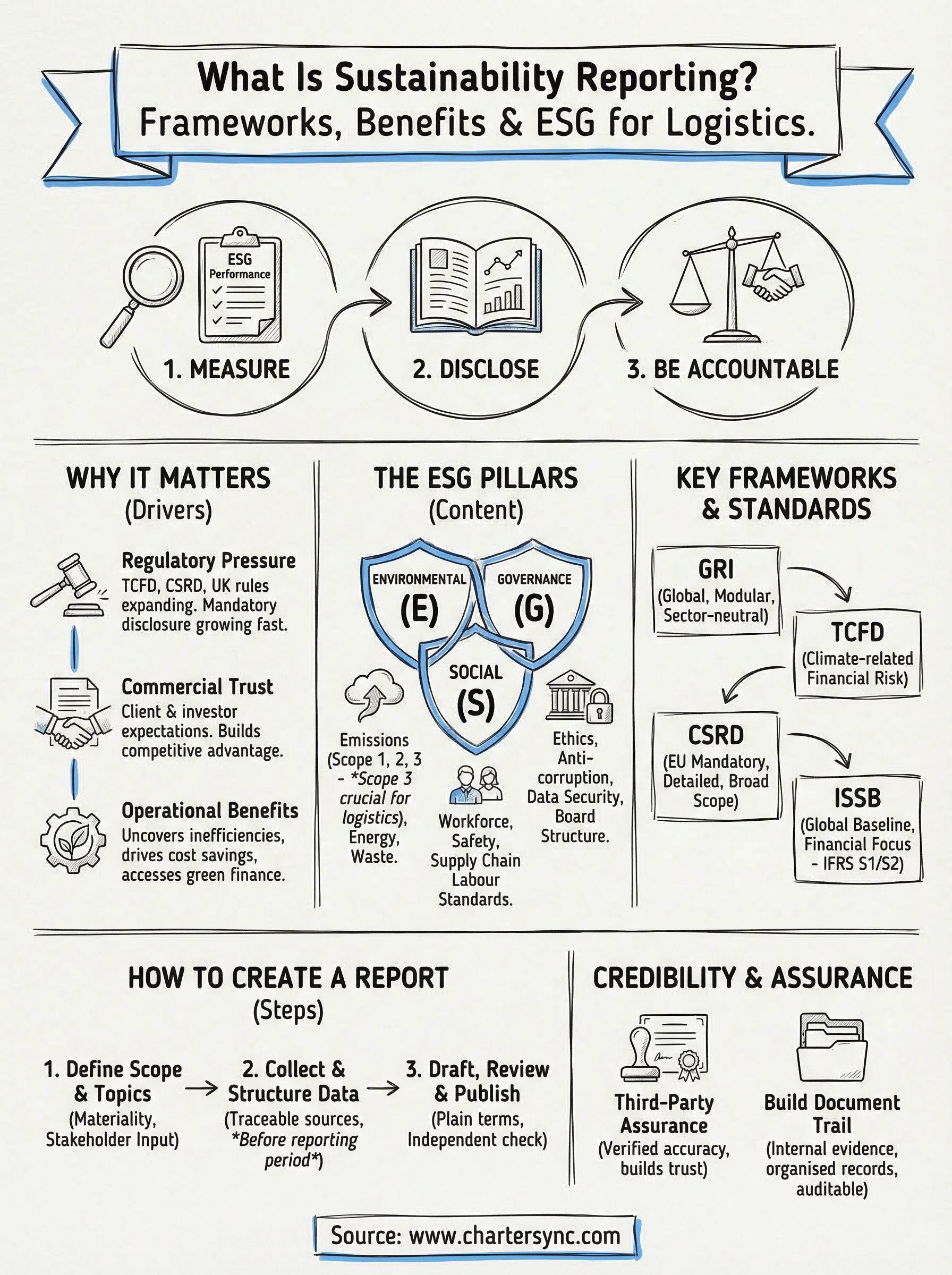
What is sustainability reporting, at its core, is a structured commitment to measuring and disclosing your environmental, social, and governance performance in a way that clients, regulators, and investors can actually rely on. For logistics professionals arranging air cargo charters, that means capturing per-shipment emissions data, governance records, and workforce metrics before a deadline forces you to reconstruct them.
The frameworks, mandatory timelines, and assurance practices covered in this article give you a complete picture of what the process involves and where to start. Sustainability reporting is not a one-time project. It is an ongoing discipline that improves as your data systems mature and your stakeholder expectations grow.
If accurate, auditable data is already central to how you manage air cargo operations, the same rigour applies to your sustainability disclosures. Explore how CharterSync supports transparent, data-backed air cargo chartering and see how operational visibility from inquiry to delivery supports the reporting your clients increasingly require.

.png)