.png)

As 2026 draws near, the logistics industry is undergoing rapid transformation, reshaping how every logistics company operates. New technologies, shifting consumer expectations, and global challenges are making supply chains more complex and competitive than ever.
For logistics leaders, staying ahead requires a proactive approach and a willingness to adapt. This article is your essential guide, offering nine actionable tips to help your logistics company boost efficiency, build resilience, and achieve sustainable growth in the evolving market.
Discover expert insights and proven strategies designed to help your business thrive in 2026 and beyond.
As 2026 approaches, the logistics company landscape is undergoing significant transformation. Leaders in the sector must navigate unprecedented change, with global trends and challenges shaping the future of every logistics company. To thrive, it is vital to understand the evolving environment and the pressures driving innovation, resilience, and growth.
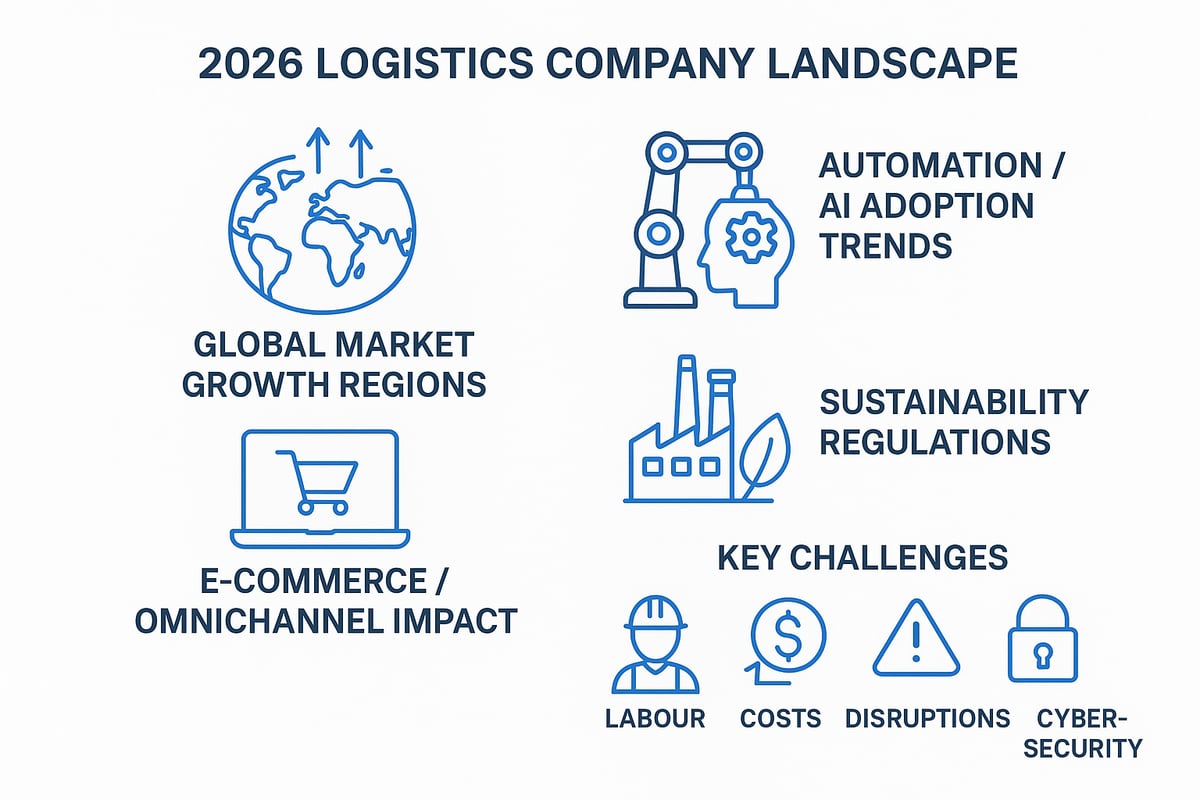
The logistics company sector is forecast to reach new heights by 2026. Global projections indicate robust market growth, driven by rapid e-commerce expansion and the rise of omnichannel retailing. As customers demand faster and more flexible delivery, every logistics company must adapt operations for higher volumes and tighter timeframes.
One major trend is the shift towards nearshoring and reshoring, as companies look to reduce risk and improve supply chain resilience. Post-pandemic lessons have made it clear that localising supply chains can protect a logistics company from global shocks. This move is particularly evident in regions like Europe and North America, where manufacturers and retailers are prioritising proximity.
Sustainability is another defining trend. Regulatory requirements around emissions and environmental impact are tightening, pushing each logistics company to embrace greener strategies. Innovations include eco-friendly packaging, electric fleets, and carbon tracking, all of which help companies comply and boost their brand reputation.
Digital transformation is accelerating across the industry. Technologies such as automation, artificial intelligence, and the Internet of Things are fundamentally changing how a logistics company operates. According to Logistics automation market growth, investments in automation are set to surge, with over 60% of logistics firms planning to adopt AI-powered solutions by 2026. These technologies increase efficiency, accuracy, and scalability.
Customer expectations are also evolving. Today’s clients want real-time tracking, transparency, and seamless communication. A logistics company that delivers reliability and visibility will stand out in a competitive market.
Finally, agility and adaptability are crucial. Geopolitical tensions, economic uncertainty, and shifting consumer behaviour mean that a logistics company must be prepared to pivot quickly. Those who invest in flexible systems and proactive strategies will be best positioned for future success.
Despite these opportunities, every logistics company faces significant hurdles. Labour shortages are a persistent issue, particularly in warehouse and transport roles. Recruiting and retaining skilled workers remains a top priority, as competition for talent intensifies.
Rising fuel and transportation costs are squeezing margins. With fluctuating energy prices and increasing regulatory fees, a logistics company must find new ways to optimise routes and reduce waste. Technology can help, but balancing costs and investments is a constant challenge.
Disruptions from global events, such as supply chain shocks and trade disputes, continue to test the resilience of the sector. For example, during the pandemic, many logistics companies had to rapidly redesign networks and implement emergency protocols to keep goods moving. This period underscored the importance of scenario planning and diversified supplier relationships.
Cybersecurity risks are also escalating. As digital systems become more integrated, a logistics company is increasingly vulnerable to cyber threats, including ransomware and data breaches. Protecting sensitive information and maintaining business continuity demands robust security measures and regular staff training.
In summary, the 2026 landscape presents both exciting growth and formidable challenges. A successful logistics company will combine innovation, sustainability, and resilience to navigate this ever-changing environment.
To secure long-term success, every logistics company must proactively adapt to emerging trends, disruptive technologies, and evolving customer expectations. The following nine tips provide a practical roadmap for logistics leaders who wish to thrive in 2026 and beyond. Each strategy is tailored to address the challenges and opportunities of the modern logistics landscape, ensuring your logistics company remains agile, resilient, and competitive.

Digitalisation and automation are at the heart of transformation for any logistics company aiming to stay ahead in 2026. Implementing advanced warehouse management systems, transport management platforms, and robotics leads to significant efficiency gains.
For example, DHL has deployed automated guided vehicles and AI-powered route optimisation, reducing manual errors and accelerating deliveries. Automation not only scales operations but also helps the logistics company handle demand spikes without compromising quality.
The benefits are clear:
A recent industry report found that automation can cut warehouse labour costs by up to 30 percent. However, logistics company leaders must be prepared for upfront investment, robust change management, and comprehensive staff training. Over 60 percent of logistics firms plan to invest in AI by 2026, highlighting the sector’s commitment to digital transformation. For further insights on how automation and AI are revolutionising the sector, explore The impact of automation and AI in logistics.
Ultimately, a logistics company that embraces digitalisation will be better equipped to compete and grow in a rapidly evolving market.
Sustainability is no longer optional for a logistics company. With environmental regulations tightening and customer demand for green solutions rising, adopting sustainable practices is essential.
Leading logistics companies are:
Maersk, for instance, has pledged to achieve net-zero emissions by 2040, setting a benchmark for the industry. A logistics company that prioritises sustainability not only meets compliance requirements but also enhances its brand reputation.
Research shows that 73 percent of consumers are willing to pay more for sustainable shipping. This trend is driving logistics company investment in green initiatives, from carbon offsetting to renewable energy in warehouses.
The sustainability journey requires ongoing commitment, but it delivers long-term benefits in cost savings, customer loyalty, and market differentiation.
Visibility is a key differentiator for any logistics company competing in today’s fast-moving market. By leveraging IoT sensors, RFID technology, and real-time tracking platforms, logistics companies can offer unprecedented transparency to both customers and partners.
FedEx’s SenseAware platform, for example, enables real-time shipment monitoring, allowing proactive responses to delays or disruptions. For a logistics company, this level of transparency builds trust and enables data-driven problem-solving.
Benefits include:
Integrating legacy systems with new visibility tools can be challenging. However, logistics company leaders who prioritise transparency will stand out in a crowded marketplace and foster long-lasting client relationships.
As digitalisation accelerates, cybersecurity becomes a top priority for every logistics company. The sector has seen a 40 percent surge in cyberattacks in 2023, making robust data protection essential.
Key steps include:
UPS, for example, has invested heavily in cybersecurity frameworks to safeguard customer data and operational continuity. For a logistics company, digital growth must be matched by equally robust security measures.
Ransomware and data breaches can disrupt operations and damage reputation. Logistics company leaders should regularly review and update their security policies to stay ahead of evolving threats.
Resilience is vital for a logistics company operating in a world of constant change. Disruptions like natural disasters, trade disputes, or pandemics have highlighted the need for flexible supply chains.
Best practices for a resilient logistics company include:
Toyota’s multi-sourcing approach after the 2011 tsunami exemplifies the power of supply chain resilience. In fact, 70 percent of logistics leaders plan to increase investment in resilience by 2026.
A logistics company that proactively builds flexibility into its operations can adapt faster to shocks and seize new opportunities. For a deeper dive into strategies for resilient logistics, consider reading Building resilient supply chains.
Data is the new currency for a logistics company. Predictive analytics, demand forecasting, and real-time dashboards empower logistics leaders to make informed decisions quickly.
Amazon’s use of big data to optimise fulfilment and inventory is a prime example. By leveraging analytics, a logistics company can:
Ensuring data quality and staff data literacy remains a challenge. However, investment in analytics training and robust data management systems will provide a logistics company with a competitive edge in 2026.
A logistics company that places the customer at the centre of its operations will build loyalty and stand apart from competitors. Flexible delivery options, transparent communication, and proactive support are now standard expectations.
DPD’s real-time tracking and customer notifications set a high bar for the industry. By collecting and acting on customer feedback, a logistics company can refine its service offerings and exceed expectations.
Statistics reveal that 89 percent of B2B buyers cite customer experience as a top factor in their choice of logistics company. Prioritising customer-centricity is not just good practice, it is critical for growth and retention.
People remain a logistics company’s greatest asset. As technology advances, the talent gap in digital and operational roles widens, making recruitment and retention more challenging.
Successful logistics companies invest in:
Kuehne+Nagel’s digital skills academy is a strong example of how to future-proof a workforce. Competing for talent in a tight market requires a logistics company to foster a culture of learning and innovation.
Human capital is as vital as technological investment for sustainable success in the logistics sector.
Collaboration is a powerful lever for growth and innovation in any logistics company. By forging alliances with technology providers, carriers, and even other logistics firms, companies unlock new efficiencies and market opportunities.
DB Schenker’s partnerships with leading e-commerce platforms illustrate how collaboration can expand service offerings and accelerate digital transformation. Sharing resources and expertise allows a logistics company to adapt quickly and scale effectively.
Industry data shows that 65 percent of logistics companies plan to increase partnerships by 2026. For a logistics company aiming to innovate and grow, strategic collaboration is essential for staying ahead of the competition.
As a logistics company faces growing complexity and heightened customer expectations, the integration of advanced technology is no longer a luxury but a critical differentiator. Embracing digital transformation is key for any logistics company striving to maintain a competitive edge in 2026. The right technology not only improves efficiency but also unlocks new opportunities for growth and resilience. Let us explore how leading-edge solutions are reshaping logistics company operations and how to measure their true impact.

For a logistics company, the adoption of transformative technologies such as AI, IoT, and blockchain is reshaping the industry landscape. Artificial intelligence enables smarter demand forecasting, route optimisation, and automates repetitive tasks, driving both cost savings and service improvements. According to recent AI adoption in supply chains statistics, over 60 percent of logistics company leaders plan to invest in AI by 2026, signalling a clear shift towards data-driven operations.
The Internet of Things (IoT) empowers a logistics company with real-time asset tracking and predictive maintenance. By deploying IoT sensors on vehicles and within warehouses, firms can monitor shipments, anticipate equipment failures, and reduce downtime. Blockchain technology, meanwhile, brings transparency and security to transactions, ensuring all parties have access to tamper-proof records. This prevents fraud and streamlines documentation, which is vital for compliance and customer trust.
Consider the case of a leading 3PL that integrated AI-powered analytics with IoT-enabled tracking and blockchain-secured documentation. This holistic approach enabled the logistics company to accelerate deliveries, reduce errors, and improve transparency for clients. However, integrating these technologies requires careful planning, staff training, and investment in robust digital infrastructure.
For a logistics company, it is essential to assess the return on investment when implementing new technologies. The key is to measure outcomes using clear, quantifiable metrics that reflect both operational improvements and customer satisfaction. Modern digital tools allow a logistics company to track performance in real time, making it easier to demonstrate value.
Below is a table summarising key ROI metrics for technology integration:
| Metric | Definition | Impact for Logistics Company |
|---|---|---|
| Delivery Speed | Time from order to delivery | Faster service, happier clients |
| Error Rates | Frequency of logistical mistakes | Lower costs, improved accuracy |
| Customer Satisfaction | Ratings and feedback | Stronger loyalty, repeat business |
| Cost Savings | Reduction in operational expenses | Higher profitability |
For example, companies adopting real-time tracking platforms have reported up to a 20 percent reduction in delivery errors and measurable increases in customer satisfaction. The most successful logistics company leaders regularly review technology performance, adjust strategies, and invest in ongoing staff development to maximise value. Ultimately, technology integration is not just about tools, but about creating a culture of innovation and continuous improvement.
To thrive in 2026, a logistics company must make continuous innovation a core priority. Embracing change and evolving with the market are essential for long-term success.
Investing in staff skills, refining processes, and nurturing a culture of experimentation helps your team adapt quickly. Learning from businesses that pivoted during past disruptions can inspire resilience and flexibility.
Staying ahead means keeping a close eye on emerging trends and technologies. Exploring resources like Air cargo charter trends for 2025 can guide your logistics company in making informed decisions. Proactive adaptation is the key to sustainable growth.

As you look ahead to 2026, staying ahead in logistics means combining smart technology with trusted expertise—exactly what CharterSync is all about. If you’re ready to streamline your air cargo operations, boost efficiency, and tap into real-time global aircraft access, it’s worth seeing how intelligent automation can transform your business. You don’t have to navigate the future alone—let’s make sure you have the right tools and support to thrive.
If you’d like to see how it all works in practice, you can request a demo and discover first-hand what seamless logistics solutions look like.

.png)