.png)

In a world where supply chains are evolving at lightning speed, mastering third party logistics is now an essential strategy for businesses aiming to thrive in 2026. The third party logistics sector has grown rapidly, with recent data showing that 90% of Fortune 500 companies now rely on these services to stay competitive.
Understanding third party logistics can unlock significant cost savings, streamline operations, and enable access to global markets for organisations of any size. Whether you are a start-up or an established enterprise, the right approach can transform your supply chain performance.
This comprehensive guide will walk you through the fundamentals of third party logistics, the different types and services available, the key benefits and challenges, expert advice on selecting a provider, integration strategies, and the latest innovations shaping the future. Get ready to discover everything you need to know to leverage third party logistics for your business success in 2026.
Third party logistics, commonly known as 3PL, is the practice of outsourcing logistics and supply chain operations to an external partner. Since its emergence in the 1970s, the term has grown to encompass a wide array of services, from warehousing and transportation to order fulfilment and inventory management. Unlike traditional logistics, where companies maintain direct control, third party logistics providers act as intermediaries, managing complex logistics tasks on behalf of their clients. Legally, the Consumer Product Safety Improvement Act of 2008 defines 3PLs as entities that receive, hold, or transport goods for others. Examples include e-commerce fulfilment centres and major carriers. Today, around 90% of Fortune 500 companies rely on third party logistics to streamline their operations.
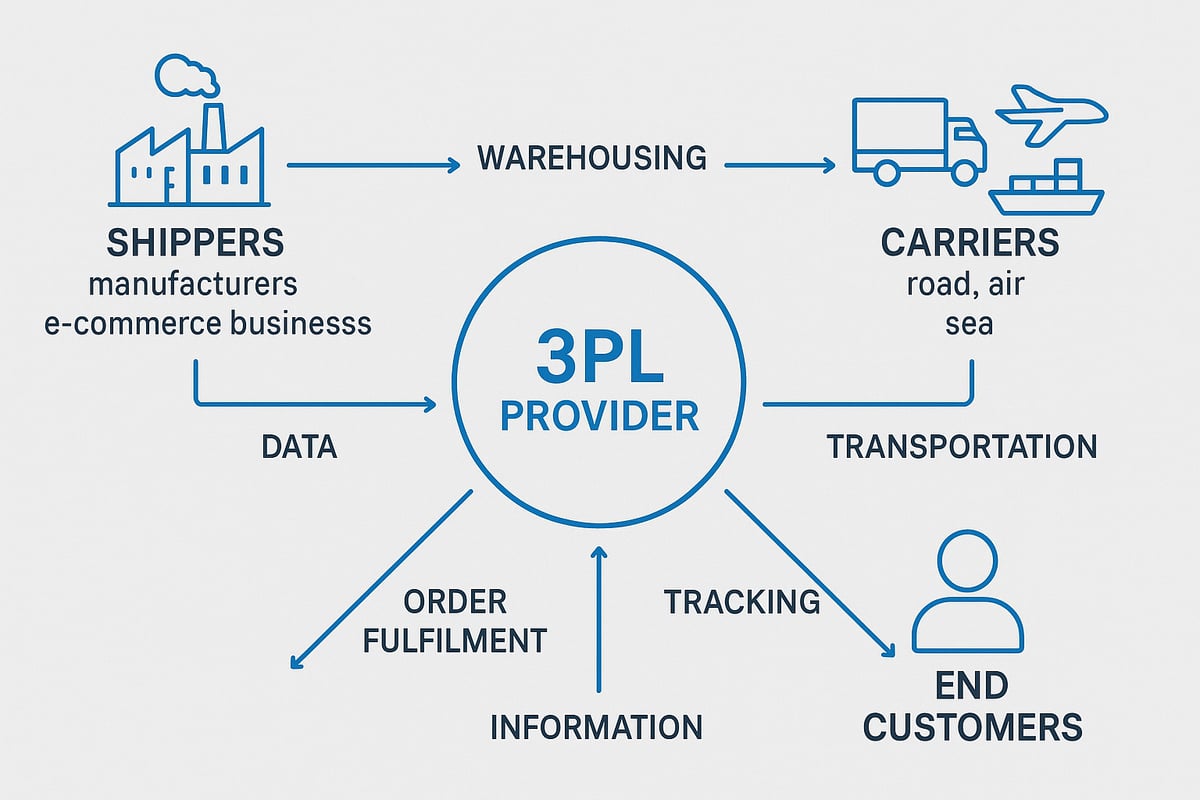
Third party logistics encompasses a broad scope of outsourced logistics services that allow businesses to delegate their supply chain operations. Since the 1970s, the concept has evolved from simple transportation management to integrated solutions covering storage, distribution, and technology-driven tracking. The primary difference between third party logistics and traditional logistics lies in the level of ownership and control, with 3PLs acting as strategic partners rather than internal departments. Legally, 3PLs are defined as organisations that receive, handle, or transport goods on behalf of others, as specified by the Consumer Product Safety Improvement Act of 2008. Modern 3PLs serve as vital outsourced partners for storage, shipping, and fulfilment, with e-commerce fulfilment centres and global carriers like FedEx and UPS being prime examples. Notably, 90% of Fortune 500 companies use third party logistics to enhance efficiency.
Imagine an e-commerce retailer looking to scale quickly. By partnering with a third party logistics provider, the retailer sends inventory to a 3PL warehouse, which then handles order picking, packing, and shipping as customers make purchases. The 3PL manages procurement, warehousing, and distribution, enabling the retailer to focus on product development and marketing. Technology plays a crucial role, with tools like RFID, GPS, and IoT devices providing real-time shipment tracking and inventory updates. For example, a book publisher might outsource fulfilment and shipping to a 3PL, freeing up resources to focus on content creation. In these scenarios, third party logistics enables businesses to concentrate on their core strengths while ensuring reliable delivery to customers.
The third party logistics market has experienced remarkable growth, reflecting its increasing importance in global supply chains. In 2014, the US 3PL market was valued at around $75 billion, and it has since more than doubled, exceeding $157 billion. This expansion is driven by several factors: explosive growth in e-commerce, globalisation of trade, and rising customer expectations for fast, reliable delivery. Regulatory changes, such as the Motor Carrier Act of 1980, have also played a role in shaping the industry. Companies demand greater supply chain visibility and operational efficiency, further fuelling 3PL adoption. According to Armstrong & Associates, market penetration continues to rise as businesses seek agile, scalable logistics solutions.
The landscape of third party logistics is populated by major global players like DHL, FedEx, UPS, DB Schenker, and Kuehne + Nagel. These companies often specialise by region, industry, or logistics function, offering tailored solutions to meet diverse client needs. Increasingly, technology-driven and asset-light providers are emerging, leveraging software and data analytics to deliver flexible services. The 3PL market can be segmented into three main types:
| 3PL Type | Focus Area | Examples |
|---|---|---|
| Transportation-based | Shipping, carriage | FedEx, UPS |
| Warehouse-based | Storage, fulfilment | DHL Supply Chain |
| Information-based | Data, analytics | Technology startups |
This segmentation allows businesses to select third party logistics providers that best align with their operational requirements.
Understanding the distinction between third party logistics, fourth party logistics (4PL), and freight forwarding is crucial for effective supply chain management. 3PL providers typically manage warehousing, transportation, and fulfilment, acting as outsourced partners. In contrast, 4PLs serve as lead logistics providers, overseeing multiple 3PLs and acting as a single point of contact for the entire supply chain. Freight forwarders, on the other hand, focus on organising shipments and may not own assets or provide end-to-end services. For a deeper dive into these differences and when to choose each model, see Freight forwarding vs. 3PL. For example, a fulfilment centre may subcontract logistics functions to a freight forwarder while a 4PL coordinates the overall process, ensuring seamless integration and accountability.
Navigating the landscape of third party logistics in 2026 requires a clear understanding of the diverse services on offer. Modern 3PL providers deliver a comprehensive suite of solutions, each tailored to address specific supply chain needs. From transportation and warehousing to advanced analytics and industry-specific expertise, the range of services is vast and ever-evolving.
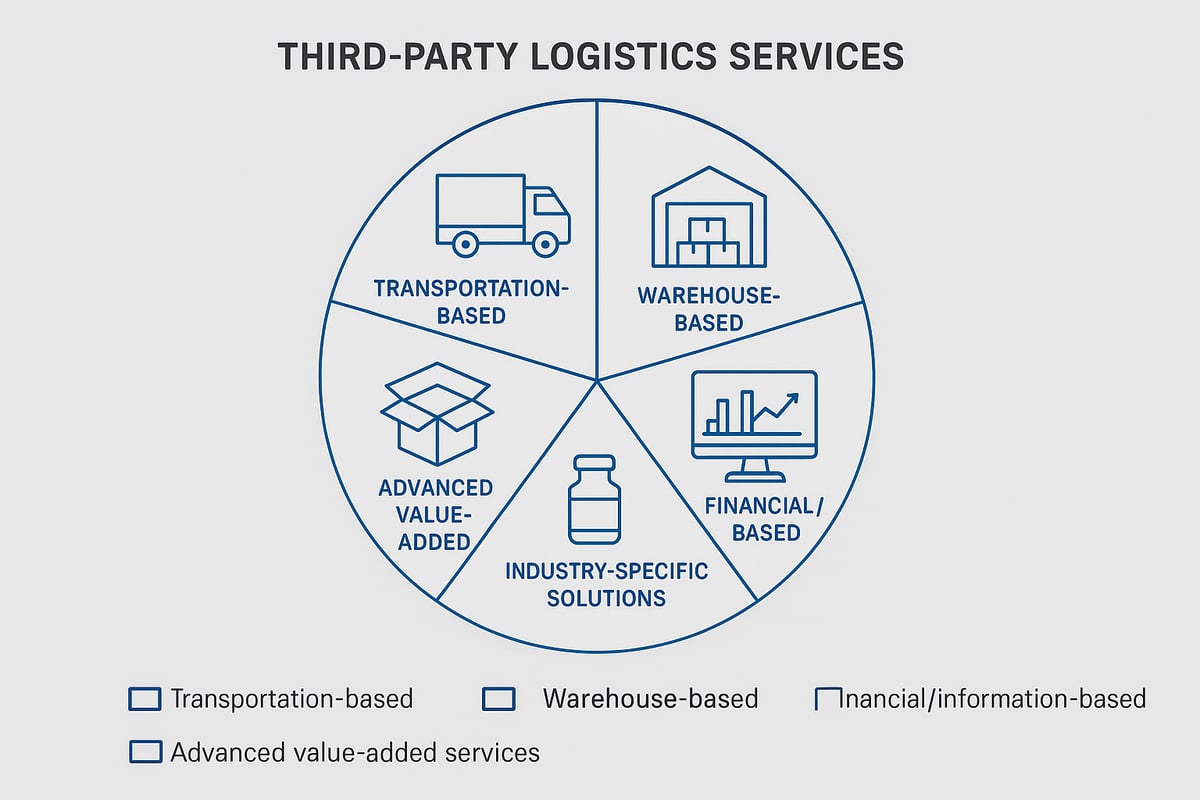
At the heart of third party logistics are three primary service categories.
For a deeper dive into the transportation aspect of third party logistics, explore these air freight and cargo solutions that illustrate how 3PLs streamline the shipping process for businesses of all sizes.
Beyond standard offerings, third party logistics providers are innovating with advanced and value-added solutions.
Service developer 3PLs offer enhanced capabilities such as:
Value-added services like kitting, labelling, and assembly allow businesses to customise orders before delivery. Scalability is a key advantage, as clients can adjust the level of service to match seasonal demand or market expansion. These tailored options set modern 3PLs apart and enable long-term strategic growth.
Lead Logistics Providers play a pivotal role in third party logistics by managing multiple logistics functions and providers on behalf of a client.
LLPs bring deep industry expertise and coordinate complex supply chains, acting as a single point of contact. There are two main models:
Strategic alliances with LLPs and customer developers foster stronger collaboration, allowing businesses to focus on their core activities while the 3PL ensures end-to-end supply chain excellence.
Technology is transforming third party logistics at every level.
Providers deploy sophisticated warehouse management systems (WMS) and transport management systems (TMS) to optimise operations. The integration of IoT devices, RFID tags, and GPS tracking enables real-time monitoring and data-driven decision-making.
These advancements deliver improved accuracy, transparency, and efficiency. Cloud-based platforms and APIs ensure seamless data exchange, supporting rapid scaling and integration with client systems. The result is a more agile third party logistics solution capable of adapting to changing business needs.
Specialisation is a hallmark of third party logistics in 2026.
Providers develop tailored solutions for industries such as:
Case studies highlight how 3PLs adapt their offerings to meet strict industry standards, manage sensitive cargo, and comply with complex regulations. This industry focus ensures that every third party logistics partnership is built on reliability, compliance, and measurable performance improvements.
Partnering with a third party logistics provider delivers a wealth of strategic advantages for businesses aiming to enhance their supply chain performance. Whether your focus is cost reduction, operational agility, or accessing cutting-edge technology, leveraging third party logistics can create tangible value across every stage of your logistics journey.
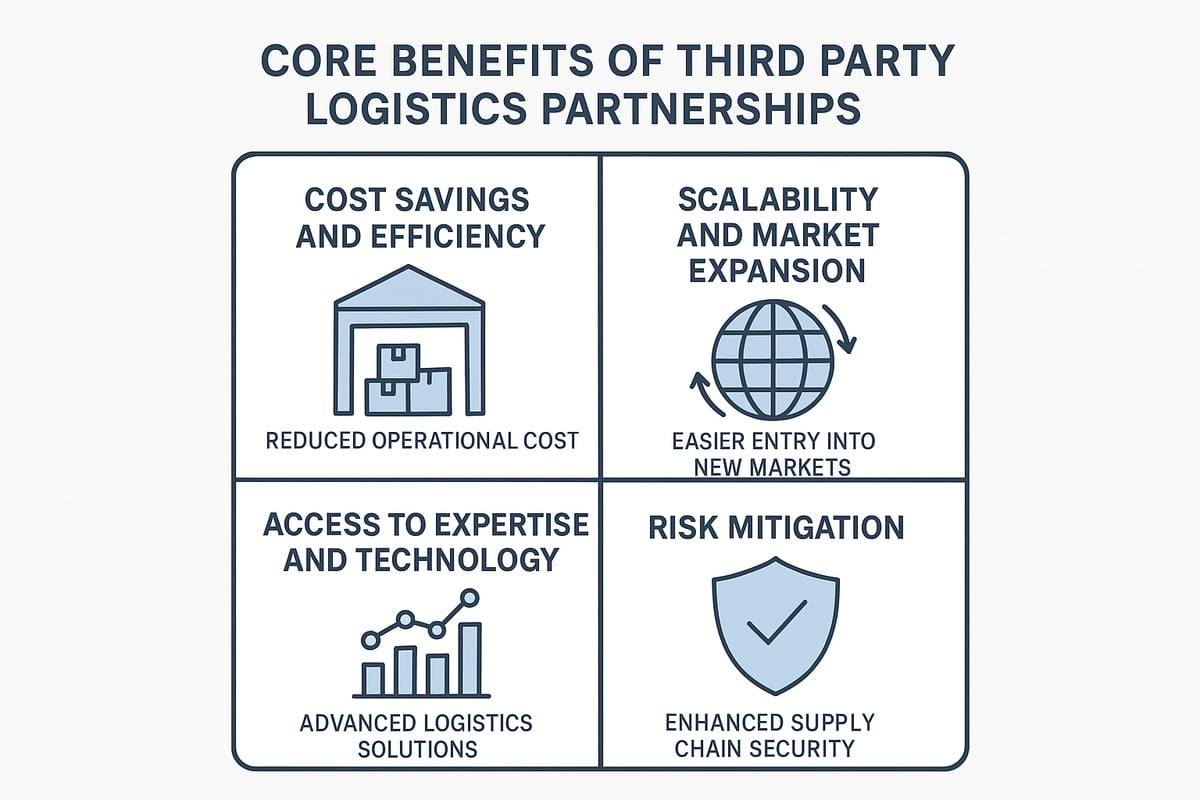
Outsourcing logistics to a third party logistics partner enables significant cost savings by reducing capital expenditure on warehouses, fleets, and complex technology systems. Specialised 3PL providers achieve economies of scale that in-house teams often cannot match, translating into lower per-unit costs and higher efficiency.
For instance, businesses can avoid hefty investments in warehouse management software, as 3PLs already possess advanced systems. According to Third-Party Logistics Market Growth & Trends, leveraging these providers can reduce logistics costs by up to 15-20 percent. This efficiency allows companies to reallocate resources to core business activities, boosting overall performance.
A key advantage of third party logistics is the ability to scale operations in line with market demand. Whether managing seasonal peaks or launching into new regions, 3PLs provide flexible solutions that adapt quickly to changing business needs.
For example, an e-commerce business looking to expand internationally can rely on a third party logistics partner to handle increased order volumes and cross-border shipping complexities. This flexibility supports smooth growth, reduces risk, and enables rapid market entry without the need for substantial upfront investment.
Third party logistics providers offer access to deep industry expertise, highly trained staff, and the latest logistics technology. By partnering with a 3PL, businesses can stay ahead of competitors through state-of-the-art warehouse management systems, real-time tracking, and advanced analytics.
This approach ensures that companies benefit from ongoing innovation without direct investment in new tools or training. The result is improved performance, better customer satisfaction, and the ability to respond quickly to industry shifts.
Mitigating supply chain risks is a core benefit of third party logistics partnerships. 3PLs take responsibility for managing disruptions, from demand spikes to transportation delays, ensuring continuity and reliability.
These providers implement robust business continuity planning, monitor market changes, and offer rapid responses when challenges arise. For example, during unexpected bottlenecks, a third party logistics partner can quickly deploy additional resources to maintain service levels and protect your brand reputation.
Navigating the world of third party logistics brings impressive benefits, but it is not without its complexities. Understanding the potential pitfalls is essential for building resilient, well-managed supply chains. Below, we explore the key challenges and risks facing organisations in 2026.

When businesses outsource to third party logistics providers, they often experience a reduction in direct oversight. This can make it harder to monitor day-to-day operations, track inventory in real time, or respond quickly to issues.
Key risks include:
To address these challenges, companies should establish robust service level agreements (SLAs), require regular performance reporting, and adopt integrated supply chain platforms. By prioritising transparency, organisations can maintain control while leveraging the expertise of third party logistics partners.
The rise in global trade and evolving regulations means compliance is more critical than ever in third party logistics. Companies must ensure partners adhere to industry standards, regional laws, and data protection requirements, especially when handling sensitive goods.
Considerations include:
According to the Third-Party Logistics Market Size & Industry Report, regulatory complexity is an increasing challenge for 3PL providers worldwide. Businesses should conduct regular audits, require certifications, and work with partners experienced in risk management to safeguard compliance and security.
A frequent hurdle in third party logistics partnerships is ensuring seamless integration between systems. Businesses may rely on various enterprise resource planning (ERP), warehouse management (WMS), or transport management systems (TMS), which can create incompatibilities.
Potential issues:
Best practices include choosing providers with API capabilities, cloud-based platforms, and a proven track record in system integration. Early collaboration between IT teams helps ensure data flows efficiently, supporting real-time decision-making in third party logistics operations.
Relying on third party logistics introduces risks around consistency and quality of service. Misaligned expectations, communication breakdowns, or over-dependence on a single provider can disrupt supply chain performance.
Mitigation strategies:
Maintaining open communication and setting measurable KPIs helps ensure third party logistics partnerships deliver reliable service and adapt to changing business needs.
Selecting the right third party logistics partner is a pivotal step for any business aiming to optimise supply chain performance in 2026. The process involves careful assessment, clear criteria, and strategic partnership building to ensure long-term success.
Before approaching any third party logistics provider, businesses must take a close look at their own supply chain requirements. Start by identifying pain points such as rising costs, inadequate customer service, or inventory management challenges.
Assess whether current logistics capabilities can support future growth or if outsourcing to a third party logistics expert would deliver greater value. For example, companies experiencing seasonal spikes or outgrowing existing facilities may benefit from external support.
Review internal resources, technology, and staff expertise to determine readiness for change. This self-evaluation ensures a tailored approach when engaging with third party logistics providers and sets the foundation for a successful partnership.
Comparing third party logistics providers requires a structured approach. Focus on industry expertise, compliance standards, security certifications, and a proven track record for customer service. Pricing transparency and robust technology integration are also essential.
Here is a simplified comparison table to guide your evaluation:
| Criteria | Importance | Example Questions |
|---|---|---|
| Industry Specialisation | High | Have they handled similar products? |
| Compliance & Security | Critical | Are they certified for your industry? |
| Technology Integration | High | Can their systems link with yours? |
| Cost Transparency | Essential | Are all fees and charges clear? |
| Service Reliability | High | What do client references reveal? |
Given the global expansion of third party logistics, as highlighted in the Global 3PL Market to Reach $1.3 Trillion by 2026, it is vital to select a provider with the scale and experience to support your business ambitions.
A systematic approach streamlines the third party logistics provider selection. Begin by defining your logistics requirements and key performance indicators (KPIs).
Shortlist potential providers based on their responses to your criteria. Request detailed proposals, then conduct site visits, reference checks, and system demonstrations to validate their capabilities.
Negotiate service level agreements that specify performance standards and escalation procedures. This step-by-step process not only reduces risk but also ensures alignment between your business goals and third party logistics support.
Long-term success with third party logistics depends on more than just contracts. Prioritise cultural compatibility and shared values when choosing a provider.
Establish open communication channels and clear escalation paths. Schedule regular performance reviews to track KPIs and encourage continuous improvement.
A strategic partnership approach allows both parties to adapt to changing market conditions. This proactive relationship management ensures your third party logistics provider becomes an extension of your own supply chain team.
When selecting third party logistics providers, avoid common pitfalls that could undermine your supply chain. Ignoring long-term scalability or flexibility can limit growth opportunities.
Watch for hidden costs, unclear pricing, or vague service agreements. Failing to define clear performance metrics can result in unmet expectations.
Other red flags include poor communication, inadequate technology compatibility, or over-reliance on a single provider. Vigilance at this stage safeguards your investment and ensures your third party logistics partnership delivers measurable value.
Integrating third party logistics into your supply chain requires careful planning and a structured approach. Success relies on aligning internal teams, leveraging the right technology, and establishing clear communication with your logistics partner. By following best practices at each stage, businesses can unlock new efficiencies and drive measurable improvements.
The onboarding phase sets the foundation for a productive third party logistics partnership. Begin by aligning your internal teams, ensuring everyone understands the goals and expected outcomes of the transition. Map out existing processes, identify gaps, and outline how responsibilities will shift to the 3PL provider.
Develop a clear onboarding plan that covers data migration, process documentation, and system integration. Assign roles for project management and IT support to handle technical challenges. Effective stakeholder communication is vital, so schedule regular updates and feedback sessions to keep everyone informed and engaged.
Robust technology integration is essential for maximising the benefits of third party logistics. Implement real-time tracking tools, inventory visibility platforms, and automated reporting to ensure transparency throughout the supply chain. Secure data exchange between your systems and the 3PL's platforms is critical for efficiency and accuracy.
Utilise APIs and cloud-based solutions to enable seamless information flow and minimise manual interventions. For insights on how technology is transforming logistics operations, explore air cargo and logistics technology. Investing in these digital tools supports proactive decision-making and enhances overall supply chain performance.
A strong relationship with your third party logistics provider depends on open collaboration and effective communication. Set up regular meetings to review performance, address concerns, and share operational updates. Use dashboards and shared platforms to monitor KPIs and track progress in real time.
Building trust requires transparency from both sides. Encourage honest feedback, resolve conflicts promptly, and adapt to changing business needs. By nurturing this partnership, you ensure both parties remain aligned and focused on shared objectives.
Measuring the impact of third party logistics integration involves setting clear KPIs such as on-time delivery rates, order accuracy, cost savings, and customer satisfaction scores. Use analytics to monitor these metrics and identify trends or areas for improvement.
Regularly benchmark your results against industry standards to maintain a competitive edge. Continuous feedback and data-driven insights enable you to fine-tune processes, address bottlenecks, and ensure your logistics strategy evolves with your business objectives and the wider market.
The future of third party logistics is rapidly evolving, shaped by transformative technologies, sustainability imperatives, shifting customer demands, and global events. To remain competitive in 2026 and beyond, organisations must understand the innovations and trends redefining the landscape. Let us explore the key developments set to influence third party logistics in the coming years.
Automation and artificial intelligence are revolutionising third party logistics operations. Warehouses now deploy collaborative robots for picking, packing, and inventory management, reducing errors and speeding up fulfilment. AI-driven route optimisation and demand forecasting enable 3PLs to cut delivery times while minimising costs.
Innovations extend beyond the warehouse. Autonomous vehicles and drones are beginning to handle last-mile deliveries, promising greater efficiency. For a deeper look at how these technologies are transforming logistics, see this article on Automation and AI in air cargo.
These advancements allow third party logistics providers to deliver faster, more reliable services, helping businesses stay ahead of the curve.
Sustainability is now a central focus for third party logistics providers. Companies are investing in electric vehicles, renewable energy sources, and recyclable packaging to reduce their carbon footprint. Many 3PLs are implementing carbon offset programmes and optimising delivery routes to cut emissions.
Customers and regulators alike are demanding greener supply chains. As a result, third party logistics firms must continually innovate to meet environmental standards and public expectations. This shift not only benefits the planet but also enhances brand reputation and aligns with consumer values.
The adoption of sustainable practices is set to accelerate, making green logistics a defining feature of the industry in 2026.
Customer expectations for speed and flexibility are reshaping third party logistics. The rise of same-day and next-day delivery, along with click-and-collect options, requires 3PLs to offer seamless omnichannel solutions. Retailers now depend on third party logistics partners to integrate online and offline channels for a unified customer experience.
Flexible returns, in-store pickups, and personalised delivery windows are becoming standard offerings. To meet these demands, 3PLs are developing advanced fulfilment networks and investing in real-time inventory visibility.
By adapting to these trends, third party logistics providers enable businesses to exceed customer expectations and expand their reach.
Data-driven decision-making is at the heart of modern third party logistics. IoT sensors, RFID tags, and cloud-based platforms provide real-time tracking of shipments, inventory, and assets throughout the supply chain.
Advanced analytics tools help 3PLs anticipate demand, manage risks, and optimise routes. Predictive analytics enable proactive responses to disruptions, ensuring consistent service levels. Real-time dashboards offer transparency and actionable insights, fostering collaboration between clients and logistics partners.
These technologies empower third party logistics providers to deliver higher accuracy, accountability, and responsiveness in an increasingly complex environment.
Global events and geopolitical shifts continue to impact third party logistics strategies. Disruptions such as pandemics, trade tensions, and natural disasters have highlighted the need for resilient and agile supply chains.
To navigate uncertainty, 3PLs diversify sourcing, invest in contingency planning, and leverage digital platforms for rapid adaptation. Market forecasts suggest that demand for flexible, technology-driven third party logistics services will only increase. For more insights, consult the U.S. Third-Party Logistics Market Forecast.
By proactively addressing these challenges, third party logistics providers become indispensable partners in managing risk and complexity.
Now that you’ve explored how third party logistics can unlock efficiency, cost savings, and global reach for your business in 2026, it’s time to see these insights in action. If you’re ready to streamline your supply chain with the power of automation and expert support, why not experience how CharterSync’s intelligent platform can transform your air cargo operations? You don’t have to navigate the future of logistics alone—we’re here to help you make smarter, faster decisions. To discover how it all works, request a demo and see the difference for yourself.

.png)