.png)
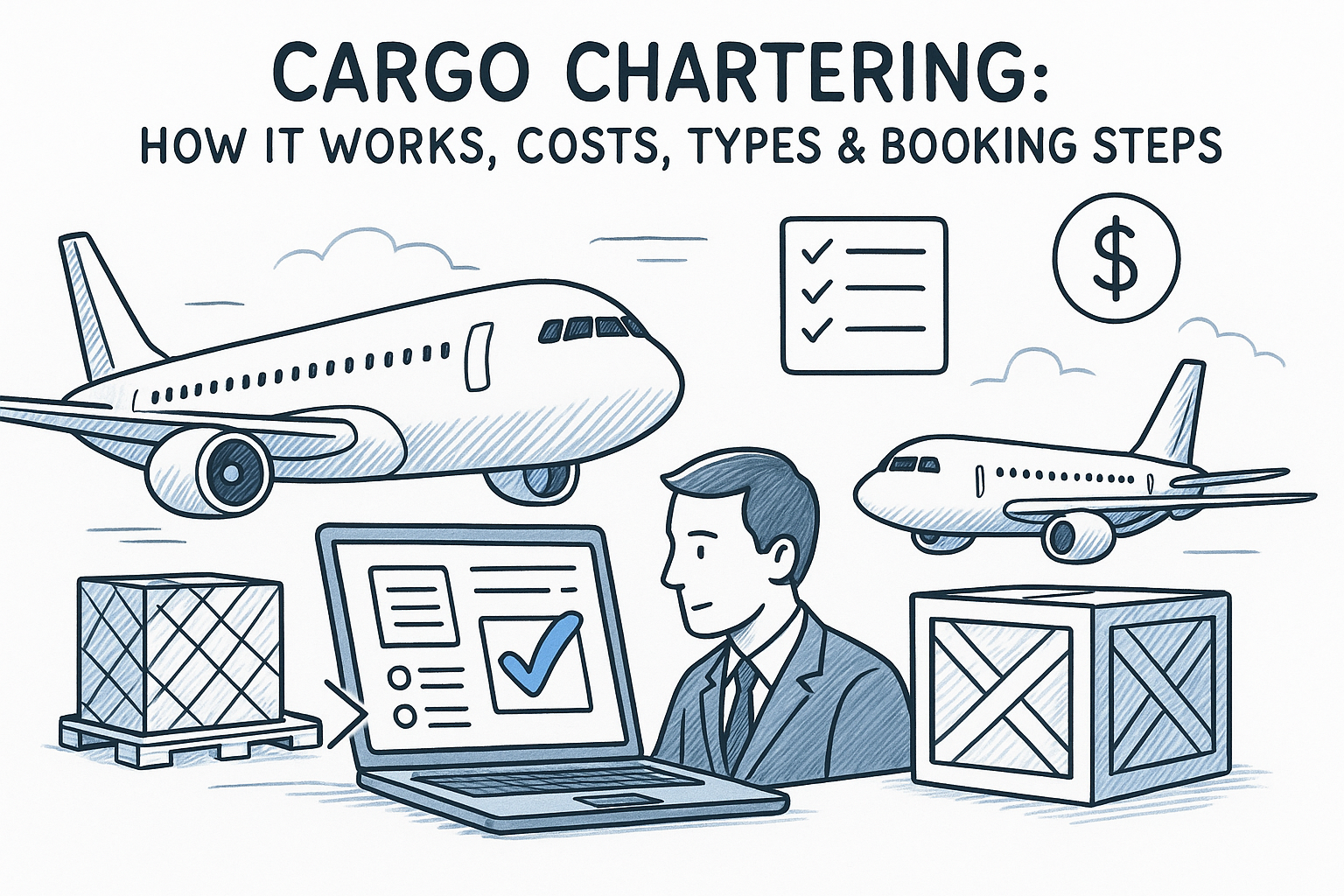
When standard airfreight capacity can't handle your shipment, whether it's oversized, time-critical, or headed somewhere off the beaten route, cargo chartering becomes the practical solution. It gives freight forwarders and logistics teams dedicated aircraft or vessel capacity, booked on their terms, without competing for space on scheduled services.
But the process behind chartering isn't always straightforward. Matching cargo dimensions to the right aircraft, confirming technical loadability, navigating overflight permits, and locking in pricing all involve layers of coordination that traditionally ate up hours of back-and-forth. That's exactly the problem CharterSync was built to solve, replacing manual workflows with a digital platform that delivers confirmed availability and technical feasibility in minutes, not days.
This guide breaks down how cargo chartering actually works, from the types of charters available to the cost factors that shape your quote and the step-by-step booking process. Whether you're arranging your first charter or looking for a more efficient way to manage recurring operations, you'll find the clarity you need to move forward with confidence.
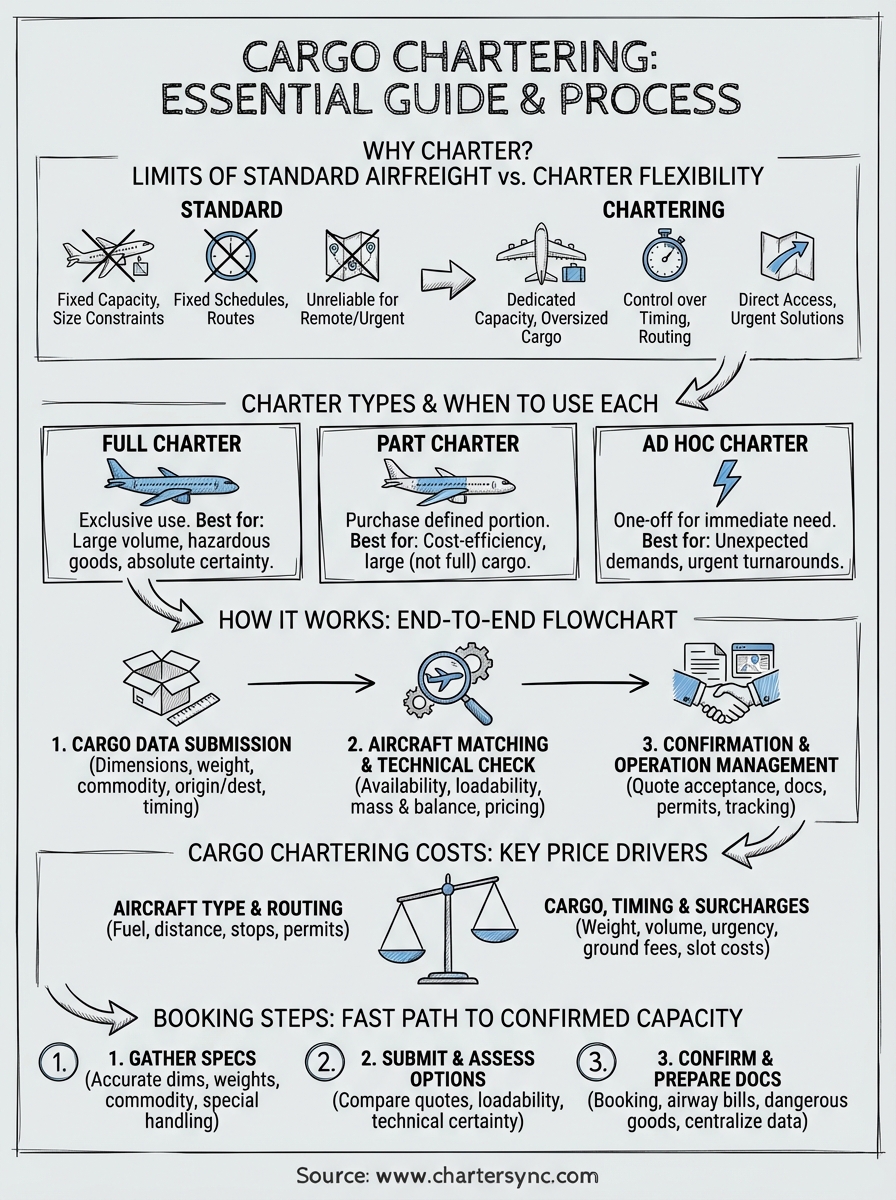
Scheduled airfreight works well for standard consignments that fit within the size and weight constraints of commercial aircraft belly holds. But a significant portion of global trade involves cargo that simply doesn't fit those constraints, whether in physical dimensions, weight, urgency, or routing requirements. Cargo chartering exists because the logistics industry needs a flexible, dedicated alternative when scheduled services fall short, one that gives you full control over capacity, routing, and timing.
When your cargo can't conform to scheduled services, a charter gives you the control to move it entirely on your terms.
Commercial airlines operate on fixed schedules, fixed routes, and fixed capacity. If your shipment is too large for a belly hold, or if the destination isn't served by direct routes, you're immediately looking at compromises: split shipments, multiple transits, or significant delays. For freight forwarders managing time-sensitive cargo, those compromises often aren't acceptable and can have serious knock-on effects for your client's supply chain.
Belly cargo capacity on passenger aircraft also varies considerably depending on the aircraft type and the number of passengers booked on each flight. This makes it unreliable for planning purposes, particularly when you're dealing with heavy industrial components, live animals, or temperature-sensitive goods that require consistent handling conditions throughout the entire journey. Chartered freighters remove that uncertainty by guaranteeing capacity before you commit.
Certain industries consistently generate cargo that pushes beyond what scheduled services can accommodate. Oil and gas equipment, aerospace components, humanitarian relief supplies, and automotive parts for production lines are all examples where the cargo itself dictates the aircraft, not the other way around. In these situations, chartering a dedicated aircraft isn't an extravagance; it's simply the only workable option available to you.
Oversized or project cargo often has physical dimensions that rule out passenger aircraft entirely. An engine cowling, a wind turbine blade, or a large industrial generator requires a freighter with the right door dimensions, floor-load ratings, and cargo handling equipment. Matching those technical requirements to available aircraft is a core part of the chartering process, and getting it wrong can ground a shipment entirely.
The volume and routing demands of these shipments also tend to be unpredictable. A machinery breakdown at a remote production site, a sudden humanitarian emergency, or an urgent shortfall in a manufacturing line can generate an immediate need for point-to-point capacity that no scheduled airline can fulfil on short notice. Chartering fills that gap by giving your team access to aircraft that can be positioned specifically for your consignment, on routes that commercial carriers don't serve, within timeframes that standard services simply cannot match.
Not all cargo chartering arrangements work the same way. The structure of your charter depends on how much capacity you need, how quickly you need it, and whether you're prepared to share space with another shipper's consignment. Understanding the main types helps you choose the right arrangement from the start rather than reconfiguring mid-process.
A full charter gives you exclusive use of the entire aircraft for your consignment. You control the routing, the schedule, and every cubic metre of available space. This is the right option when your cargo fills or nearly fills the aircraft, when you're moving hazardous or sensitive goods that can't be co-loaded with other cargo, or when you need absolute certainty over departure and arrival times. Full charters are common in the oil and gas, aerospace, and humanitarian sectors.
A part charter lets you purchase a defined portion of an aircraft's payload, with the remaining capacity sold to other shippers. This reduces your cost significantly when your cargo is large but doesn't warrant a full aircraft. The trade-off is less flexibility over scheduling, since the aircraft only departs once all allocated capacity is filled or a fixed departure date is agreed.
If your consignment doesn't fill a full aircraft, a part charter lets you pay only for the capacity you actually use.
An ad hoc charter is a one-off arrangement booked to meet an immediate or unexpected need, without any long-term commitment. It's the most common structure in cargo chartering because most chartering needs arise from sudden operational demands rather than planned schedules. Turnaround times for ad hoc charters can be tight, which is why having fast access to confirmed aircraft availability makes such a measurable difference to your operation.
The cargo chartering process follows a clear sequence, from your first cargo submission through to final delivery. Each stage builds directly on the previous one, and understanding the full flow helps you prepare the right information upfront and avoid the friction that typically adds hours to a traditional chartering operation.

Every charter starts with the cargo itself. You need to provide accurate dimensions, weight, and commodity type for each piece in your consignment, along with your origin, destination, and required delivery window. The more precise your initial data, the faster the process moves.
Errors at this stage cause the most friction downstream, particularly when aircraft door clearances are tight or your cargo requires special handling conditions throughout the flight.
Accurate cargo data at the start saves significantly more time than correcting mistakes once aircraft options are already on the table.
Once your cargo details are submitted, the process moves to matching them against available aircraft across the global network. This involves checking door dimensions, payload capacity, range, and current positioning. Finding an aircraft that can carry the weight is only part of the work; the process also requires confirming that your cargo can physically enter the hold and be loaded safely.
Loadability analysis and mass and balance calculations happen at this stage, giving you technical certainty before you commit to any booking.
After a suitable aircraft is confirmed, you receive a full quote covering all relevant cost components, along with permit lead time assessments for any restricted airspace on your routing. Once you accept the quote, documentation management begins and real-time tracking activates.
You can then monitor the shipment from initial booking through to delivery from a single centralised dashboard, removing the need to chase updates across multiple contacts or email chains.
Cargo chartering costs vary considerably depending on several interconnected factors. No single variable determines your final quote in isolation; aircraft type, routing distance, cargo weight, and timing all combine to shape what you pay. Understanding the main price drivers helps you budget more accurately and present stronger inquiries that generate faster, more precise responses.

The type of aircraft your cargo requires has the single largest effect on your quote. Larger freighters such as the Boeing 747-8F or Antonov AN-124 carry significantly higher operating costs than mid-size alternatives like the Boeing 737 freighter. Routing directly affects the price too, because longer sectors burn more fuel and may require technical stops or overflight permits, both of which add cost and lead time to your operation.
Choosing the right-sized aircraft for your cargo rather than defaulting to the largest available option is one of the most direct ways to control your costs. A well-matched aircraft keeps payload utilisation high and reduces the likelihood of being charged for unused capacity, which is a common cost inefficiency in poorly planned charters.
Right-sizing your aircraft choice to your actual cargo requirements is the single most effective way to reduce your charter quote.
Actual weight and volumetric weight both factor into how an aircraft is loaded and priced. Dense cargo that pushes against maximum payload limits, or bulky cargo that fills the hold before the payload limit is reached, both affect the commercial structure of your quote. Booking on short notice adds further cost, since aircraft positioning and crew scheduling become more complex under tight timeframes. Additional charges to factor into your budget include:
Building these variables into your planning from the initial inquiry stage prevents surprises when the full confirmed quote arrives.
Booking a cargo charter follows a logical sequence that moves quickly when you have the right information ready from the start. Each step builds directly on the previous one, and preparation early in the process gives you a faster path to confirmed capacity with fewer delays.
Before submitting anything, compile complete and accurate cargo data for every piece in your consignment: gross weight, dimensions (length, width, height), commodity description, and any special handling requirements such as temperature control or hazardous goods classification. You also need your origin and destination airports and your required uplift date.
Accurate specifications at the inquiry stage are what separates a confirmed quote in minutes from hours of back-and-forth clarification.
Once your data is ready, submit your inquiry to trigger an immediate aircraft matching process against available freighters that meet your technical requirements. Review options against payload capacity, door dimensions, routing, and total confirmed cost rather than selecting on headline price alone.
Comparing aircraft options side by side at this stage, including loadability analysis and mass and balance confirmations, gives you the technical certainty you need before committing to a booking.
After selecting your aircraft, confirm the booking formally and begin preparing your shipping documentation: airway bills, packing lists, dangerous goods declarations where applicable, and any import or export permits your routing requires. Keeping all documentation centralised in one platform removes the risk of delays at departure.
Cargo chartering gives you the flexibility, capacity, and control that scheduled services simply cannot match when your shipment is oversized, urgent, or routed beyond standard networks. The difference between a smooth charter operation and a costly delay almost always comes down to how accurately you prepare your cargo data and how quickly you access confirmed aircraft options that meet your technical requirements.
Every step in this guide, from understanding charter types to reading your cost drivers, points toward the same outcome: moving cargo with certainty rather than chasing updates across disconnected conversations. The right platform removes that friction entirely, giving you matched aircraft options, loadability confirmations, and real-time tracking from a single place.
If you're ready to move faster and with greater confidence on your next operation, book a cargo charter with CharterSync and see how quickly a well-matched aircraft quote lands in your hands.
.png)