.png)
Whether you're moving urgent freight on a charter flight or shipping commercial goods via standard airfreight, how long does customs clearance take is one of the first questions that comes up once cargo lands. The short answer: anywhere from a few hours to several weeks, depending on documentation accuracy, commodity type, and the clearance method used.
For logistics professionals arranging time-critical shipments, customs delays can unravel even the best-planned transport chain. A charter aircraft might deliver cargo to its destination airport in hours, but if that shipment sits in customs for days due to missing paperwork or an HS code mismatch, the speed advantage disappears. At CharterSync, we see this regularly, our platform helps freight forwarders and cargo managers arrange air charters in minutes, yet the customs stage remains the one variable that's hardest to control.
This guide breaks down realistic UK customs clearance timelines, the most common reasons shipments get held up, and practical steps you can take if your cargo is currently stuck.
No single fixed schedule governs how long customs clearance takes, because the process involves multiple independent variables that interact with each other. HMRC's border systems, the nature of your cargo, and the quality of your documentation all combine in ways that can either accelerate clearance or extend it by days.
The type of goods you're shipping directly affects how quickly customs will process your entry. Regulated or restricted commodities such as pharmaceuticals, live animals, dangerous goods, or dual-use items require additional licences, certificates, or specialist checks that standard cargo does not. Similarly, high-value shipments attract closer scrutiny because customs authorities assess duty and VAT liability more carefully when declared values exceed certain thresholds.
The more regulated your commodity, the more buffer time you should build into your clearance timeline before cargo needs to move.
Incorrect or incomplete paperwork remains one of the most consistent causes of delays across all shipment types. If your Commercial Invoice, Packing List, or Air Waybill contains errors, HMRC will query the entry and hold the shipment pending clarification. A mismatched Harmonised System (HS) code is particularly problematic because it can trigger a full document review or a physical inspection, adding days to your clearance time.
Your customs broker or freight forwarder carries real responsibility at this stage. Even minor discrepancies between declared weight, quantity, or country of origin can flag an entry for manual review, which removes it from automated fast-track processing entirely and places it in a queue that moves considerably slower.
When freight forwarders ask how long does customs clearance take in the UK, the honest answer depends on which clearance route your shipment follows. HMRC processes the majority of entries through its Customs Declaration Service (CDS), and most straightforward shipments move quickly through it. Knowing these typical windows helps you plan around them rather than scramble to react.
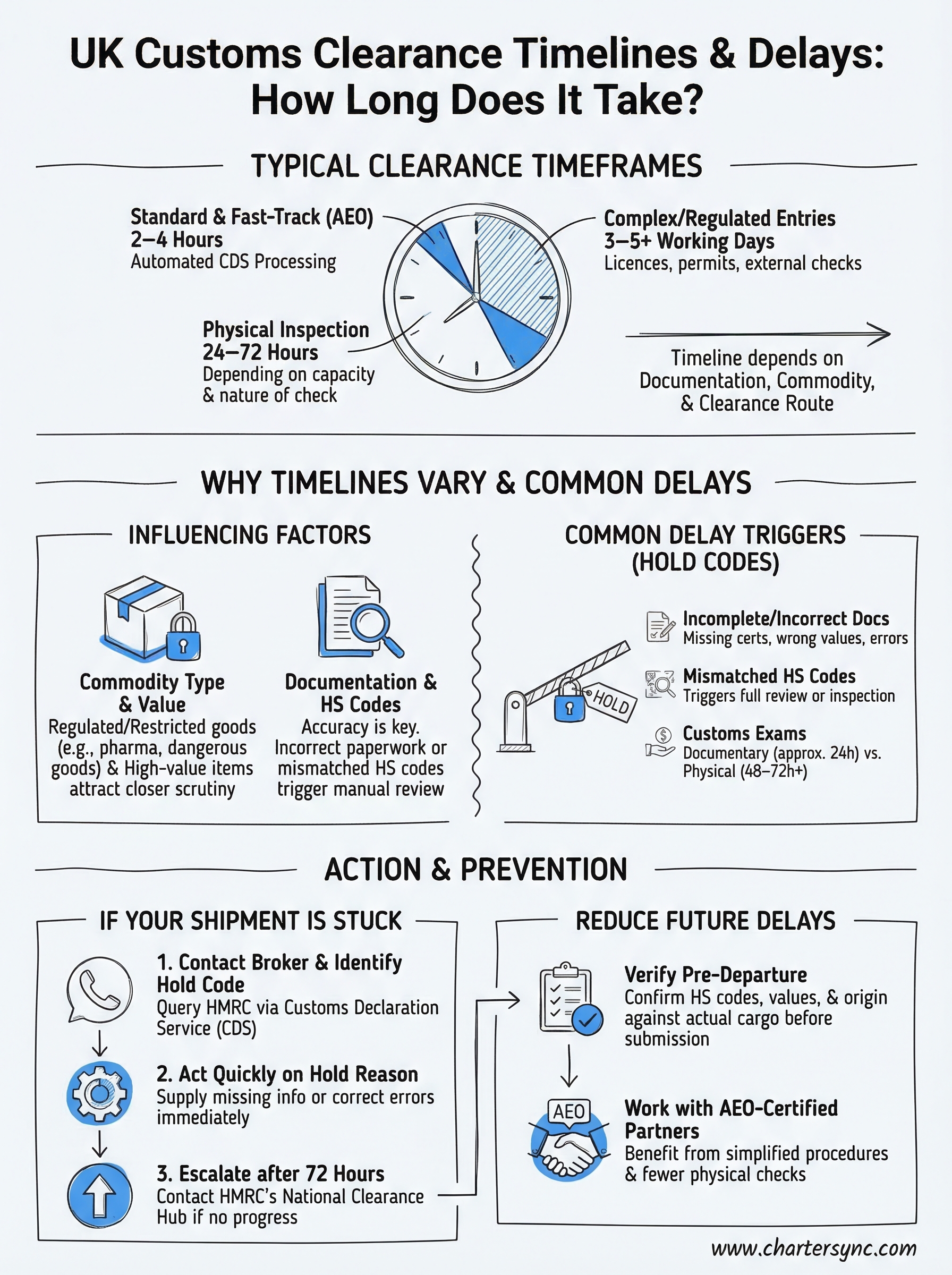
For well-documented, low-risk cargo, HMRC's automated CDS system typically clears entries within 2 to 4 hours of submission. Shipments from trusted traders, particularly those operating under HMRC's Authorised Economic Operator (AEO) status, can clear even faster because they benefit from simplified procedures and reduced physical checks.

AEO-certified operators consistently experience the shortest clearance windows, making that accreditation worth pursuing if you move high volumes of air cargo regularly.
If your shipment gets flagged for a physical inspection, clearance time extends to anywhere between 24 and 72 hours, depending on port capacity and the nature of the check. Entries involving licences, permits, or certificates for controlled goods often take 3 to 5 working days, and in some cases longer if regulatory bodies outside HMRC need to verify documentation.
Understanding why shipments stall gives you a clearer picture of how long customs clearance takes in practice. The UK's HMRC border systems process thousands of entries daily, and any entry that triggers a manual review gets pulled out of the automated queue immediately.
Missing certificates, incorrect declared values, or mismatched HS codes are the most common triggers for delays. Customs officers cannot release goods until every discrepancy is resolved, and resolving them means communication between your broker, the importer, and HMRC that can stretch across multiple working days.
Getting your documentation right before cargo departs is the single most effective way to protect your clearance timeline.
HMRC assigns hold codes to shipments that require further checks, ranging from document verification to full physical examination. A documentary hold typically resolves within 24 hours if your paperwork is in order. A physical examination, where officers inspect the actual cargo, takes longer, often 48 to 72 hours, and that window extends further if port resources are stretched or your commodity requires a specialist inspection team. Regulated goods, including pharmaceuticals and dual-use items, almost always attract these deeper checks.
When your cargo stalls, the first step is to gather accurate information rather than wait passively. Contact your customs broker or freight forwarder immediately and ask them to pull the entry status from the Customs Declaration Service. Most delays have a specific hold code attached, and knowing that code tells you exactly what HMRC needs to release your goods.
Your broker can query HMRC directly and obtain the specific hold code assigned to your entry. Each code points to a defined action, whether that's supplying a missing certificate, correcting a declared value, or scheduling a physical inspection slot.
Acting on the hold reason quickly reduces how long the shipment waits, because delays compound when responses are slow. Understanding how long does customs clearance take under each hold type also helps you reset expectations with your end client before the situation escalates further.
The faster you supply missing information to HMRC, the sooner your goods move through the clearance queue.
If your shipment stays on hold after 72 hours without clear progress, ask your broker to escalate through HMRC's National Clearance Hub. For urgent or perishable cargo, formal escalation can get an officer assigned to your case sooner.
Raising an escalation also creates a documented record of your response timeline, which matters if you need to make a claim against delays or prove due diligence to your client.
The most reliable way to cut how long customs clearance takes is to act before your cargo departs. Preparation at the pre-shipment stage has a direct impact on clearance speed, because entries with complete, accurate documentation move straight through automated processing without triggering manual review queues.
Treating documentation as part of your transport plan rather than an afterthought saves significant time once cargo lands.
Spend time confirming your HS codes, declared values, and country of origin against the actual cargo before your broker submits the entry. Any mismatch between your Commercial Invoice and Packing List flags the entry immediately, pulling it out of automated processing and into a manual review queue.
Running a pre-departure document check takes minutes and routinely prevents delays that stretch across multiple working days. Build it into your standard pre-shipment workflow as a fixed step.
Choosing a customs broker or freight forwarder with Authorised Economic Operator (AEO) status gives your shipments access to simplified customs procedures and lower physical inspection rates. AEO-accredited supply chains clear faster because HMRC treats them as trusted traders, which means fewer holds and less time waiting at the border.
If your current partners lack AEO certification, it is worth reviewing whether that gap is adding unnecessary clearance time to every shipment you move.
How long does customs clearance take depends almost entirely on factors you can influence before your cargo lands. Accurate documentation, correct HS codes, and AEO-certified partners consistently produce the fastest clearance outcomes, while errors at the pre-shipment stage trigger manual reviews that add days to your timeline.
When a shipment stalls, act on the hold code immediately rather than waiting for your broker to update you. Escalating through HMRC's National Clearance Hub after 72 hours without progress protects your timeline and creates a documented record.
For air cargo specifically, customs is often the stage that cancels out the speed advantage of chartering. If you're arranging time-critical freight and want a platform that handles the transport side with the same precision you apply to compliance, explore CharterSync's air cargo charter platform to see how fast the quoting and booking process can move.

.png)