.png)

Getting cargo into or out of the UK is only half the job. Once your shipment lands, whether it's an urgent AOG part or a full charter load, it still needs to clear customs. A reliable customs clearance agent UK businesses can count on makes the difference between goods reaching their destination on time and goods sitting in a bonded warehouse, racking up storage fees while paperwork gets sorted.
At CharterSync, we help freight forwarders and logistics teams arrange air cargo charters in minutes, with full loadability confirmation and real-time tracking from inquiry to delivery. But we also know that a seamless charter means nothing if your shipment stalls at the border due to incorrect commodity codes, missing documentation, or HMRC compliance issues. That's why choosing the right customs clearance partner matters just as much as choosing the right aircraft.
This guide breaks down exactly what to look for in a UK customs clearance agent, from qualifications and HMRC authorisation to communication standards and technology capabilities, so you can make a confident, informed decision before your next shipment arrives.
A customs clearance agent acts as the intermediary between your business and HMRC, handling the declarations, documentation, and duty calculations that allow goods to legally cross the UK border. Without one, your team is responsible for submitting entries through the Customs Declaration Service (CDS), assigning the correct tariff codes, and managing any holds or inspections that arise during transit.
Every shipment entering or leaving the UK requires accurate commodity codes (also called HS codes) to determine the correct duty rates and VAT treatment. Your agent assigns these codes, prepares all required paperwork, and submits the full declaration to HMRC on your behalf. Getting a code wrong can trigger fines, delays, or seizure of goods.
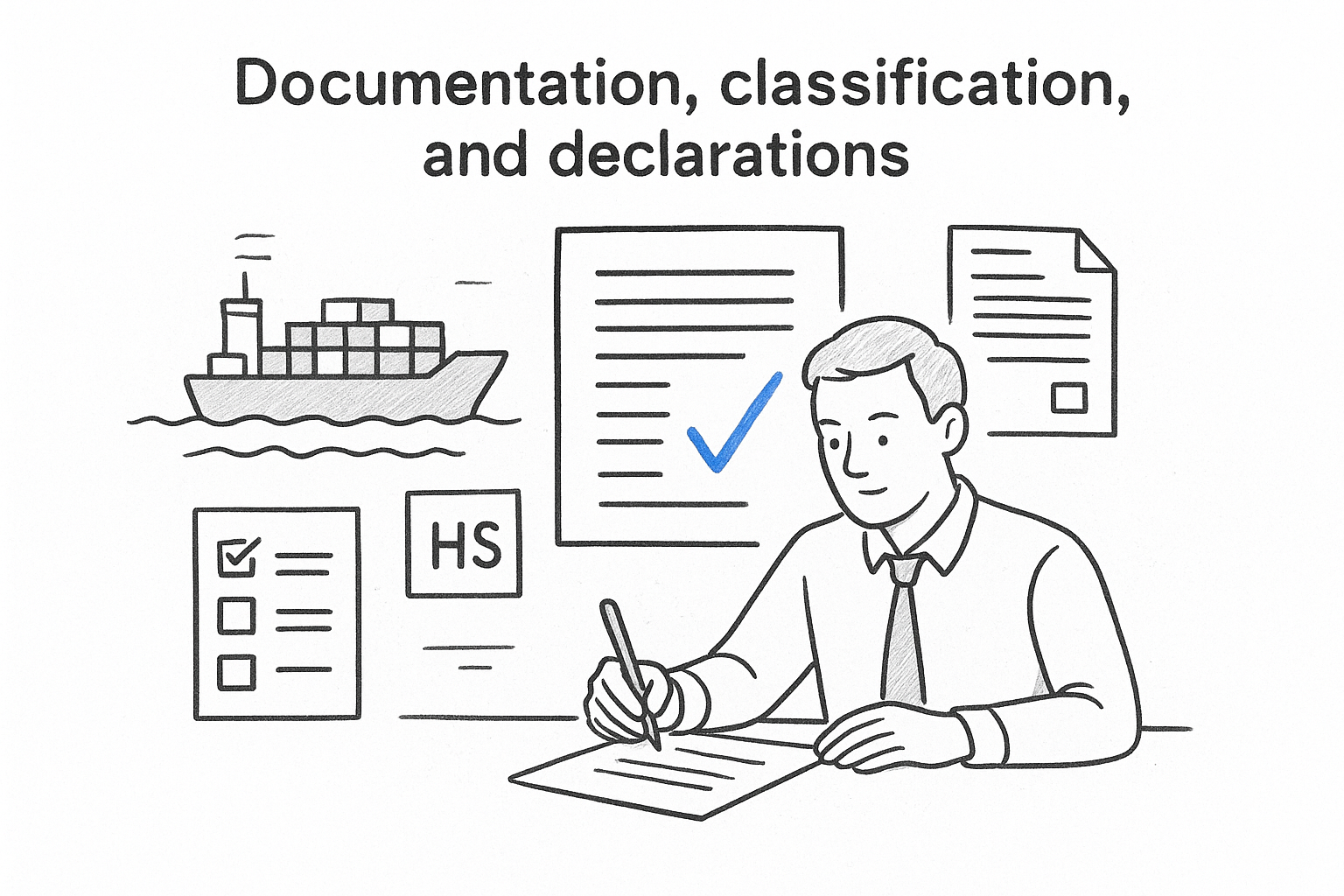
A single incorrect commodity code can result in underpaid duty, which HMRC can recover up to three years after the original declaration.
The core documents a customs clearance agent UK businesses use will typically prepare and manage include:
A licensed agent holds EORI (Economic Operator Registration and Identification) credentials and operates under HMRC-approved duty deferment accounts, so they can pay duties on your behalf and consolidate payment cycles. They also identify duty relief schemes such as Inward Processing Relief or Temporary Admission, which can reduce costs significantly on goods that are repaired or re-exported.
Beyond the paperwork, your agent communicates directly with freight handlers, ground agents, and Border Force officers to release cargo as quickly as possible. For air freight specifically, this coordination with the cargo terminal prevents the storage charges that accumulate rapidly when a shipment sits uncollected after landing.
Before you call or email any customs clearance agent UK businesses recommend, gather the key information about your shipment. Agents can only give you accurate quotes and timelines if you come prepared with the right details upfront.
Walking into that first conversation without your commodity details or EORI number forces the agent to estimate, which leads to inaccurate costings and potential delays at clearance.
You need a clear picture of your cargo and its country of origin before any agent can assess your requirements accurately. Pull together the following before you make contact:
Having this information ready cuts the back-and-forth significantly and lets the agent identify the right duty relief schemes or licence requirements before your goods arrive.
Not every customs clearance agent handles every type of shipment. Some specialise in air freight, others focus on sea freight or road haulage. Before you build your shortlist, identify the agents whose core experience matches your trade lanes and cargo type.
Picking a generalist when you move controlled goods or temperature-sensitive cargo regularly means you'll spend time educating your agent instead of clearing your shipments.
Start by filtering for agents who regularly handle your specific commodity type, whether that's aerospace parts, pharmaceuticals, or industrial machinery. Check whether they have dedicated teams covering your primary import and export routes, such as UK-to-EU or UK-to-US lanes.
Use these three criteria to narrow your initial list:
Your shortlist should now contain a manageable group of customs clearance agent UK options with directly relevant experience, which makes the vetting process in the next step considerably faster.
Once you have a shortlist, you need to verify that each customs clearance agent UK option holds the correct authorisations and carries adequate professional liability cover. An agent can present themselves well in a conversation, but credentials and insurance are what protect your business when something goes wrong.
Your agent must be HMRC-authorised to submit declarations on your behalf through the Customs Declaration Service. Beyond that, check whether they hold membership with the British International Freight Association (BIFA), as members are bound by standard trading conditions that include a defined liability framework. Ask directly for proof of both before proceeding.
An agent without BIFA membership or equivalent professional standing has no standardised liability cap, which leaves you exposed if a misdeclaration results in a fine.
Ask each agent for their professional indemnity insurance level and whether it covers the full value of your typical shipment. On service levels, get specific commitments in writing rather than general assurances. The questions below help you compare agents clearly:
Once you've confirmed compliance and service levels, compare the fee structures of each shortlisted customs clearance agent UK candidate. Many agents quote a basic clearance fee but add separate charges for document handling, HMRC submission, or disbursements at the port or airport, so always request a fully itemised quote before you commit to anyone.
Ask for a written breakdown that lists every charge separately, not a single headline figure, so you can compare each agent on exactly the same terms.
Use the template below to collect consistent information from each agent you are evaluating:
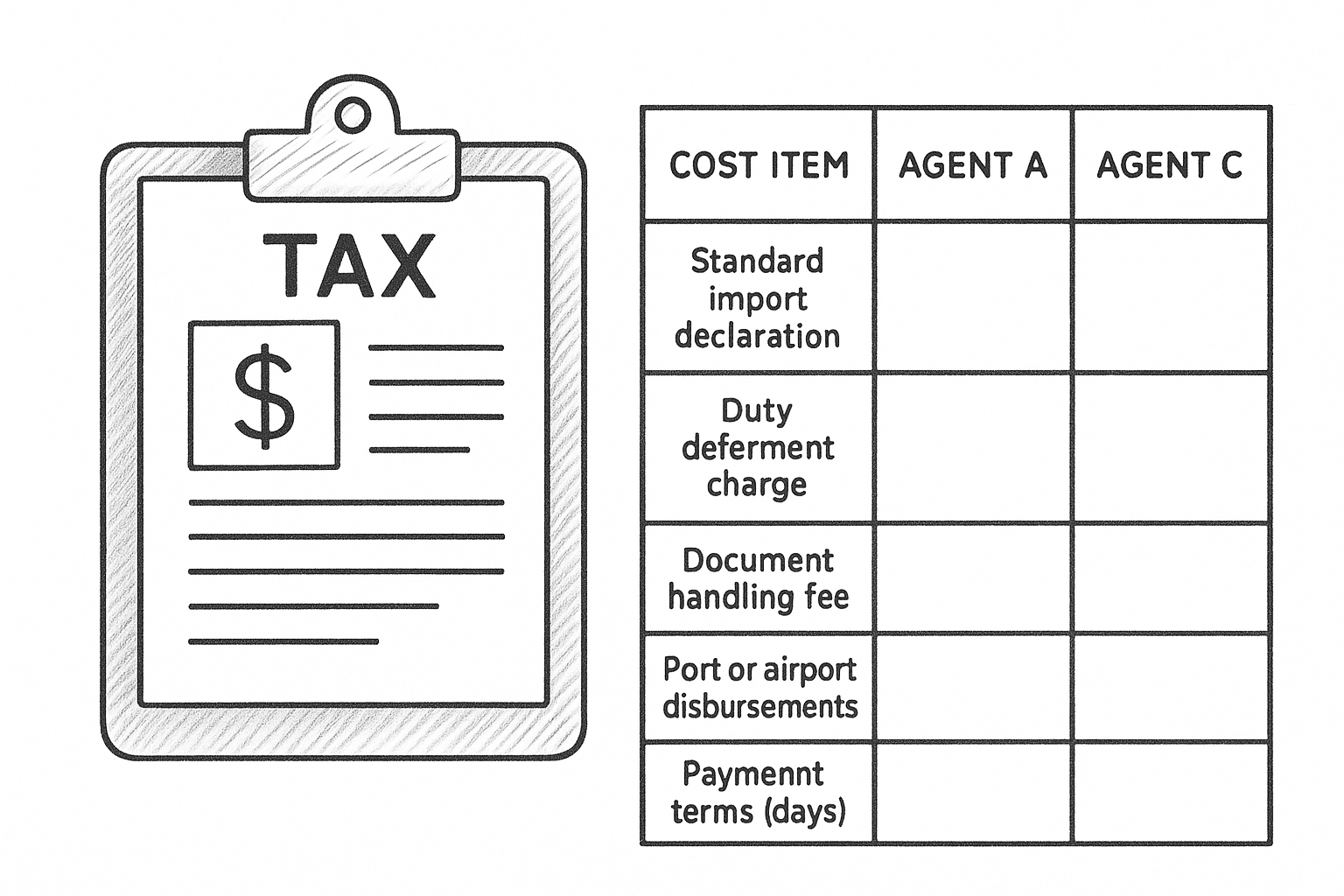
| Cost item | Agent A | Agent B | Agent C |
|---|---|---|---|
| Standard import declaration | |||
| Duty deferment charge | |||
| Document handling fee | |||
| Port or airport disbursements | |||
| Payment terms (days) | |||
| Average clearance timeline |
Your payment terms affect cash flow directly, particularly on high-value shipments where duty and VAT can be substantial. Confirm whether the agent requires upfront payment or offers 30-day terms, and verify whether they hold a duty deferment account that rolls your monthly liability into a single consolidated payment cycle.
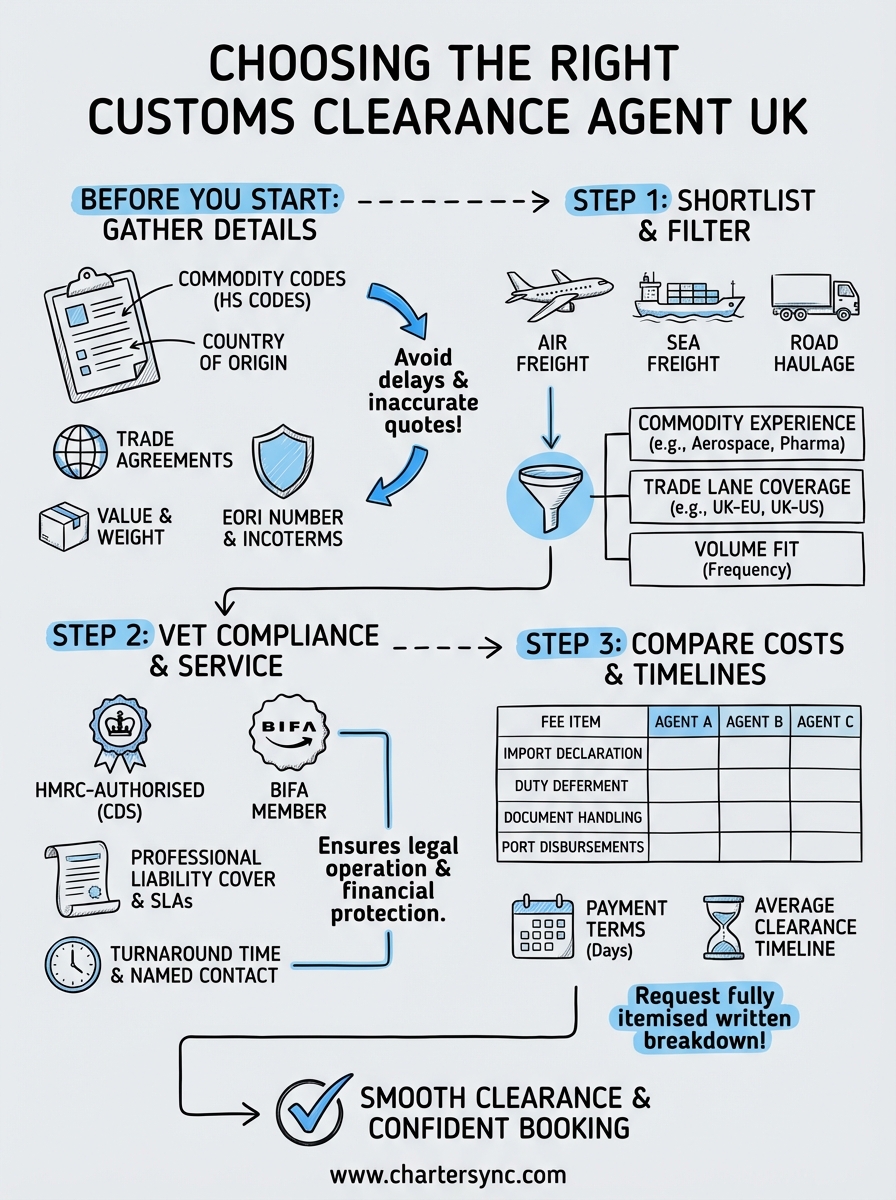
Choosing the right customs clearance agent UK businesses rely on comes down to three things: relevant commodity experience, verified HMRC authorisation, and a transparent fee structure you can compare directly. Work through the steps in this guide before your next shipment arrives rather than scrambling to find an agent under pressure when cargo is already sitting in transit and storage fees are accumulating.
Your clearance agent handles the border side of the equation. For the transport side, particularly when you are moving time-critical or oversized cargo by air, you need the same speed and certainty at the charter stage too. Slow quotes and provisional estimates cost you time you cannot afford. CharterSync gives freight forwarders and logistics teams confirmed aircraft availability, full loadability analysis, and real-time tracking in minutes, so you can book with confidence and keep both ends of your supply chain moving without delays.
.png)