.png)
Every shipment that crosses the UK border, whether arriving by sea, road, or air, must pass through customs. For freight forwarders and logistics managers arranging urgent cargo movements, customs clearance services UK providers handle the documentation, compliance checks, and communication with HMRC that keep goods moving. Get it wrong, and your shipment sits idle. Get it right, and clearance becomes invisible, exactly as it should be.
If you're booking air cargo charters through platforms like CharterSync, customs clearance is the final link in the chain. The aircraft lands, the cargo offloads, and then what? Without a reliable clearance agent, even the fastest charter becomes pointless. That's why understanding how customs brokerage works, and what separates a competent agent from an exceptional one, matters just as much as selecting the right aircraft.
This guide breaks down what customs clearance services actually include, what you can expect to pay, and the practical steps for choosing a provider that matches your operational needs. Whether you're importing time-critical components or exporting high-value goods, you'll find the information you need to make a confident decision.
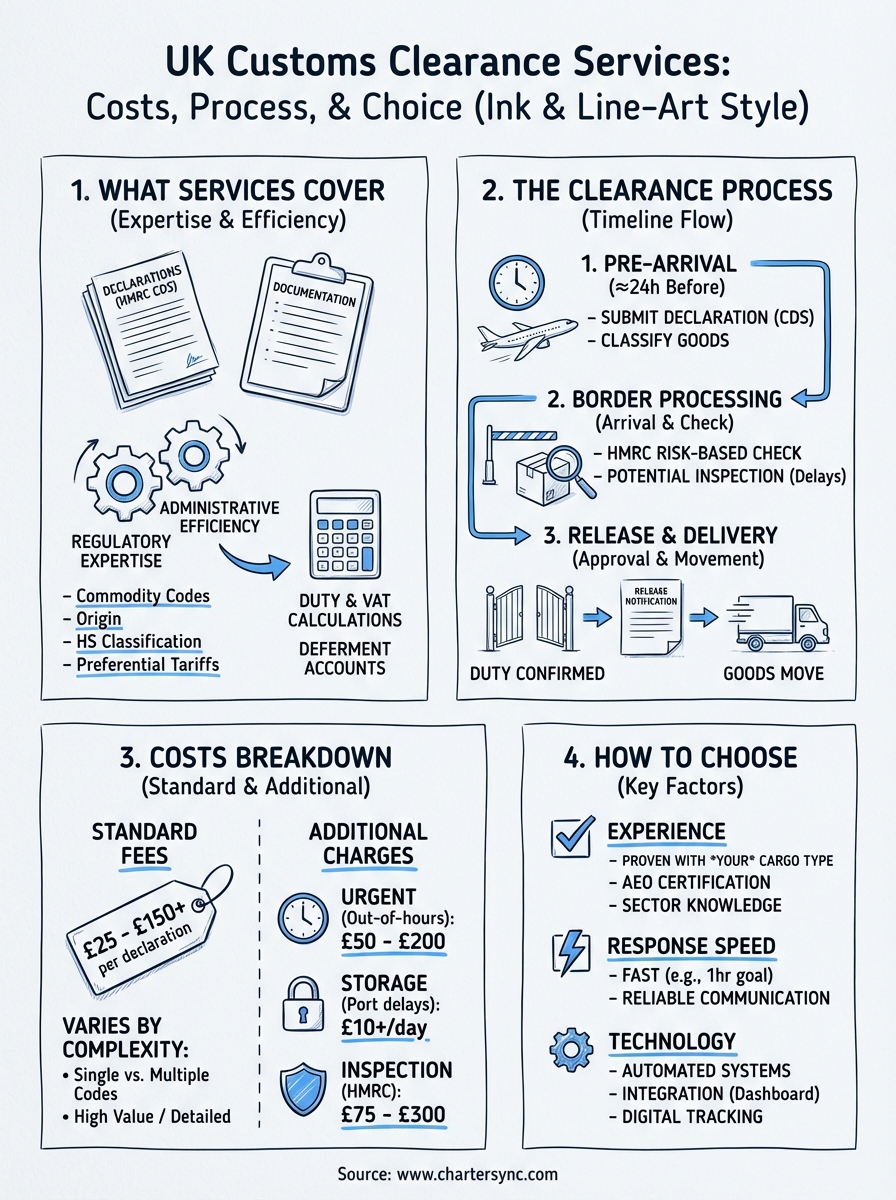
When you hire a customs broker in the UK, you're paying for regulatory expertise and administrative efficiency. Most customs clearance services UK providers handle the full cycle, from classifying your goods under the correct commodity codes to submitting declarations through HMRC's Customs Declaration Service (CDS). The broker acts as your legal intermediary, taking responsibility for accuracy and compliance so you can focus on moving cargo rather than decoding tariff schedules.
Your agent prepares and submits the customs declaration that tells HMRC what's entering or leaving the country. This includes commodity codes, country of origin, declared value, and the HS classification that determines duty rates. For imports, they'll submit either a full declaration at the border or a simplified declaration if you're using a deferment account. They also manage supporting paperwork like commercial invoices, packing lists, certificates of origin, and any permits required for controlled goods.
A competent broker doesn't just file forms. They validate data accuracy before submission, reducing the risk of delayed inspections or penalties.
Brokers calculate the import duty and VAT liability based on your shipment's classification and value. If you're using a duty deferment account, they'll ensure the charges are deferred correctly so you're not paying upfront at the border. For exports, they confirm whether relief or zero-rating applies. Most agents also flag potential preferential tariff opportunities if your goods qualify under trade agreements, though not all providers actively look for savings unless you ask.
Physical inspections, bond arrangements, and temporary admission procedures also fall under their remit when required. The breadth of service varies, so confirming scope before you commit matters.
Post-Brexit, every commercial shipment between the UK and EU now requires customs clearance. For freight forwarders managing time-critical cargo, this adds a compliance layer that didn't exist before 2021. Your ability to clear goods quickly directly affects delivery reliability, client satisfaction, and whether your cargo sits waiting at a port or moves straight through to its destination.
When customs paperwork contains errors or omissions, HMRC flags the shipment for physical inspection. Your cargo gets pulled aside, unloaded, and examined. That process can take hours or days, depending on the port's workload and the complexity of your goods. Storage fees accumulate, delivery windows collapse, and production lines stop if you're shipping components for manufacturing clients.
Every hour your shipment waits at the border is an hour your client isn't getting what they paid for.
Competent customs clearance services UK providers prevent these delays by submitting accurate declarations the first time. They understand commodity classifications, know which permits different goods require, and flag potential compliance issues before your cargo reaches the border. That front-loaded diligence becomes critical when you're moving urgent freight on tight deadlines.
The UK customs clearance process follows a predictable sequence that starts before your goods arrive and ends when HMRC releases them for delivery. Professional customs clearance services UK providers manage each stage on your behalf, submitting declarations through the Customs Declaration Service (CDS) and liaising with border officials when queries arise. Understanding this timeline helps you anticipate where delays might occur and why hiring experienced agents makes the process faster.

Your broker receives shipment details from you or your freight forwarder, typically 24 hours before arrival at the UK border. They classify your goods under the correct commodity codes, calculate duty and VAT, and submit the import declaration to HMRC. For air freight, this declaration often goes in while your cargo is still in flight. The earlier your agent receives accurate documentation, the smoother this stage runs.
Submit complete paperwork early, and your shipment clears the moment it lands.
When your cargo arrives, Border Force checks the declaration against physical goods. Most shipments with compliant declarations pass through automatically using HMRC's risk-based selection system. If your goods get flagged for inspection, officers examine packaging, verify quantities, and confirm classification accuracy. Inspections add hours or days depending on port capacity and cargo complexity.
Once HMRC approves the declaration and confirms duty payment, they issue release notification to the carrier. Your goods move from the customs-controlled zone to your nominated delivery address or consolidation facility. The entire process takes minutes for routine shipments with experienced brokers handling the paperwork.
Most customs clearance services UK agents charge between £25 and £150 per declaration, with prices varying based on shipment complexity and service level. You'll pay more for urgent processing, high-value goods requiring detailed classifications, or shipments with multiple commodity codes. The basic fee covers declaration submission and HMRC communication, but additional costs stack up quickly if your cargo requires physical inspections, specialist permits, or out-of-hours handling.

Basic import declaration fees start around £25 for straightforward consignments with single commodity codes. Complex shipments containing multiple products or requiring preferential tariff applications push fees toward £100 or higher. Your agent's pricing structure matters because some brokers charge flat rates per declaration regardless of value, while others use tiered pricing based on shipment worth or weight. Always confirm whether VAT and duty calculations are included in the quoted fee or billed separately.
Most hidden costs appear when you assume "clearance" includes services that actually carry separate charges.
Expect extra fees for urgent clearance requests outside standard working hours, typically £50 to £200 depending on timing. Storage charges apply if your goods await clearance at the port, often starting at £10 per day. Physical inspection fees can add £75 to £300 when HMRC selects your shipment for examination, covering officer time and facility use.
Choosing the right customs clearance services UK provider comes down to three factors: their track record with your cargo type, their speed of response, and whether their technology matches your operational needs. You're not just buying declaration filing. You're selecting a partner who'll prevent costly delays when you're moving time-critical freight. Ask specific questions before you commit, and verify answers with references from clients who ship similar goods.
Your agent needs proven experience clearing the specific products you ship. Pharmaceutical shipments require different expertise than machinery parts or perishable goods. Ask how many declarations they process monthly for your cargo category and whether they hold AEO certification, which signals HMRC recognises their compliance standards. Agents handling high volumes in your sector understand the common pitfalls and know which commodity codes attract scrutiny.
Specialist knowledge prevents the errors that cause border delays.
You need agents who respond within one hour during working hours, not the next day. Confirm whether they use automated systems that integrate with your freight management software or CharterSync's dashboard. Digital tracking beats email chains when you're managing multiple shipments. Test their responsiveness before signing contracts by sending sample documentation requests.
Once you've selected your customs clearance services UK provider, brief them on your typical cargo types and expected shipment frequencies before your first consignment arrives. Share your commercial invoice templates, standard product classifications, and any preferential tariff certificates you use regularly. This front-loaded preparation means your agent can process declarations faster when urgent shipments land, and you'll avoid last-minute scrambles for missing documentation.
Set up regular review meetings every quarter to assess clearance performance. Track average processing times, inspection rates, and whether your agent proactively flags cost-saving opportunities like duty relief schemes. Good brokers improve as they learn your business, but only if you measure what matters.
When you're arranging time-critical air cargo charters, the speed advantage disappears if customs clearance becomes the bottleneck. CharterSync handles the aircraft sourcing and booking, but pairing that capability with a competent clearance agent completes the chain. Your cargo moves at the speed your clients expect, from takeoff to final delivery.
.png)