.png)
When standard air freight schedules can't meet your deadline, or your cargo is too large, too heavy, or too urgent for commercial flights, a cargo charter becomes the logical solution. Chartering a dedicated aircraft gives you full control over routing, timing, and handling, but it also introduces questions about costs, aircraft types, and booking logistics.
For freight forwarders and supply chain managers dealing with time-critical shipments, understanding how cargo charters work is essential. Whether you're moving humanitarian relief supplies or urgent manufacturing components, the right charter arrangement can mean the difference between meeting your delivery window and missing it entirely.
This guide breaks down the fundamentals: what a cargo charter actually involves, the different charter types available, typical cost structures, and the step-by-step process from inquiry to delivery. At CharterSync, we've built our platform around making this process faster and more transparent, so you can make informed decisions with confidence.
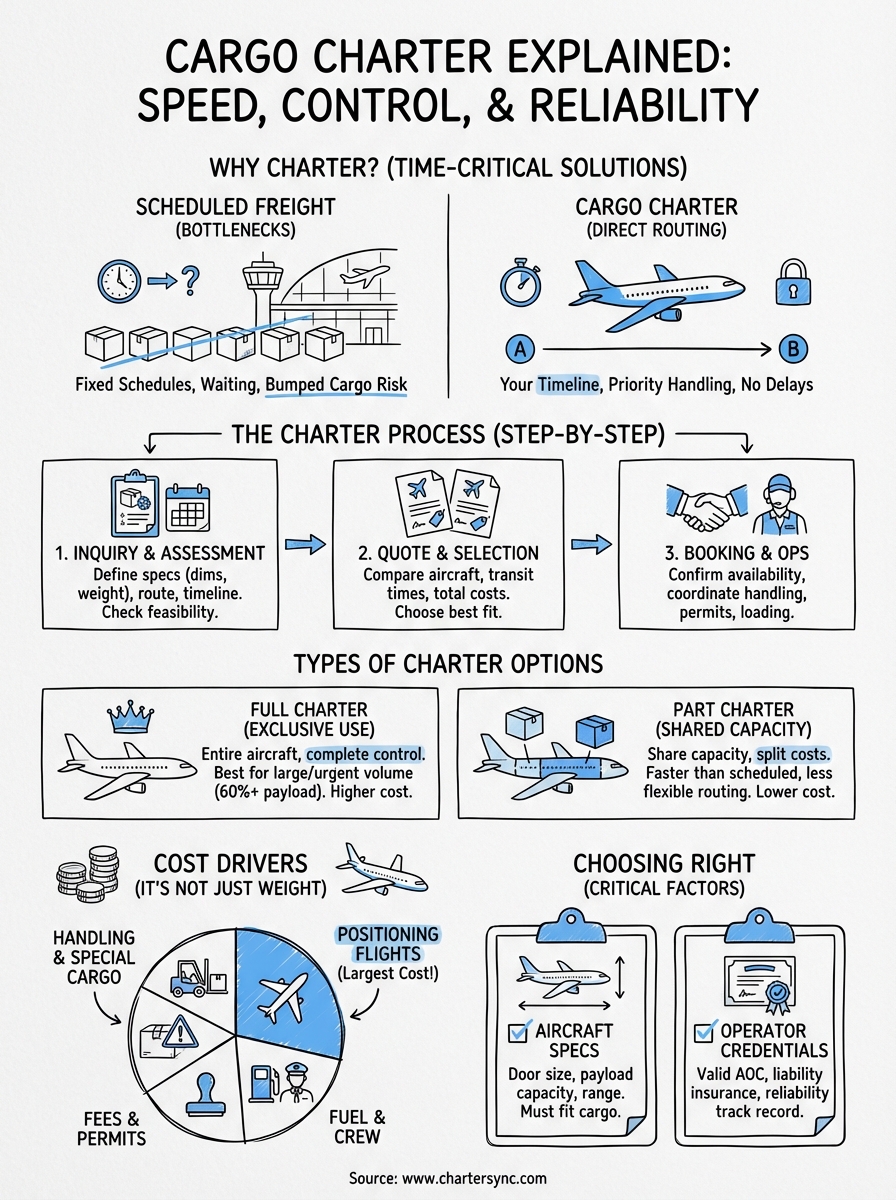
Standard air freight operates on fixed schedules and predetermined routes, which means your cargo waits for available space, connections, and handling slots. When you charter a dedicated aircraft, you eliminate these bottlenecks entirely. Your shipment moves on your timeline, following the most direct route possible, and receives priority handling at every stage.
Commercial freight routes often involve multiple touchpoints and transfers, each introducing potential delays. If you're shipping automotive parts to restart a production line, medical equipment for emergency deployment, or perishable goods with strict temperature requirements, waiting 48 to 72 hours for scheduled service isn't viable. A cargo charter puts your freight on a direct flight, cutting transit time by half or more in many cases.
You also avoid the risk of bumped cargo. Commercial flights prioritise passenger baggage and mail, and freight can be offloaded when weight limits are tight. Charter operations guarantee your cargo reaches its destination without competing for space.
Chartering eliminates the uncertainty that comes with relying on scheduled capacity, giving you complete control over departure times and routing decisions.
Missing a production deadline can cost tens of thousands of pounds per hour in lost output. For high-value machinery, pharmaceutical shipments, or aerospace components, the financial impact of delay often far exceeds the charter cost itself. You need to weigh the premium for speed and certainty against the commercial consequences of late delivery, including contractual penalties and reputational damage with your clients.
When you book a cargo charter, you typically choose between two arrangements based on your shipment size and budget constraints. Full charters give you exclusive use of an entire aircraft, while part charters let you share capacity with other shippers to reduce costs. Understanding which option fits your needs depends on your cargo volume, timeline flexibility, and the level of control you require over the transport process.

A full charter means you rent the entire aircraft, giving you complete control over departure times, routing, and handling protocols. You pay for the whole plane regardless of how much cargo you load, which makes this option most cost-effective when your freight fills at least 60 to 70% of the available payload. Full charters work best for oversized machinery, urgent production materials, or sensitive shipments requiring dedicated security and temperature controls.
Full charters eliminate the coordination challenges that come with shared capacity, letting you dictate every aspect of the transport process.
Part charters allow you to book a portion of an aircraft's payload, splitting costs with other shippers who need the same route. You still benefit from faster transit than scheduled freight, but you sacrifice some flexibility on departure times and routing. This arrangement suits smaller shipments where the speed advantage of chartering justifies the premium over commercial freight, but your volume doesn't warrant a full aircraft.
Booking a cargo charter follows a defined sequence that moves from initial inquiry to final delivery, typically compressed into hours rather than days. The process starts when you submit cargo specifications and routing requirements to charter brokers or platforms, who then identify suitable aircraft and provide quotes. Understanding each stage helps you prepare the right documentation upfront and avoid delays in securing capacity.
You begin by providing detailed cargo information: dimensions, weight, packaging type, and any special handling requirements like temperature control or hazardous material classification. The charter provider needs your preferred departure and arrival airports, along with your timeline constraints. This data allows them to assess which aircraft types can physically accommodate your freight and meet your delivery deadline.
Accurate cargo specifications at the inquiry stage prevent costly surprises during loading and ensure the selected aircraft actually fits your freight.
Charter providers return quotes showing available aircraft, transit times, and total costs broken down by positioning flights, fuel, handling fees, and permits. You compare these options based on price, speed, and the operator's reliability record. Once you select an aircraft, the provider confirms availability, prepares the charter agreement, and coordinates with ground handlers to schedule loading slots at both origin and destination airports.
Cargo charter pricing operates on a different model than scheduled freight, where you pay per kilogram based on published rates. Instead, you're paying for dedicated aircraft time, which means costs reflect the total flight hours, positioning flights, and operational expenses rather than cargo weight alone. A charter from London to Dubai might cost £40,000 to £120,000 depending on aircraft size, but the final figure depends on factors you need to understand before accepting a quote.

The largest cost component comes from positioning flights that get the aircraft to your departure airport when it's not already stationed there. If you book a cargo charter from Manchester but the nearest available aircraft sits in Frankfurt, you pay for the empty flight from Germany to collect your freight. Fuel prices, crew duty time, and airport landing fees all feed into the base rate, with larger aircraft consuming more fuel but offering lower per-tonne costs when you fill the capacity.
Positioning flights can add 30 to 50% to your total charter cost, making aircraft location a critical factor in quote comparisons.
Beyond the base flight cost, you encounter handling fees at origin and destination airports, customs clearance charges, and overflight permits for each country your route crosses. Specialist cargo like dangerous goods or live animals triggers additional certification and equipment costs that standard freight doesn't require.
Selecting the right aircraft and cargo charter operator requires you to balance technical capability, operational track record, and transparent pricing structures. You need an aircraft that physically accommodates your freight while ensuring the operator holds current certifications and adequate insurance coverage. This decision directly impacts whether your shipment arrives on time and in the condition you expect.
Match your cargo dimensions against the aircraft's door height, width, and cargo hold volume before accepting any quote. An Antonov AN-124 handles outsized machinery that won't fit through a Boeing 747F's side cargo door, while smaller BAe 146s access restricted airstrips that heavy freighters can't reach. You also need to verify the aircraft's maximum payload capacity and range cover your shipment weight and routing without requiring fuel stops that add transit time.
The wrong aircraft choice leads to rejected shipments at loading, forcing expensive last-minute rebooking and missing your delivery deadline entirely.
Check that your charter operator holds valid Air Operator Certificates (AOC) and maintains comprehensive liability insurance covering your cargo value. Request references from previous clients who shipped similar freight types to verify on-time performance and handling standards.
Understanding cargo charter options gives you the foundation to make informed decisions when urgent freight demands dedicated capacity. You now know the core cost drivers, the difference between full and part charters, and what technical specifications matter when selecting aircraft. The next time you face a time-critical shipment that scheduled freight can't accommodate, you can evaluate charter options with clarity.
Speed matters most when booking. Traditional charter brokers require hours of back-and-forth communication to confirm aircraft availability and technical feasibility. CharterSync eliminates this delay by providing instant aircraft matching and confirmed loadability analysis in minutes. You get transparent quotes, real-time tracking, and a centralised dashboard that manages every aspect of your cargo charter from inquiry through to delivery. When your deadline depends on certainty rather than estimates, digital tools replace guesswork with data-backed decisions.
.png)