.png)
When standard scheduled flights cannot accommodate your cargo's size, weight, or timeline, a charter airline becomes the practical solution. These operators provide dedicated aircraft for specific missions, whether moving oversized machinery, urgent medical supplies, or time-critical automotive parts across continents. Unlike commercial carriers bound by fixed schedules and shared capacity, charter services offer flexibility that scheduled freight simply cannot match.
For logistics professionals and freight forwarders, understanding how charter airlines work is essential to making informed decisions under pressure. This article breaks down the core types of charter operations, what drives their costs, and how the booking process actually functions, from initial enquiry to wheels-up.
At CharterSync, we've built a platform that connects freight forwarders with verified cargo aircraft globally, using AI-powered matching to cut through the complexity. Whether you're new to chartering or looking to streamline your current process, this guide provides the foundational knowledge you need to navigate your options with confidence.
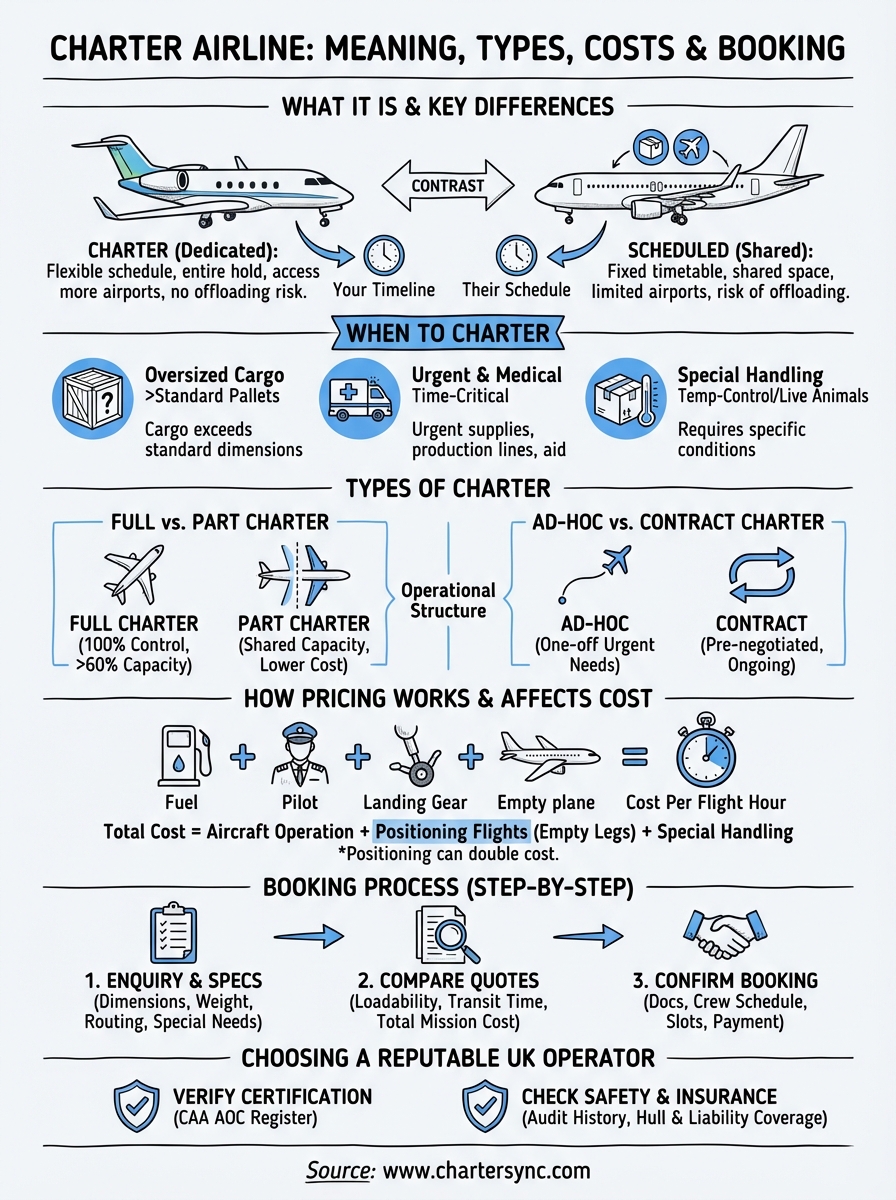
A charter airline operates aircraft on a non-scheduled basis, meaning you book the entire aircraft for your specific cargo movement rather than purchasing space on a pre-planned route. The operator provides the aircraft, crew, maintenance, and insurance as a complete package, tailored to your shipment's exact requirements. This stands in sharp contrast to scheduled freight services, where your cargo competes for limited space alongside other customers' goods.
Charter operators maintain fleets ranging from small turboprops to wide-body freighters, each suited to different payload capacities and range requirements. Unlike passenger airlines that occasionally carry belly freight, these specialists focus exclusively on moving cargo where and when you need it. Your single shipment occupies the entire hold, eliminating the risk of offloading or delays caused by overbooking.
Scheduled freight services run on fixed timetables between established airports, regardless of whether you have cargo ready to move. You adapt your logistics to their schedule, not the other way around. Charter airlines reverse this dynamic entirely. They fly to your timeline, can access smaller regional airports that scheduled carriers bypass, and configure their aircraft specifically for your cargo's dimensions and handling needs.
Charter services give you control over departure times, routing, and aircraft selection based on your cargo's physical characteristics and urgency.
You should consider charter when your cargo exceeds standard pallet dimensions, requires temperature-controlled environments that scheduled services cannot guarantee, or operates under time constraints that scheduled flights cannot meet. Projects involving humanitarian aid, automotive production lines, aerospace components, or live animal transport frequently justify the premium over scheduled freight through reduced handling, faster transit, and guaranteed capacity.
Charter airlines operate under several distinct models, each suited to different cargo scenarios and budget constraints. Understanding these operational structures helps you match your shipment's needs to the most cost-effective solution without compromising on service quality or reliability.

When you book a full charter, you lease the entire aircraft exclusively for your cargo, giving you complete control over departure timing and routing decisions. This model suits shipments that fill 60% or more of the aircraft's payload capacity or require dedicated handling protocols that shared space cannot accommodate.
Part charter arrangements allow you to share aircraft capacity with other shippers moving cargo on similar routes and timelines. You pay only for the space your cargo occupies, making this option viable for smaller shipments that still need charter-level speed but cannot justify the cost of an entire aircraft.
Part charters reduce your per-tonne costs by splitting operational expenses across multiple customers while maintaining faster transit than scheduled services.
Ad-hoc charters address one-off urgent requirements, such as production line failures or emergency medical equipment deliveries. Contract charters establish pre-negotiated terms for recurring movements over weeks or months, locking in rates and guaranteeing aircraft availability for ongoing projects.
Charter airline pricing operates on a cost-per-flight-hour basis rather than per kilogramme like scheduled freight. You pay for the entire aircraft's operational time, which includes positioning flights to reach your loading airport, the loaded flight itself, and any repositioning needed afterward. This structure means your total quote depends on aircraft type, distance, and routing complexity.
Aircraft operating costs form the largest expense, covering fuel burn, crew salaries, insurance, and landing fees at each airport involved. Larger aircraft with higher payload capacities command steeper hourly rates but deliver better per-tonne economics when you fill most of the available space. Crew duty time limits and regulatory rest requirements can force overnight stops on longer missions, adding accommodation and positioning costs to your final invoice.
Positioning flights inflate your costs when the aircraft must fly empty to reach your departure airport. Short-notice bookings during peak seasons or to remote destinations carry premium rates due to limited availability and complex permit requirements. Special handling needs like refrigeration, hazmat certification, or oversized cargo doors restrict your aircraft options and typically increase pricing by 15 to 40 percent over standard charters.
Aircraft positioned more than 500 nautical miles from your loading point can double your effective charter cost through deadhead flight charges.
Booking a charter flight involves three distinct phases that move you from initial enquiry to confirmed departure. Each stage requires specific documentation and decisions that directly impact your aircraft options and final costs. Understanding this workflow prevents delays and ensures you secure the right capacity at competitive rates.

You begin by providing detailed cargo dimensions, weight, and routing requirements to charter brokers or platforms like CharterSync. Your specifications must include packing list details, temperature requirements, and any handling restrictions that affect aircraft selection. Operators need this information to confirm whether your cargo physically fits through aircraft doors and stays within payload limits.
Charter providers return quotes showing available aircraft types, departure slots, and total flight costs including positioning charges. You compare options based on loadability confirmations, transit time, and price per tonne rather than hourly rate alone. This stage determines whether you need a single aircraft or must split your shipment across multiple flights.
Confirmed loadability analysis prevents costly surprises at the loading ramp when cargo dimensions exceed what the aircraft can physically accommodate.
Once you accept a quote, you provide commercial invoices, airway bills, and export permits required for clearance. The charter airline finalises crew scheduling, fuel planning, and airport slot reservations to lock in your departure time.
Selecting a charter airline requires verification of operational credentials and safety standards rather than relying on price comparisons alone. Your cargo's value and delivery timeline depend on the operator's regulatory compliance and technical capability, making due diligence non-negotiable before you commit to any booking.
Every legitimate charter airline operating in UK airspace must hold an Air Operator Certificate (AOC) issued by the Civil Aviation Authority. You can verify this certification through the CAA's public register, which confirms the operator's legal authority to conduct commercial cargo flights. Operators without current AOC status cannot legally fly your cargo, regardless of how competitive their pricing appears.
AOC verification takes five minutes but prevents partnerships with uncertified operators that expose you to liability and shipment delays.
Request proof of hull and liability insurance covering the aircraft's full replacement value and third-party damage claims. Reputable operators maintain comprehensive coverage without hesitation and provide certificates within 24 hours. Review their safety audit history and any incident reports filed with aviation authorities, as patterns of maintenance issues or regulatory violations signal operational risks that threaten your cargo and delivery commitments.
Charter airlines provide dedicated aircraft capacity when scheduled freight cannot meet your cargo's specific requirements for size, timing, or routing. Understanding the difference between full and part charters, recognizing how positioning costs affect your total spend, and verifying operator certifications through the CAA's register protects both your budget and your cargo's safe delivery.
The booking process demands accurate cargo specifications from your first enquiry to avoid loadability issues at the ramp. Reputable operators respond with confirmed technical analysis rather than provisional estimates, giving you certainty before you commit funds. Price comparisons must account for the total mission cost, not just hourly rates, as positioning flights and handling requirements can swing economics dramatically.
CharterSync's platform eliminates the manual back-and-forth by matching your cargo specifications against verified aircraft globally, providing instant loadability confirmation and transparent quotes. Request access today to experience how AI-powered charter booking reduces your procurement time from hours to minutes.
.png)