.png)

Getting an accurate air freight quote can feel like assembling a puzzle with missing pieces. Between fluctuating fuel surcharges, dimensional weight calculations, and carrier-specific fees, the final number often surprises even experienced logistics professionals. Yet understanding how these costs come together is essential for maintaining competitive margins and meeting client expectations.
The challenge isn't just obtaining a quote, it's knowing whether that quote reflects the best available option. Traditional methods involve contacting multiple carriers, waiting for responses, and manually comparing figures across spreadsheets. This process consumes hours that could be spent on higher-value tasks, and still leaves room for costly errors or missed opportunities.
This guide breaks down exactly how air freight costs are calculated, what factors influence pricing, and how to compare rates effectively. Whether you're shipping time-sensitive cargo or planning regular charter operations, you'll learn practical methods to secure better pricing with confidence. At CharterSync, we've built our platform around solving these exact challenges, giving freight forwarders instant access to transparent quotes and side-by-side aircraft comparisons without the back-and-forth.
An air freight quote comprises multiple layers of charges that stack on top of each other to produce the final cost. The base rate per kilogram forms only the foundation, while surcharges and ancillary fees can add 30% to 50% to the initial figure you see. Understanding each component helps you spot where costs genuinely differ between carriers and where you're simply looking at different presentation formats for identical charges.
Every quote starts with a base transportation rate calculated against your shipment's chargeable weight (more on this calculation shortly). Carriers price per kilogram or per pound, typically offering tiered rates that decrease as volume increases. You'll also encounter minimum charges that apply regardless of actual weight, meaning small shipments often cost disproportionately more per kilogram than larger consignments.
The base rate reflects aircraft type, route density, and current market demand. Peak seasons (typically October through December) see rates climb 20% to 40% above off-peak pricing. Routes with daily scheduled service cost less than those requiring dedicated charters or connections through secondary hubs.
Fuel surcharges fluctuate monthly based on global oil prices and typically represent the largest variable cost beyond the base rate. Security charges cover mandatory screening procedures, while handling fees apply at both origin and destination airports. You may encounter currency adjustment factors when shipping across different monetary zones, protecting carriers against exchange rate fluctuations.
Surcharges often receive less scrutiny than base rates, yet they frequently account for the majority of price differences between carriers.
Dimensional weight penalties appear when your cargo occupies more space than its actual weight justifies. Special handling charges apply to hazardous materials, live animals, or temperature-sensitive goods. Documentation fees, customs clearance support, and insurance premiums round out the typical surcharge list, each adding incremental costs that transform a seemingly competitive base rate into an expensive final invoice.
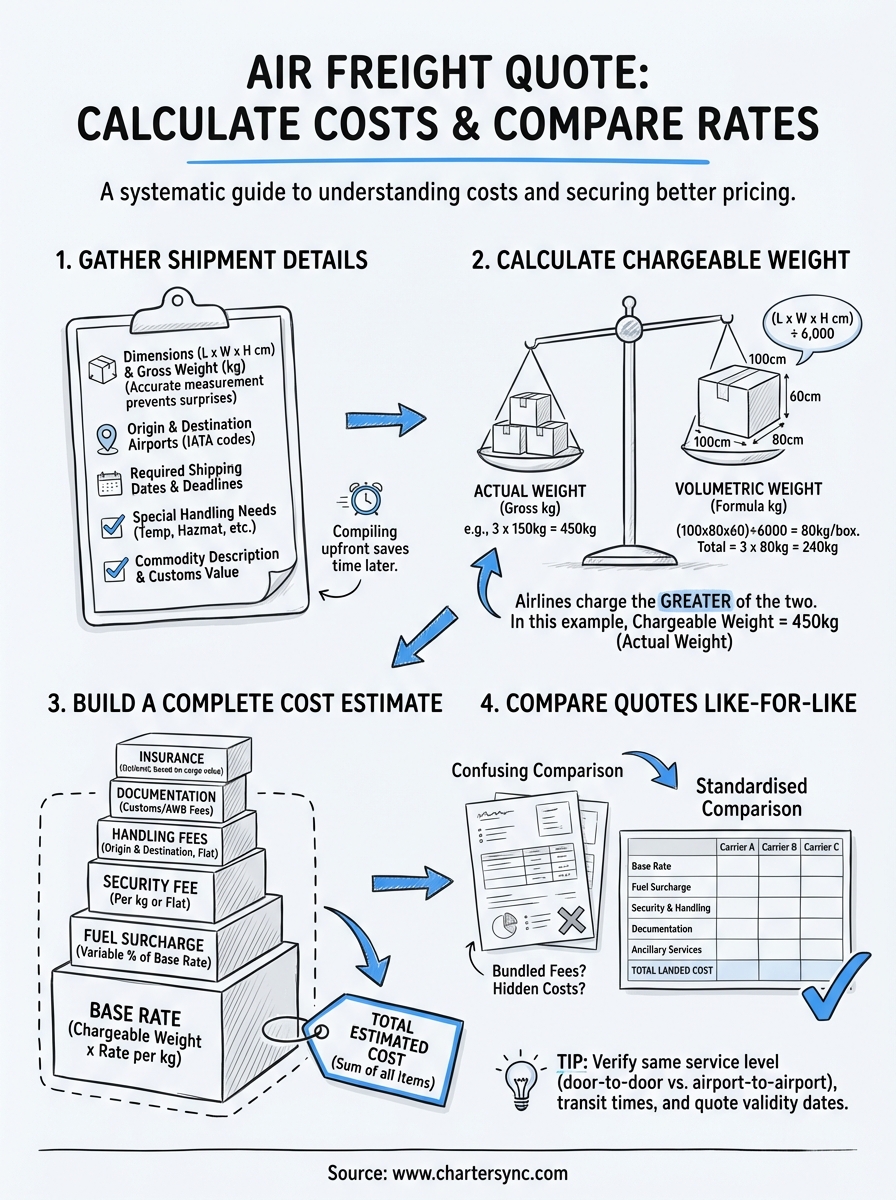
Before requesting an air freight quote, you need precise shipment information at hand. Incomplete or inaccurate details force carriers to provide provisional estimates that rarely match the final invoice, creating budget overruns and client dissatisfaction. Taking fifteen minutes to compile comprehensive cargo data upfront saves hours of back-and-forth clarification later.
Start with the physical dimensions of each piece in your shipment: length, width, and height measured in centimetres. Record the gross weight in kilograms for every item, including packaging materials and pallets. Document the exact number of pieces you're shipping, as carriers price multi-piece consignments differently than single-unit shipments.
Accurate measurements prevent dimensional weight surprises that can double your quoted rate.
You'll also need your origin and destination airports using their three-letter IATA codes (for example, LHR for London Heathrow or JFK for New York). Specify your required shipping dates, including any delivery deadlines that affect transit time requirements. Note whether your cargo requires special handling, such as temperature control, hazmat certification, or security screening beyond standard procedures. Finally, declare the commodity description and customs value, as certain goods attract additional fees or restrictions that affect pricing substantially.
Airlines charge based on whichever figure is greater: your actual weight or your volumetric weight. This calculation determines the true cost basis for your air freight quote, and getting it wrong means your budget won't match reality. The volumetric weight formula accounts for space occupied in the aircraft, preventing shippers from filling cargo holds with lightweight but bulky goods at rates meant for dense freight.
You calculate volumetric weight by multiplying your cargo's length, width, and height in centimetres, then dividing by 6,000 (the standard air freight divisor). The formula looks like this:

Volumetric Weight (kg) = (Length × Width × Height) ÷ 6,000
Each piece gets calculated separately, then you sum the results for your total volumetric weight. Compare this figure against your actual gross weight, and the higher number becomes your chargeable weight that carriers use for pricing.
Suppose you're shipping three identical boxes, each measuring 100cm × 80cm × 60cm and weighing 150kg per box. Your actual total weight equals 450kg. Calculate volumetric weight as follows: (100 × 80 × 60) ÷ 6,000 = 80kg per box, or 240kg total for three boxes.
Carriers always bill the higher figure, so your chargeable weight equals 450kg in this scenario.
If those same boxes weighed only 50kg each (150kg total), your volumetric weight of 240kg would exceed actual weight, making 240kg your chargeable weight instead.
Once you've calculated your chargeable weight, you can assemble a complete cost estimate by adding all applicable charges together. This step transforms individual rate components into a total landed cost that reflects what you'll actually pay. Most carriers provide itemised quotes, but you need to verify every line item to catch hidden fees or missing services.
Start with your base freight rate multiplied by chargeable weight. Add the current fuel surcharge percentage (typically shown as a percentage of the base rate rather than a fixed fee). Include security charges, which usually apply per kilogram or as a flat fee per shipment. Factor in origin handling charges at departure and destination handling fees at arrival, as these apply regardless of whether you use the carrier's ground services.
Most budget discrepancies arise from overlooked handling fees and customs documentation charges.
You can structure your estimate using this format to ensure nothing gets missed:
Base Rate: (Chargeable Weight × Rate per kg)
Fuel Surcharge: (Base Rate × Current %)
Security Fee: (Per kg or flat rate)
Origin Handling: (Flat fee)
Destination Handling: (Flat fee)
Documentation: (Customs/AWB fees)
Insurance: (Optional, based on cargo value)
Total Estimated Cost: Sum of all items above
Request itemised air freight quote breakdowns from carriers to compare these elements accurately.
Placing multiple air freight quote options side by side reveals that carriers structure their pricing differently, making direct comparison surprisingly difficult. One carrier might bundle handling fees into the base rate while another itemises every charge separately. You need a standardised comparison method that cuts through presentation differences to identify the genuinely lowest total cost.
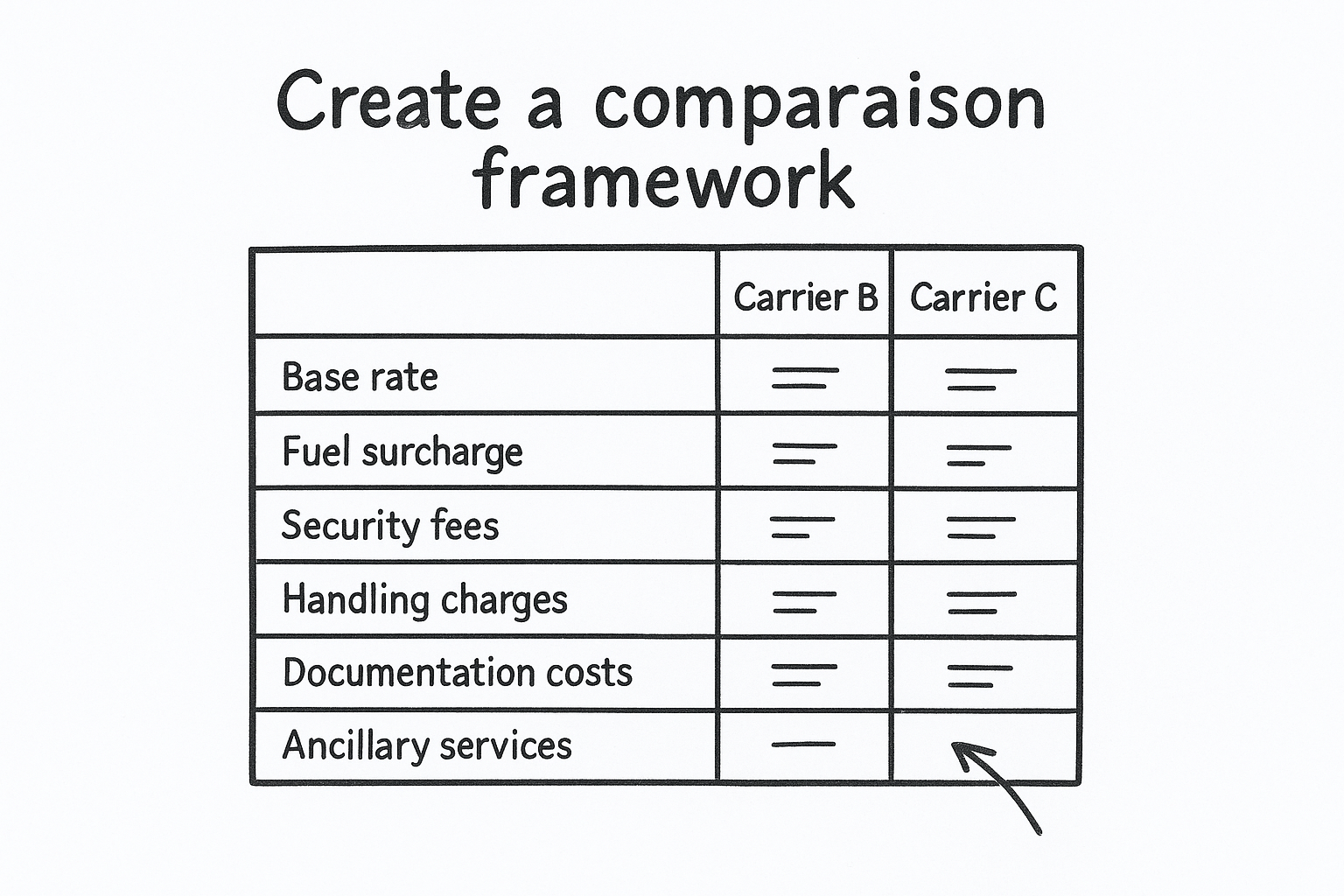
Build a simple spreadsheet with identical line items across all quotes. List each carrier as a column header, then create rows for base rate, fuel surcharge, security fees, handling charges, documentation costs, and any ancillary services. Where a carrier doesn't itemise a particular fee, calculate backwards from their total to estimate what's included.
Carriers that resist providing itemised breakdowns often hide uncompetitive pricing in bundled figures.
Check whether quotes include the same service level (door-to-door versus airport-to-airport), transit times, and liability coverage. A quote that's 15% cheaper but takes three extra days or caps insurance at half the cargo value isn't genuinely comparable. Verify that all quotes reference your correct chargeable weight calculation, as errors here skew the entire comparison. Request validity dates for each quote, since rates fluctuate and comparing a week-old quote against today's pricing produces misleading results.
You now understand how to calculate chargeable weight, identify cost components, and compare multiple air freight quote options systematically. Apply this framework to your next shipment by requesting itemised breakdowns from carriers and building your comparison spreadsheet before committing to a booking. Track which carriers consistently deliver competitive pricing on your regular routes, as these patterns help you negotiate better rates over time.
Manual quote comparison still consumes hours of your working day, even with these structured methods. CharterSync eliminates this friction by automatically matching your cargo specifications against our global aircraft network, providing instant technical feasibility and transparent pricing without the email chains. Our ExtractCS tool reads your packing lists and shipping documents, while our AI engine calculates chargeable weight and compares options in minutes rather than days. Request your first quote through our platform to see how digital charter procurement transforms your workflow.

.png)