.png)
Every year, millions of tonnes of goods move by air, from automotive parts and pharmaceuticals to e-commerce orders and emergency relief supplies. Air freight cargo remains the fastest way to ship goods internationally, but the process behind booking it is often anything but fast. For freight forwarders and logistics managers, securing the right aircraft at the right rate still involves rounds of emails, provisional estimates, and hours of manual back-and-forth with brokers.
That gap between how quickly cargo can move and how slowly it gets booked is exactly what needs fixing. Rates shift based on fuel costs, route availability, aircraft type, and cargo dimensions, and without clear, comparable quotes, making confident decisions becomes difficult. The result? Delays, overspending, and unnecessary risk on shipments that can't afford either.
This guide breaks down how air freight cargo rates work, what influences the quotes you receive, and where the booking process is heading. We'll also show how CharterSync's platform gives logistics professionals instant aircraft matching, transparent pricing, and confirmed loadability analysis, replacing guesswork with data-backed certainty in minutes, not hours.
Air freight cargo is a broad term that covers any goods transported by aircraft, whether on scheduled commercial flights or dedicated charter services. The category spans everything from small parcels moving in the belly hold of passenger jets to full freighter aircraft loaded with oversized industrial equipment. Understanding the scope helps you match your shipment to the right service and avoid costly booking errors.
Goods shipped by air fall into several distinct categories. General cargo includes standard commercial shipments: electronics, clothing, machine parts, and consumer goods. Beyond that, you have special cargo, which requires specific handling conditions, temperature control, or regulatory approval before it can move. This includes pharmaceutical products, perishables, live animals, and dangerous goods classified under IATA regulations.
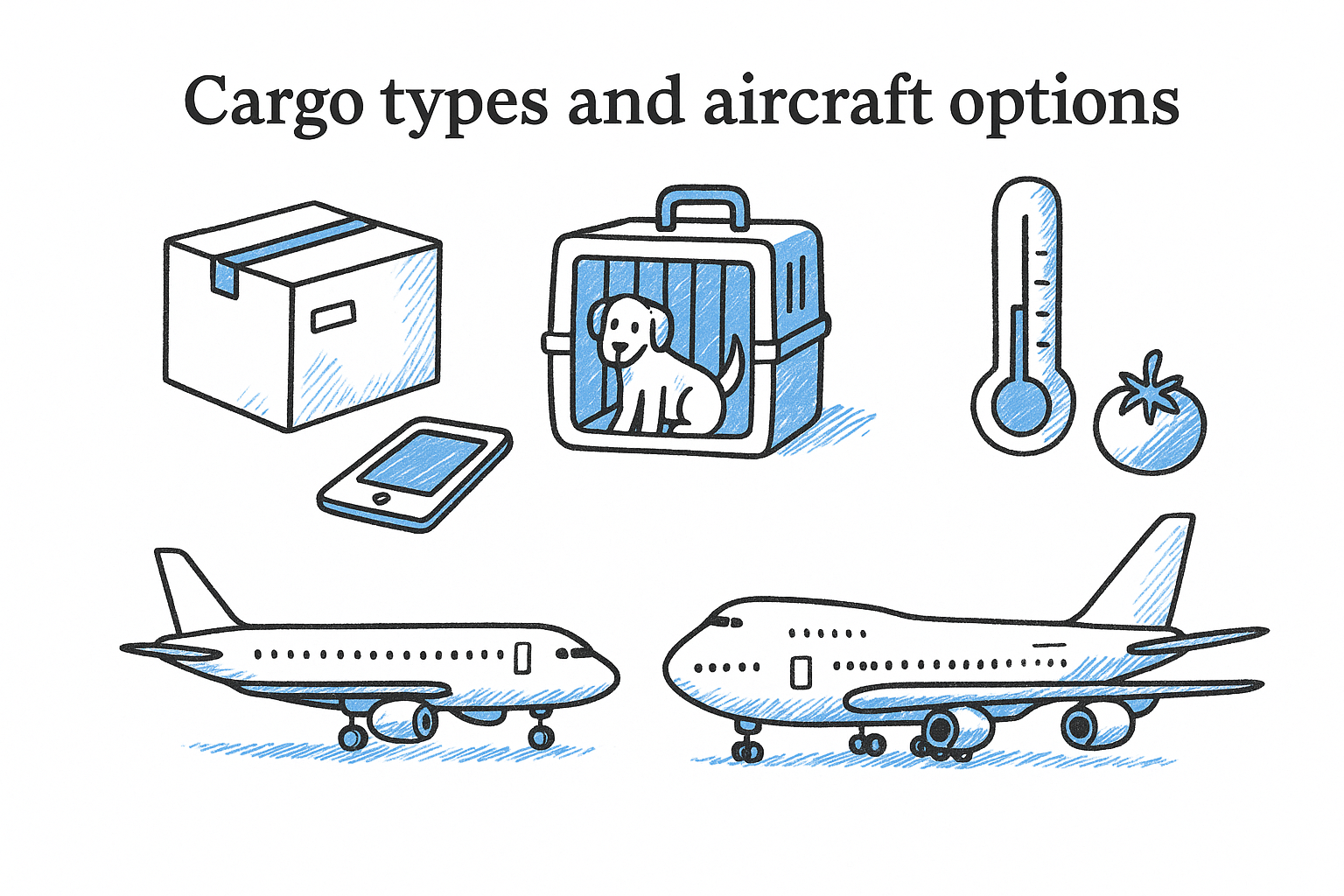
The aircraft type you select directly affects whether your cargo is technically loadable, which is why door dimensions, payload limits, and range all need to match your shipment specs before booking.
Your options on the aircraft side range from narrow-body freighters for smaller loads to wide-body aircraft like the Boeing 747F for high-volume or heavy shipments. Charter services give you full control over the aircraft and routing, while belly freight on scheduled services offers lower rates for smaller, non-urgent shipments. Knowing which configuration suits your cargo determines both your cost and your transit time.
Some goods need additional documentation, permits, or specialist handling to move by air. Dangerous goods (DG) must comply with IATA's Dangerous Goods Regulations, covering everything from lithium batteries to chemicals. Perishable and temperature-sensitive cargo requires pre-approved cold chain solutions and specific aircraft equipment to maintain product integrity throughout transit.
Common regulated cargo categories include:
Businesses choose air freight cargo when time and reliability matter more than cost. Whether you're managing a just-in-time supply chain or responding to unexpected demand, air freight gives you the transit speed and route flexibility that sea or road freight simply cannot match. For high-priority shipments, it remains the only realistic option.
For time-sensitive goods, air freight cuts transit times from weeks to days. Production stoppages, missed deadlines, and lost contracts all become more likely when freight is delayed. Air freight gives you consistently short, predictable transit windows that keep supply chains moving.
When a delayed shipment costs more than the freight itself, speed stops being a premium and becomes a necessity.
Common situations where businesses prioritise speed:
Moving goods faster means you carry less safety stock in your warehouses. Faster replenishment cycles let you respond to demand shifts without tying up capital in excess inventory.
For high-value products like electronics or pharmaceuticals, reducing storage time lowers the risk of damage, theft, or expiry, which directly protects your margins.
Air freight cargo rates are calculated on chargeable weight, which is the higher of the actual gross weight and the volumetric weight of your shipment. Carriers use this method because a large, light shipment occupies space that could otherwise carry heavier, more profitable cargo. Understanding this calculation upfront prevents surprises when you receive a quote.
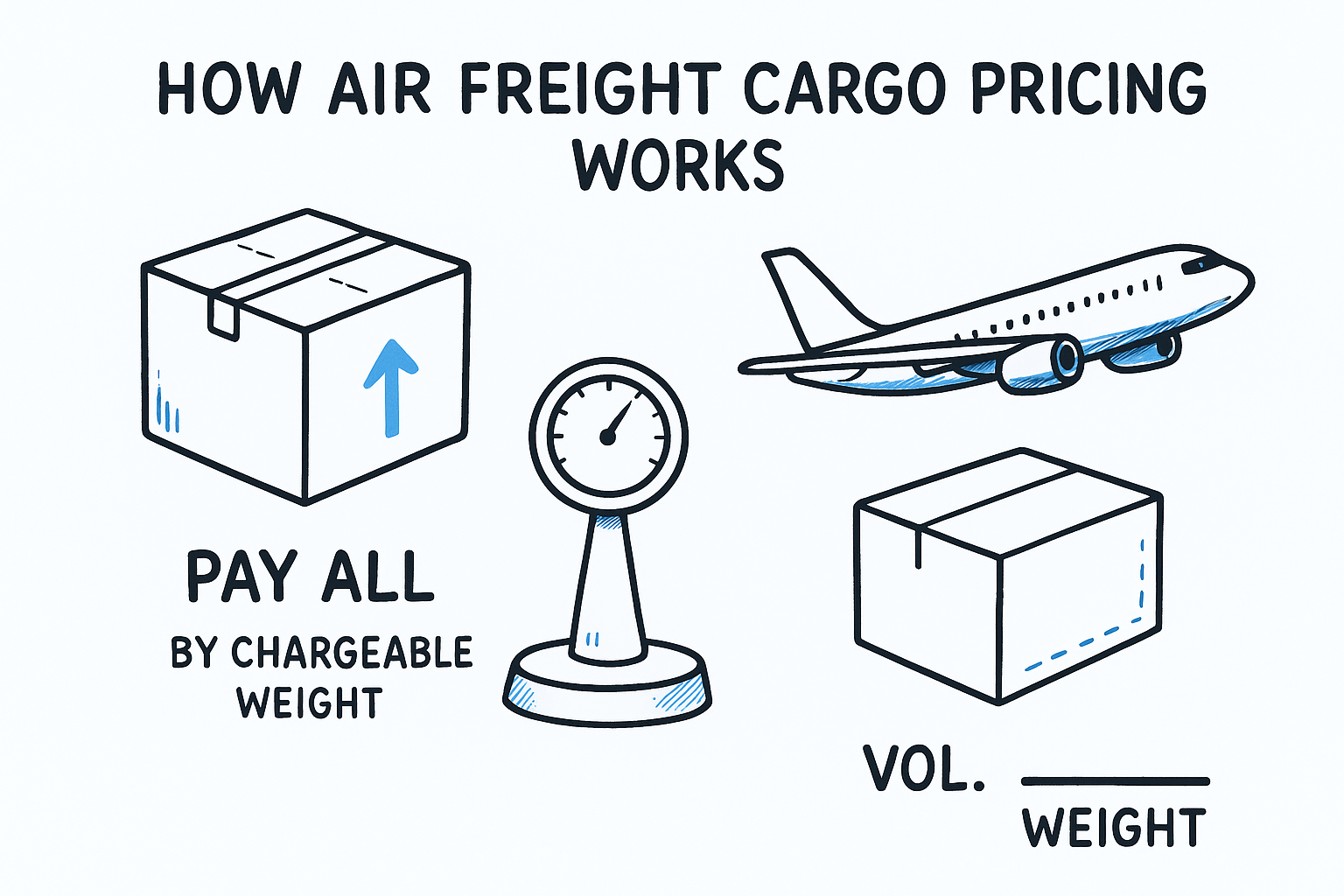
The standard volumetric weight formula divides length x width x height (cm) by 6,000, giving you the weight equivalent your carrier will price against.
Several variables drive the final rate you pay. Fuel surcharges fluctuate with oil prices and can represent a significant portion of your total cost. Route availability, aircraft type, and transit time all push rates up or down depending on demand and current market conditions.
Charter pricing operates differently from standard airfreight tariffs. You pay for the whole aircraft, giving you full control over routing and scheduling rather than fitting into a carrier's fixed timetable.
For large or urgent shipments, a dedicated charter often delivers better value per unit than multiple consolidated bookings on scheduled services.
Getting an accurate air freight cargo quote starts with having complete cargo details ready before you approach a carrier. You need commodity type, dimensions, gross weight, origin, destination, and any special handling requirements to get a rate that holds at booking. Incomplete information produces provisional estimates that shift once the full picture emerges.
The more precise your cargo data at the outset, the faster you move from quote to confirmed booking.
Manual quoting relies on brokers cross-referencing aircraft specs, checking route availability, and confirming payload feasibility by hand. Each step adds time, and errors in cargo dimensions or weight trigger renegotiation after the initial quote. For time-critical shipments, that back-and-forth carries real commercial risk.
Common causes of quoting delays:
Platforms like CharterSync replace that manual process by automatically matching your cargo specs against live aircraft availability. You get side-by-side comparisons, confirmed loadability, and transparent pricing in minutes rather than hours, giving you the certainty to commit quickly.
Your booking confirmation includes mass and balance checks and permit lead time assessments, so you are not discovering technical issues after you have already committed to a rate.
Most standard commercial goods move by air freight cargo without issue, but certain commodities require you to complete compliance checks before a carrier will accept your booking. Skipping these steps risks a shipment being held at origin or rejected entirely, which is far more disruptive than handling the paperwork upfront.
Confirming compliance before you book protects your delivery window and prevents last-minute rejections that can disrupt an entire supply chain.
Dangerous goods, lithium batteries, and temperature-controlled pharmaceuticals each fall under specific regulatory frameworks covering declaration, packaging, and handling. You need to verify your commodity's classification against IATA Dangerous Goods Regulations before approaching a carrier to confirm the shipment is acceptable.
High-value goods and live animals also require additional declarations before a carrier will confirm your booking. Live animals specifically need CITES compliance and welfare documentation suited to your destination country.
Before confirming your booking, run through these key checks to avoid costly delays:
Completing these checks early keeps your booking on track and avoids holding up confirmed capacity that you have already secured at a fixed rate.
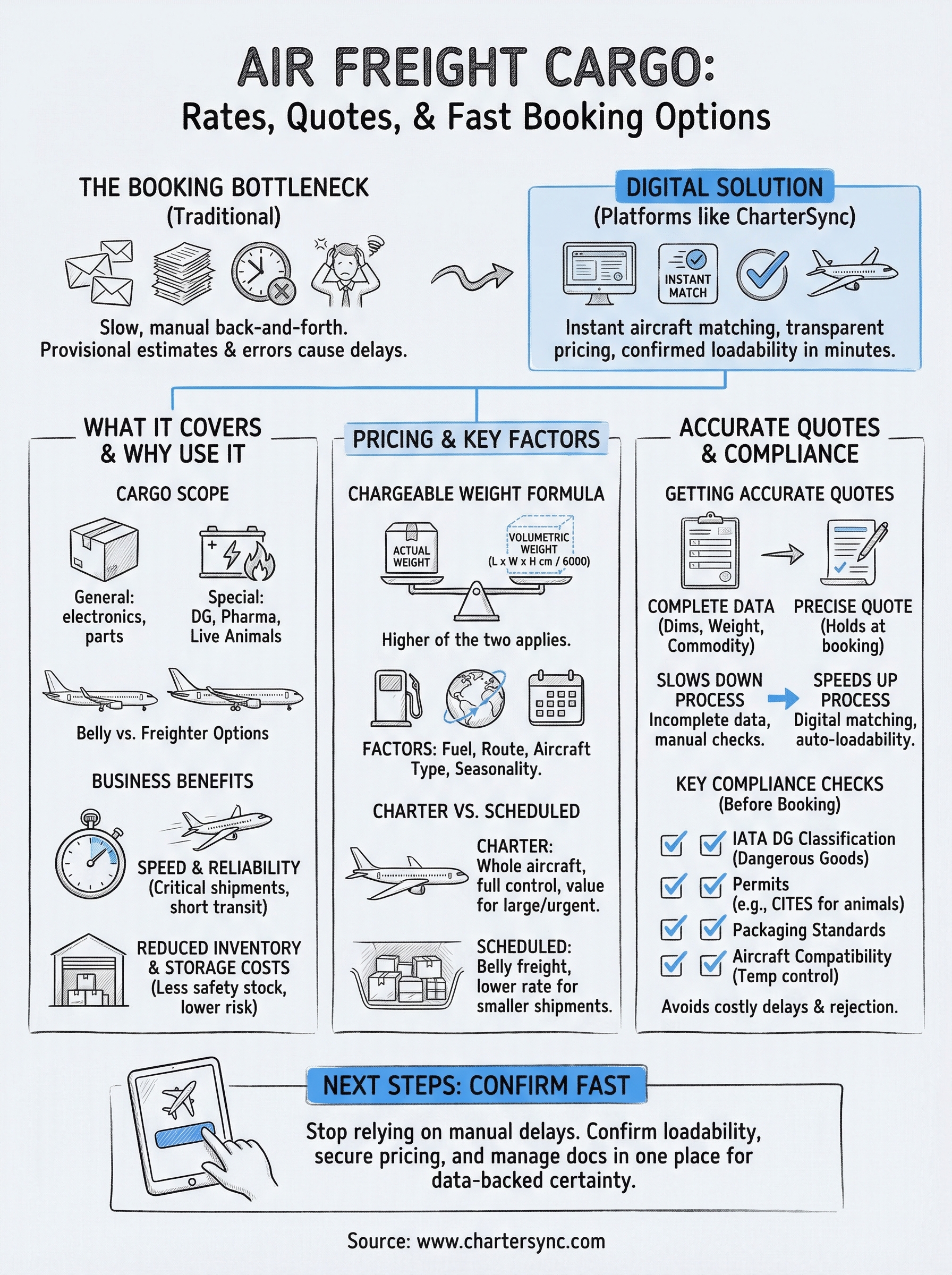
Air freight cargo moves fast, but the booking process behind it does not have to slow you down. You now know how rates are calculated, what drives quote accuracy, which compliance checks protect your shipment, and where the traditional process loses time. That knowledge lets you approach your next booking with a clearer picture of what to prepare and what to expect.
The practical next step is to stop relying on manual processes that introduce delays and provisional estimates into time-critical decisions. Confirming loadability, securing accurate pricing, and managing documentation in one place removes the friction that costs logistics professionals hours on every booking. If you handle urgent or high-value shipments regularly, that time adds up quickly.
Book your next air cargo charter on CharterSync and get confirmed aircraft matching, transparent quotes, and full loadability analysis in minutes, backed by expert support throughout the entire operation.

.png)