.png)
A cargo airline is an airline that operates aircraft exclusively, or primarily, for transporting freight rather than passengers. These carriers move everything from electronics and pharmaceuticals to oversized industrial equipment, forming the backbone of global supply chains that keep industries running.
Understanding how cargo airlines operate matters if you're a freight forwarder or logistics manager sourcing charter capacity. The aircraft types, payload limits, door dimensions, and route networks vary significantly between operators, and picking the wrong one can mean delays, failed loadability, or unnecessary cost. That's exactly the problem CharterSync solves: our platform uses AI-driven aircraft matching to pair your cargo specifications with the right operator and airframe, giving you confirmed technical feasibility in minutes rather than hours.
This article breaks down what cargo airlines do, how their operations work from booking to delivery, and which major operators dominate the market right now.
Global trade doesn't run on ships alone. Air freight accounts for roughly 35% of global trade by value, despite representing less than 1% by volume - a gap that tells you something important about what moves by air. The goods that travel this way are typically high-value, time-critical, or technically sensitive, and the cargo airline network is what keeps those goods flowing between manufacturers, distributors, and end customers across every continent.
When a production line stalls because a critical component hasn't arrived, or a pharmaceutical shipment must reach its destination within a narrow temperature-controlled window, surface freight is not an option. Air cargo can move goods across continents in under 24 hours, a capability no other transport mode matches. For freight forwarders managing urgent shipments, choosing the right cargo airline directly affects whether your client's deadline is met or missed.
The ability to move freight overnight across continents is not a premium add-on - it is a fundamental requirement for industries running lean, just-in-time supply chains.
Many markets, particularly in regions with limited road or rail infrastructure, depend almost entirely on air freight for rapid goods movement. A cargo airline with broad regional coverage can serve landlocked countries, remote production facilities, or humanitarian response zones where surface delivery is impractical or dangerously slow. Your access to these routes depends heavily on which operators you work with and whether their networks align with your specific origin and destination requirements. Understanding the landscape of operators, and their respective capabilities, is the first step to making faster, better-informed sourcing decisions.
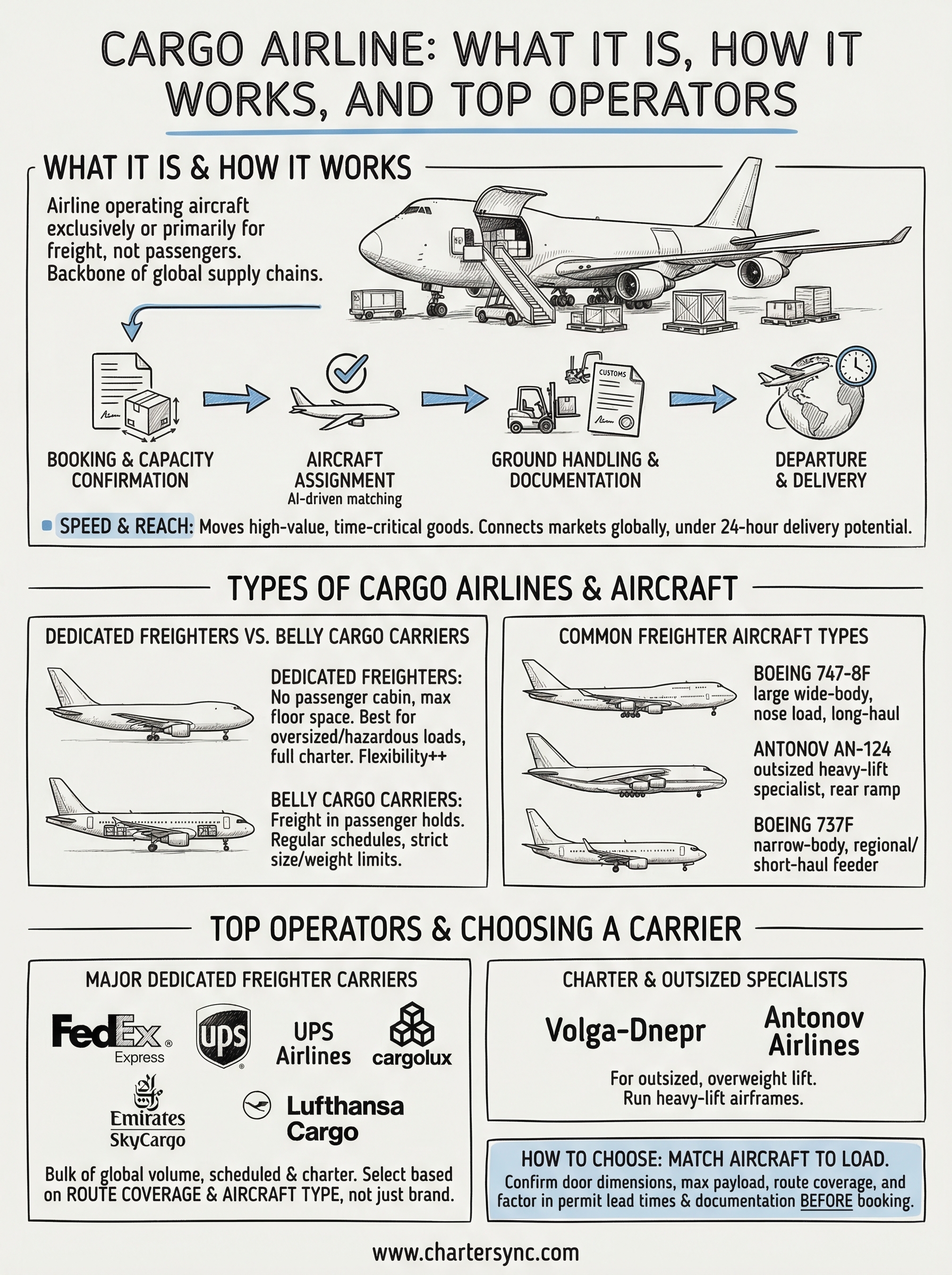
A cargo airline operates through a structured sequence that begins long before any aircraft leaves the ground. Booking and capacity confirmation come first, where the freight forwarder submits cargo dimensions, weight, and routing requirements so the operator can assess whether a suitable aircraft is available and technically feasible for the shipment.
Once you submit a cargo request, the operator checks aircraft availability, payload capacity, and door dimensions against your specific shipment profile. This matching step is critical because a mismatch here means your freight physically cannot board the aircraft, regardless of how urgently it needs to move.
Getting loadability confirmed before booking is what separates a smooth operation from a costly last-minute rebooking.
After confirmation, ground handling teams prepare the cargo using Unit Load Devices (ULDs) or loose-load configurations depending on the aircraft type and the nature of your goods. You also need to ensure that customs documentation, airway bills, and dangerous goods declarations are filed accurately before departure. Delays at this stage cascade through the entire operation, affecting departure slots and any onward logistics at the destination airport.
Not every cargo airline operates the same way, and understanding the distinctions helps you source capacity more efficiently. The two main structural categories are dedicated freighters and belly cargo carriers, and each comes with different capabilities, constraints, and cost profiles that affect what you can ship and how fast it can move.
Dedicated freighters operate aircraft configured exclusively for freight, with no passenger cabin and maximum usable floor space. These are your best option for oversized loads, hazardous goods, or shipments that need full aircraft charter capacity. Belly cargo carriers, by contrast, carry freight in the lower holds of passenger aircraft, offering regular scheduled frequency but strict size and weight limits dictated by the passenger airframe.
For time-critical or oversized cargo, dedicated freighter capacity nearly always outperforms belly hold options on flexibility.
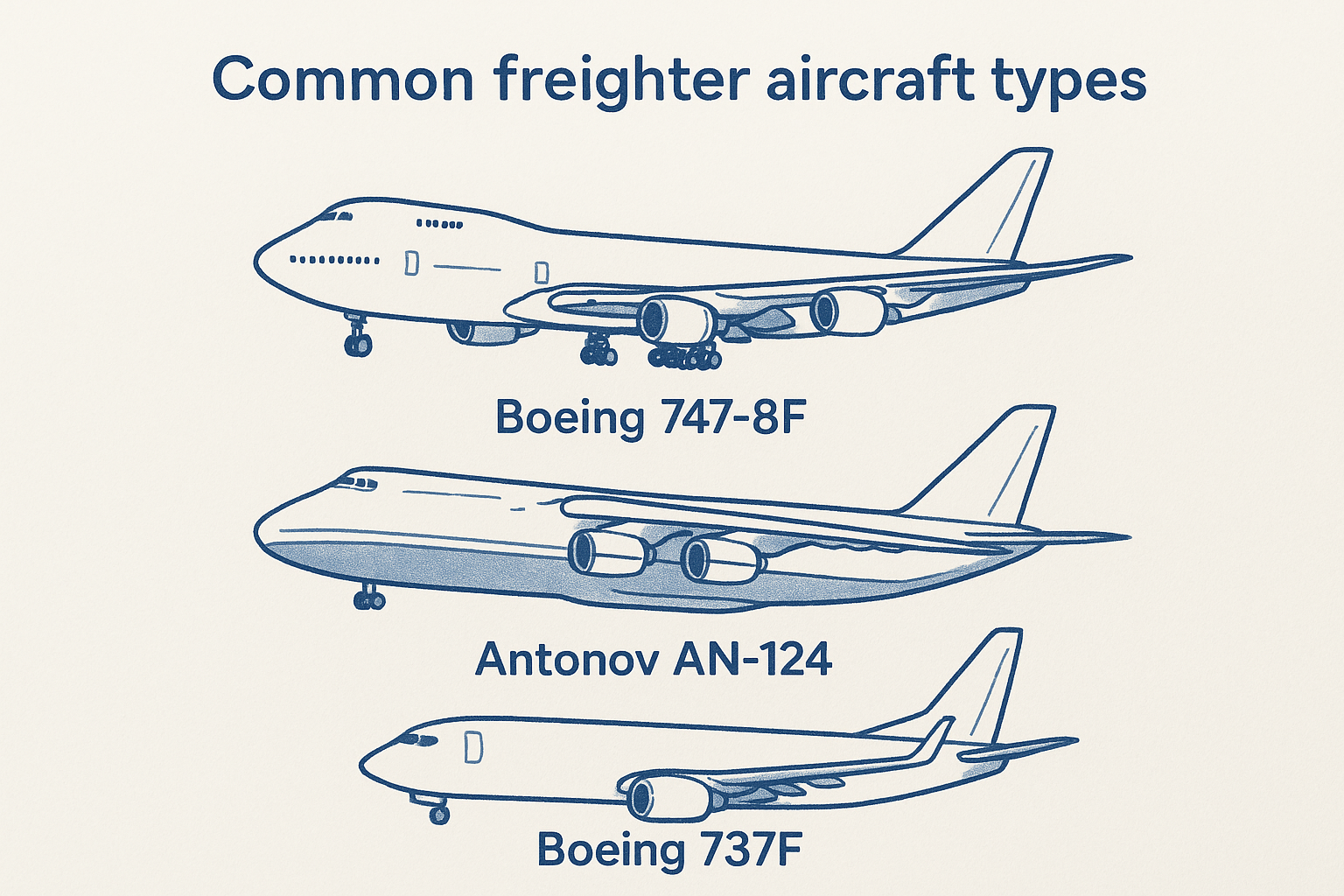
The aircraft type determines what your shipment can physically do on a given route. Matching your cargo dimensions and weight to the right airframe before you book prevents costly rerouting. The most widely used freighter aircraft include:
Knowing which cargo airline operators dominate the market helps you source capacity faster when a shipment needs to move urgently. Different carriers specialise in different regions, aircraft types, and cargo categories, so your shortlist should reflect your specific routing and load requirements rather than simply defaulting to the largest name.
The operators below handle the bulk of global air freight volume across both scheduled and charter services:
Carrier selection should always start with route coverage and confirmed aircraft type, not brand recognition alone.
For cargo that falls outside standard scheduled service parameters, charter operators such as Volga-Dnepr and Antonov Airlines provide outsized and overweight lift that scheduled carriers cannot accommodate. These operators run AN-124 and similar heavy-lift airframes, covering routes and payload requirements that no belly carrier or standard freighter can match.
Choosing the right cargo airline or charter operator starts with your shipment's specific technical profile. Before comparing rates, you need confirmed answers on three core points: whether your cargo physically fits the aircraft's door dimensions, whether the payload stays within the operator's certified limits, and whether their network covers your exact origin and destination pair without unnecessary transshipment adding time and risk.
Your cargo dimensions and weight should drive the aircraft selection, not the other way around. Outsized or overweight freight requires operators running heavy-lift airframes like the AN-124, while standard palletised goods fit most wide-body freighters. Confirm loadability and mass and balance calculations before you book to avoid costly rebooking or last-minute ground delays.
Key technical checks before selecting an operator:
Getting technical confirmation upfront is what separates a smooth operation from an expensive reroute.
Permit requirements and customs clearance timelines vary significantly by route and cargo type. Dangerous goods, temperature-sensitive shipments, and cross-border movements each carry specific documentation obligations that directly affect your departure slot. Build realistic lead time assessments into your operator selection process from the start, not as an afterthought once booking is confirmed.
Selecting the right cargo airline for a specific shipment comes down to technical precision and speed. You need confirmed loadability, accurate payload data, and route coverage aligned to your cargo before any booking makes sense. The operators and aircraft types covered in this article give you a solid reference point, but translating that knowledge into a fast, reliable charter booking requires the right tools backing your decision.
CharterSync removes the manual back-and-forth that slows traditional chartering down. The platform uses AI-powered aircraft matching to instantly check your cargo dimensions and weight against available airframes, confirms technical feasibility, and gives you comparable quotes side by side. You get confirmed availability and loadability analysis in minutes, not hours, with full documentation management built in from initial inquiry through to delivery. If you're ready to move faster on your next shipment, book your next air cargo charter with CharterSync and see exactly how it works.

.png)