.png)
An aircraft charter gives you exclusive use of a plane for a specific trip, no fixed schedules, no shared cargo space, no routing compromises. Whether you need to move time-critical freight across continents or fly a team to a location commercial airlines don't serve well, chartering puts you in control of the operation from departure to destination.
But the process behind booking a charter isn't always straightforward. Aircraft types vary widely in payload, range, and door dimensions. Costs shift based on routing, fuel prices, overflight permits, and repositioning. And getting accurate quotes traditionally meant hours of back-and-forth with brokers. That's exactly the problem we built CharterSync to solve, a digital platform that matches cargo specifications to verified aircraft availability in minutes, with full technical loadability confirmed upfront.
This article breaks down the core types of aircraft charter, what drives pricing, and how the booking process works step by step. Whether you're a freight forwarder arranging your first charter or a logistics manager comparing options, you'll walk away with a clear, practical understanding of how chartering actually works, and how to do it efficiently.
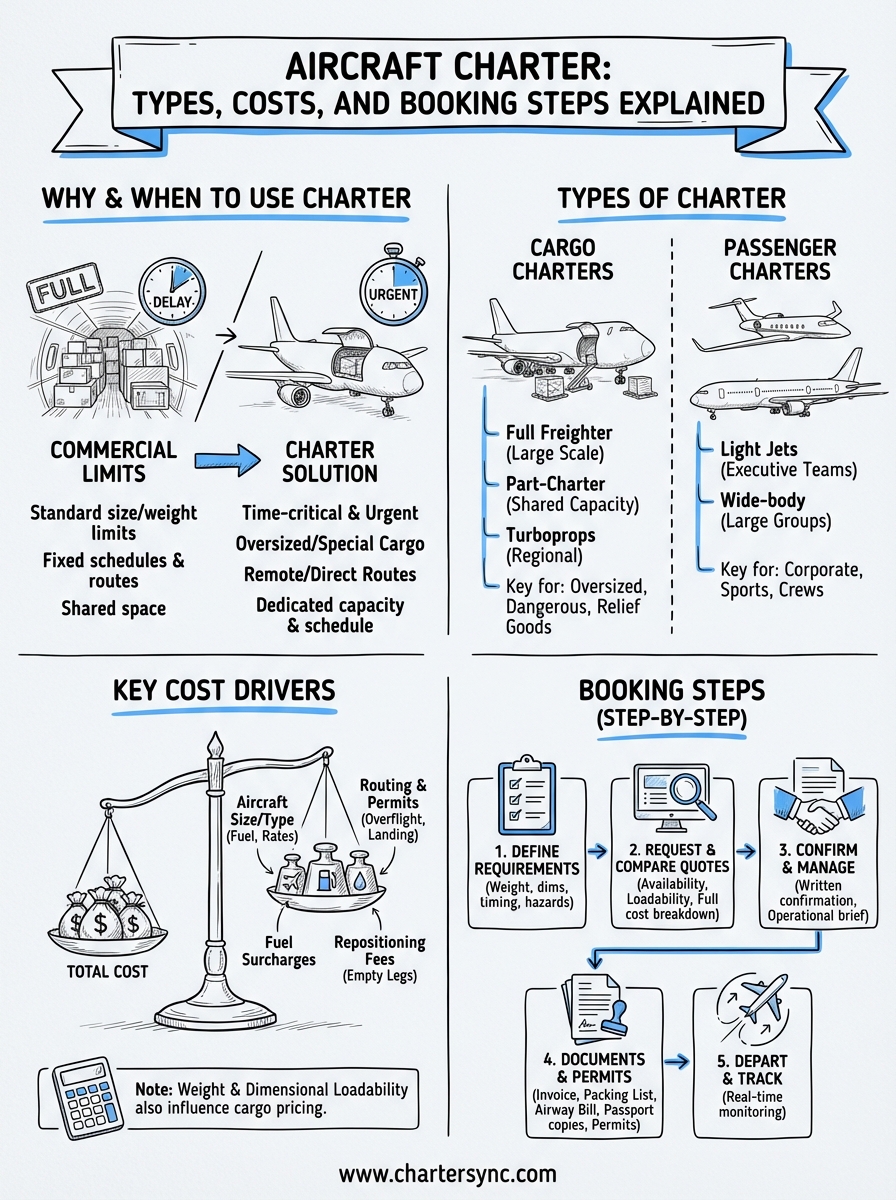
Commercial aviation works well for predictable, non-urgent freight that fits within standard size and weight limits. But commercial schedules and cargo holds aren't built around your shipment; they're built around passenger demand and network hubs. Aircraft charter fills that gap by giving you a dedicated aircraft that operates on your timeline, your route, and your terms, with no shared space and no routing compromises.
Some cargo simply cannot move through commercial channels. Oversized industrial equipment, live animals, dangerous goods, or humanitarian relief supplies often exceed the constraints of belly-hold freight or scheduled freighter services. In these cases, an aircraft charter isn't a premium option, it's the only practical one.
Chartering becomes necessary the moment your cargo's dimensions, weight, or urgency falls outside what commercial networks can reliably handle.
You'll also encounter situations where route availability makes commercial freight impractical. Remote destinations, landlocked regions, or locations served by a single carrier with infrequent departures can add days of delay to what should be a fast movement. Chartering lets you fly direct and cut transit time significantly.
Production line stoppages, medical supply chains, and disaster relief operations share one common factor: delay carries a direct, measurable cost. In manufacturing, a grounded production line can cost thousands per hour. In humanitarian response, timing and cargo capacity can determine whether aid reaches people effectively. These are precisely the scenarios where chartering delivers real operational value.
Beyond emergencies, project freight for oil, gas, and infrastructure industries often runs on strict installation windows. A charter gives you confirmed capacity and a defined schedule, so your project timeline stays intact rather than bending around commercial network constraints.
The aircraft charter market splits into two broad categories: cargo and passenger. Within each, you'll find several subtypes depending on the size, range, and configuration of the aircraft involved. Understanding which category fits your need is the first step toward getting an accurate quote and a technically sound operational plan.

Cargo charters cover everything from full freighter aircraft like the Boeing 747-8F for large-scale shipments to smaller turboprops for regional movements. You can book on a full charter basis, where the entire aircraft is exclusively yours, or a part-charter, where you share capacity with another shipper to reduce cost. The right option depends on your cargo's dimensions, total weight, and how quickly it needs to move.
Full charters give you confirmed space and a fixed schedule, which matters most when your shipment is time-critical or physically oversized.
Passenger charters range from light jets suited to small executive teams to wide-body aircraft for large group movements. Sports organisations, energy sector crews, and corporate travel teams commonly use this option when commercial schedules don't align with operational demands. You select the aircraft based on passenger count, required range, and destination accessibility.
Aircraft charter pricing doesn't follow a fixed rate card. The total cost of a charter depends on several variables that shift with every operation, route, and cargo type. Understanding these factors helps you assess whether a quote reflects genuine value or hides costs that surface later.
The biggest cost driver is rarely the aircraft itself. It is the combination of routing, repositioning, and permits that determines the final figure.
Several variables directly affect what you pay for a charter. Aircraft type and size set the baseline, as larger jets with greater range consume more fuel and command higher operator rates. Repositioning fees apply when the aircraft needs to fly empty to your departure point, which can add significant cost to one-way operations.
Fuel surcharges, overflight permits, and ground handling fees at both origin and destination all layer on top of the base rate. For cargo charters specifically, weight and dimensional loadability also influence pricing, since aircraft with larger door openings or higher payload ratings typically cost more per flight hour. Getting a quote that itemises each of these elements upfront is the clearest way to compare operators and avoid surprises.
Booking an aircraft charter follows a clear sequence. The more precisely you define your requirements at each stage, the faster you move from enquiry to confirmed operation.

Start by gathering the key specifications your operator needs: total weight, dimensions, hazardous goods classifications if applicable, and your required departure window. For cargo, accurate measurements and weight data prevent technical mismatches that delay confirmation.
The quality of your initial brief directly determines how accurate and comparable your quotes will be.
Send your specification to operators or use a digital platform like CharterSync to match your requirements against available aircraft automatically. Review each quote for confirmed availability, loadability analysis, and a full cost breakdown, including repositioning and permit fees.
Side-by-side comparisons help you identify the best technical and commercial fit. Look for quotes that confirm loadability and pricing in a single step rather than requiring follow-up exchanges.
Once you select an aircraft, confirm the booking in writing and ensure all parties hold the operational brief. From there, you complete the documentation and track your shipment in real time through delivery.
Every aircraft charter involves a set of documentation and regulatory requirements that must be completed before the aircraft departs. Missing paperwork or permit delays are among the most common reasons charters slip their departure windows, so addressing these early in the booking process protects your timeline.
Your operator will need a commercial invoice, packing list, and airway bill for cargo movements, along with any hazardous goods declarations if your shipment includes restricted materials. For passenger charters, passport copies and travel authorisations for all passengers should be submitted well in advance of departure.
Submitting complete documentation at the point of enquiry, not after booking, cuts the risk of last-minute delays significantly.
Overflight permits and landing rights can take anywhere from a few hours to several days to secure, depending on the countries involved in your routing. Some regions, particularly in the Middle East and Africa, require permits to be filed well in advance.
Your operator will typically manage permit applications on your behalf, but you should confirm this responsibility is clearly assigned at the time of booking to avoid any gaps in the operational plan.
Aircraft charter gives you a direct route around the limitations of commercial freight and passenger networks. Whether you're moving oversized industrial cargo, coordinating a time-critical delivery, or arranging group travel to a remote destination, the fundamentals stay the same: match your requirements to the right aircraft, get a full cost breakdown upfront, and complete your documentation early to protect your departure window.
The process works best when you have accurate cargo data from the start and a clear view of every cost before you commit. Getting that clarity traditionally took hours of back-and-forth with brokers. Today, it doesn't have to.
If you're arranging a cargo charter and want confirmed aircraft availability and technical loadability analysis in minutes, request a quote through CharterSync and see how the platform turns a slow, manual process into a fast, data-backed decision.

.png)