.png)
An air charter is the hire of an entire aircraft for a specific flight or series of flights, rather than purchasing individual seats on a scheduled service. It gives shippers and travellers full control over routing, timing, and capacity, which is exactly why freight forwarders and logistics teams turn to charters when standard airfreight options fall short.
Whether you need to move oversized machinery to a remote airstrip, relocate urgent spare parts overnight, or fly a delegation on a fixed schedule, chartering puts the operation on your terms. But the process has historically involved back-and-forth emails, provisional estimates, and limited visibility into aircraft availability. That's the problem CharterSync was built to solve, replacing manual brokerage with a digital platform that matches cargo to confirmed aircraft in minutes, complete with loadability analysis and transparent pricing.
This article breaks down what air charter actually means, the main types available, what drives cost, and how the booking process works from first enquiry to wheels-up. If you're evaluating whether a charter is the right move for your next shipment or flight, you'll find the practical detail you need here.
Businesses turn to air charter when scheduled services can't meet the deadline, or when the cargo simply won't fit within the constraints of a commercial flight. The core appeal is full operational control: you set the route, the timing, and the capacity, rather than working around an airline's fixed schedule. That makes a charter a practical tool for anyone operating in time-sensitive or non-standard logistics scenarios.
Production lines, medical equipment deliveries, and humanitarian relief operations all share one characteristic: a delay has serious operational or financial consequences. When a factory shuts down waiting for a spare part, or a hospital needs urgent equipment on-site, a charter flight can be sourced, loaded, and airborne within hours. You're not dependent on the next available scheduled departure or subject to the cargo cut-off times that commercial airlines impose.
An air charter can compress a multi-day logistics problem into a same-day solution when the timeline leaves no margin for error.
Getting confirmed availability quickly matters as much as the flight itself. Knowing the aircraft exists, is correctly positioned, and can technically carry your load removes the uncertainty that manual brokerage typically introduces at the worst possible moment.
Standard belly cargo and commercial freighter services set strict limits on dimensions, weight, and cargo type. If your shipment includes industrial machinery, wind turbine components, live animals, or dangerous goods that need special handling, a dedicated charter gives you the flexibility to select an aircraft matched to your exact cargo profile. You choose the right aircraft for the load, not the other way around.
Technical loadability checks that confirm door dimensions, floor strength, and payload capacity before booking eliminate the risk of discovering a fit problem at the ramp on departure day.
The air charter market splits into several distinct categories. Knowing which type fits your operation shapes every subsequent decision, from the aircraft you select to the cost structure you should expect and the documentation you need to prepare.
Cargo charters dedicate the entire aircraft to freight. You can access full-freighter aircraft such as the Boeing 747F or Antonov AN-124 for heavy or oversized loads, or smaller turboprops for routes into airstrips where commercial services don't operate. The key advantage is that you control the hold configuration and can load specialist cargo that standard services won't accept.
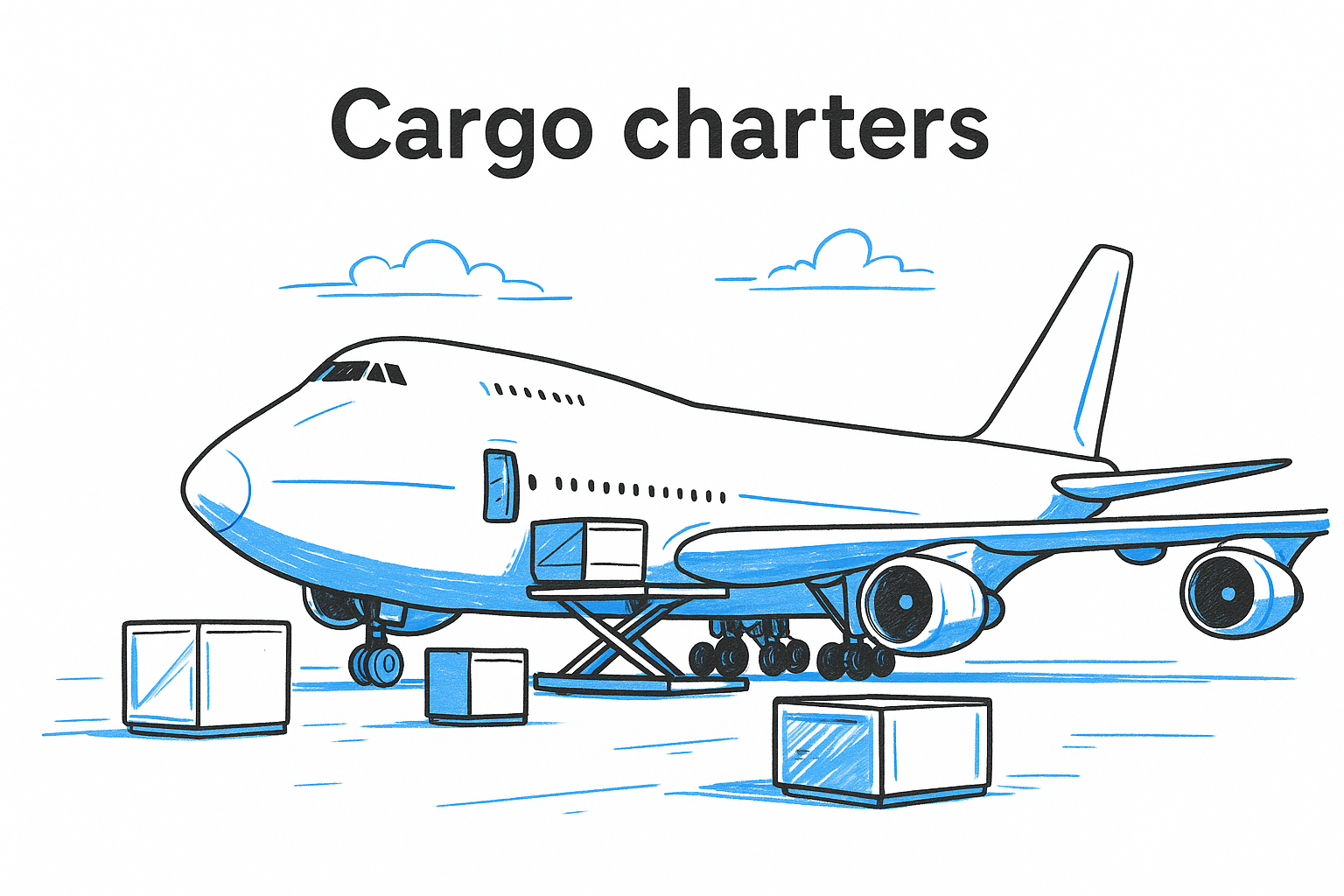
Confirming technical loadability before you book removes the risk of a fit problem appearing at the ramp on departure day.
Passenger charters cover everything from private jet hire for small executive groups to wide-body jets for sports teams or large delegations. You book the full cabin, set the schedule, and fly directly between the airports that suit you, bypassing hub connections entirely.
An ad hoc charter covers a single flight arranged at short notice. A series charter locks in multiple legs on a recurring schedule, which suits regular freight lanes or seasonal passenger demand. Series agreements typically reduce the per-flight cost compared to booking each leg independently.
Air charter pricing varies widely because every flight is priced individually based on the specific aircraft, route, and operational requirements. A light turboprop charter for a short domestic leg will cost far less than a wide-body freighter operating across multiple continents. Expect to pay anywhere from a few thousand pounds for a short private jet hop to several hundred thousand pounds for a heavy-lift cargo operation.
Several variables drive the final quote you receive. Aircraft type and size sit at the top of the list, since larger aircraft consume more fuel and carry higher crew and maintenance costs. Routing and distance matter too, particularly when the aircraft needs to reposition empty before or after your flight, which adds cost to the overall operation.
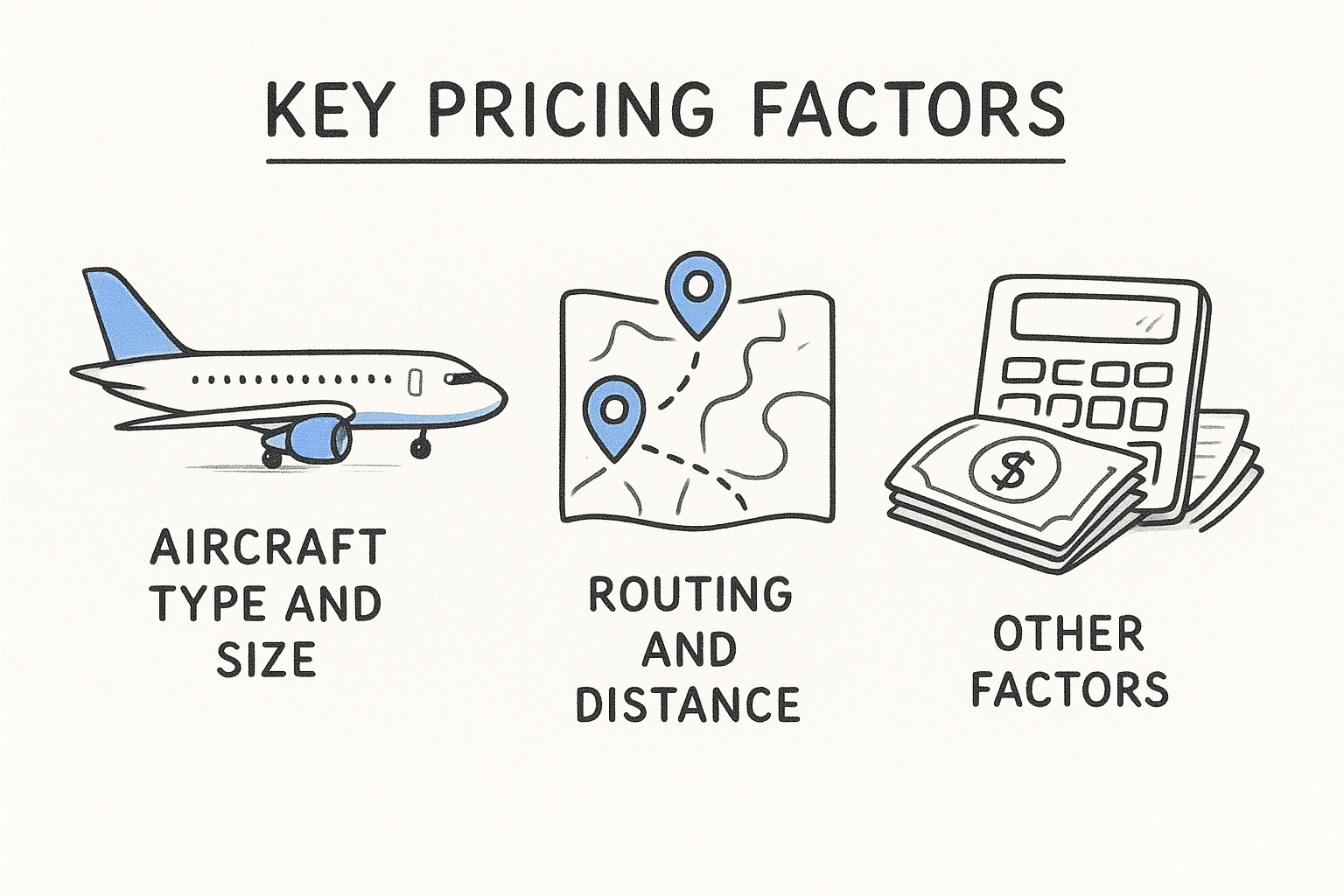
Repositioning fees, known as empty legs, can make up a significant portion of the total charter cost, so always confirm whether they are included in your quote.
Other factors include airport handling fees, permits for international routes, and any specialist ground equipment your cargo requires. Comparing quotes side by side with full cost breakdowns, rather than headline figures alone, gives you an accurate picture of the total spend before you commit.
Booking an air charter follows a logical sequence, and knowing each step before you start keeps the whole process moving without costly delays. The faster you can supply accurate cargo or passenger information upfront, the faster you receive confirmed aircraft availability and pricing from your provider.
Before you contact any provider, gather the core details: cargo dimensions, weight, origin, destination, and required delivery window. For passenger charters, confirm your group size and preferred departure times. Having this information ready from the start means your enquiry generates a usable, accurate quote rather than a holding reply asking for more data.
Submit your requirements and compare the full cost breakdown, not just the headline figure. Check whether repositioning fees, handling charges, and international permits are included. A quote that omits these costs will look cheaper but rarely is.
Always ask for written confirmation of aircraft availability and technical loadability before you commit to any booking.
Once you select an aircraft, sign the charter agreement and prepare the required documentation, including cargo manifests, permits, and customs paperwork where applicable. Your provider should guide you through any specialist requirements specific to your route or cargo type before departure.
Selecting the right partner for your air charter matters as much as selecting the right aircraft. The provider controls access to operators, handles critical documentation, and takes responsibility for every quote they issue. A weak link here creates problems at every stage that follows.
Reputable providers work with licensed aircraft operators and hold recognised industry accreditations. Before you commit, confirm the following:
A provider that cannot confirm technical loadability upfront is giving you an estimate, not a guarantee.
Your provider should supply full cost breakdowns before you commit, covering all fees including repositioning and handling charges. Platforms that offer side-by-side aircraft comparisons with confirmed availability and loadability analysis remove the guesswork that manual brokerage typically introduces.
Asking for written confirmation of aircraft availability before you sign anything is a straightforward test of how a provider operates. If the quotes arrive without technical detail attached, treat that as a gap worth questioning before you proceed.
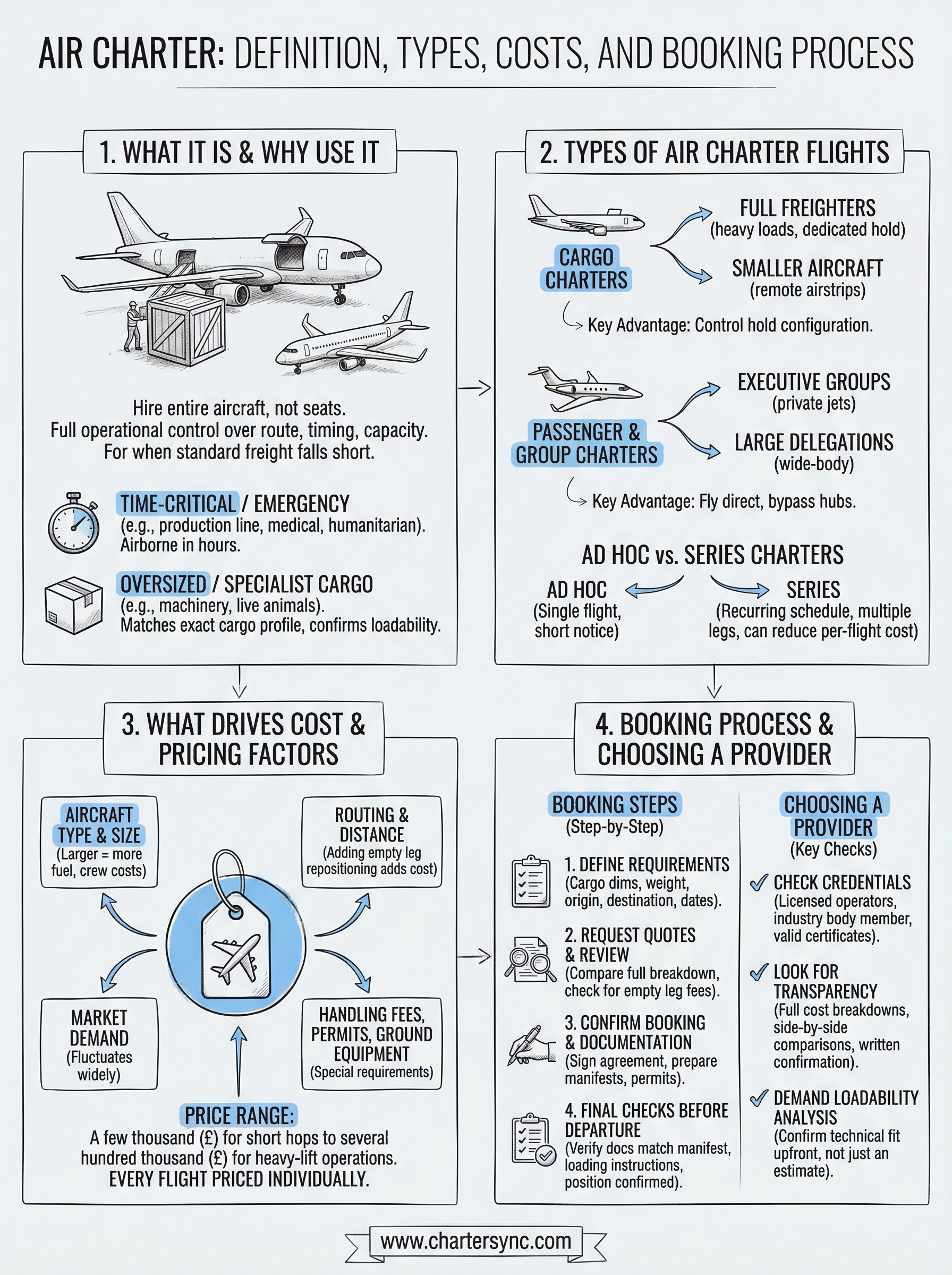
Before your air charter departs, run through a short checklist to confirm everything is in order. Verify that your cargo documentation matches the aircraft manifest, that any required permits are confirmed in writing, and that your ground handling team has everything they need at origin. A missing document or an unresolved permit at this stage can ground your operation just as effectively as an aircraft fault.
Your provider should confirm final loading instructions and any weight distribution requirements before departure day. Ask for written confirmation that the aircraft is positioned and ready, rather than relying on verbal assurances. Small gaps in communication at this stage have a habit of becoming expensive delays once you're at the ramp.
If you want to remove the uncertainty from this entire process, from initial enquiry through to final delivery, CharterSync gives you confirmed aircraft availability, full loadability analysis, and transparent pricing in minutes rather than hours.

.png)