.png)
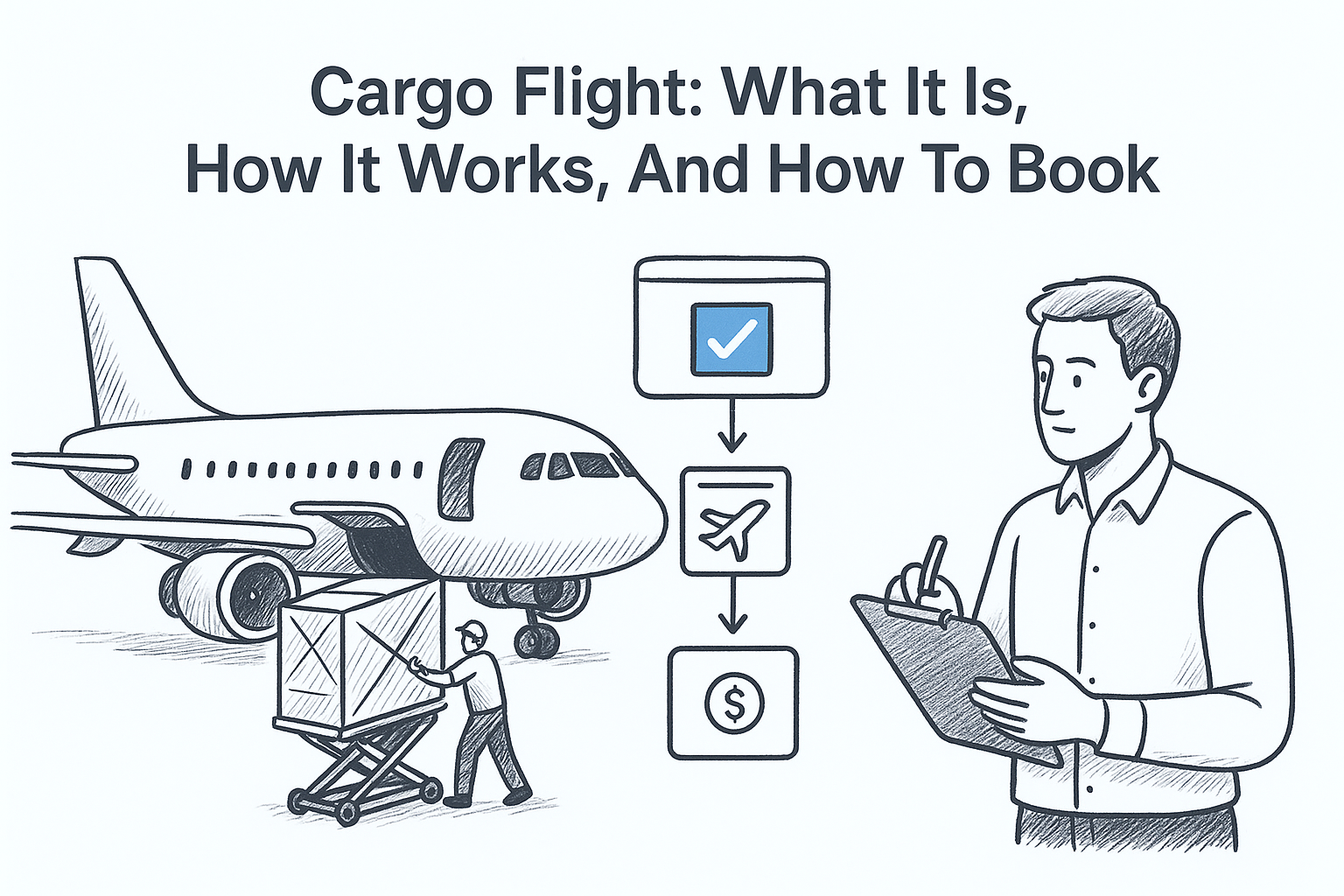
A cargo flight is any aircraft operation dedicated to transporting goods rather than passengers. That sounds simple enough, but the mechanics behind it, from aircraft selection and loadability checks to permits and routing, involve a level of complexity that catches many first-time charter buyers off guard.
Whether you're a freight forwarder quoting a client on an urgent shipment or a logistics manager trying to move oversized equipment across continents, understanding how cargo flights actually work gives you a real edge. It helps you ask better questions, compare options with confidence, and avoid costly mistakes that stem from incomplete information.
This guide breaks down the fundamentals: what cargo flights are, the different aircraft types used, how the booking process works from inquiry to delivery, and what to look for in a provider. We'll also explain how platforms like CharterSync use AI-driven aircraft matching and real-time tracking to cut through the manual back-and-forth that has traditionally slowed the chartering process down.
A cargo flight carries freight, not people. The aircraft operates on a specific route to move goods, equipment, or materials from origin to destination, with no passenger cabin in use. That distinction matters more than it might seem, because cargo operations follow different regulations, handling requirements, and aircraft configurations than commercial passenger flights.

Not every flight that carries freight is a dedicated cargo flight, and that difference directly affects pricing, lead time, and what you can actually ship.
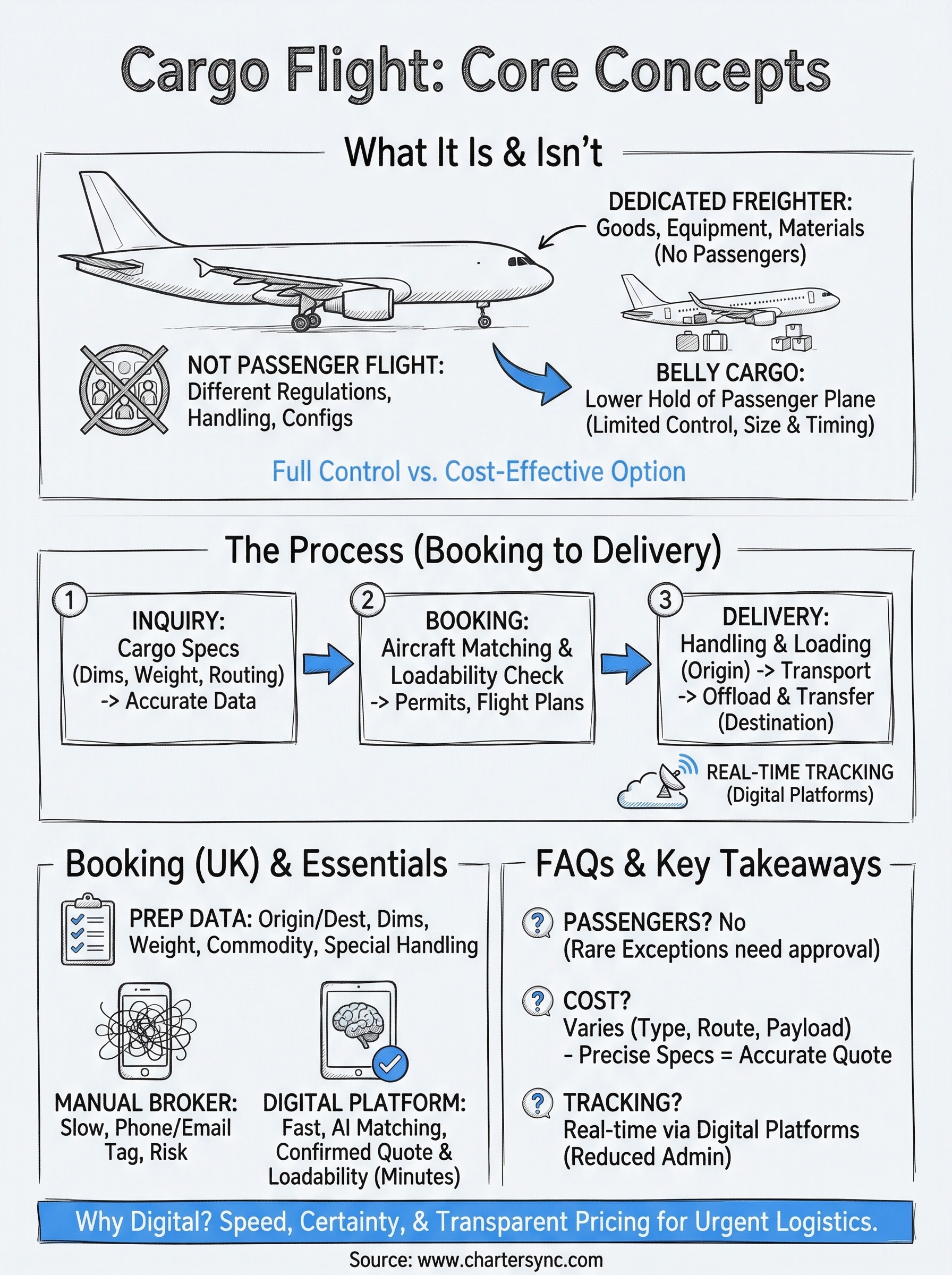
Dedicated freighters are aircraft built or converted specifically to carry cargo. They have no passenger seats, a reinforced main deck, and large cargo doors that allow loading teams to bring freight directly onto the aircraft. Types like the Boeing 747-8F or Antonov AN-124 sit in this category. When you book a full charter on one of these aircraft, you control the entire payload, departure timing, and routing to match your shipment's exact requirements.
These aircraft handle everything from palletised general cargo to outsize equipment that will not fit anywhere else. Hazardous materials, live animals, and temperature-sensitive goods each come with specific handling requirements that a dedicated freighter can accommodate without compromise.
Belly cargo is freight carried in the lower hold of a passenger aircraft, alongside checked luggage. Airlines sell this unused space to freight forwarders as a cost-effective option for smaller, standard shipments. Your control over timing, routing, and shipment priority is limited here, because passenger schedules and operational decisions always take precedence over what sits in the hold.
For urgent, oversized, or high-value consignments, belly cargo rarely meets requirements. That is precisely where a dedicated cargo flight becomes the operational choice rather than just one option among several.
Global supply chains run on speed and reliability. When a production line stalls because a critical component is sitting in a warehouse on the wrong continent, air freight is often the only realistic answer. A dedicated cargo flight gives logistics teams the control to move goods on their own schedule, not around someone else's passenger timetable or network constraints.
When every hour of delay translates directly into financial loss, having access to a confirmed aircraft makes the difference between keeping a contract and losing it.
Standard freight services work well for predictable, planned shipments with flexible timelines. Charters fill a different function: they exist for situations where standard options cannot deliver fast enough or handle the cargo type. Think humanitarian relief shipments, industrial equipment for an offshore platform, or automotive parts needed to restart a stalled production line.
Your ability to secure a charter quickly, with confirmed loadability and accurate cost data, directly affects operational outcomes for your clients and your business. The procurement process has become as important as the flight itself, which is why more logistics professionals now look to digital platforms to speed up what was once a painfully slow manual exercise.
The process starts before the aircraft ever leaves the ground. You submit your cargo details, including dimensions, weight, and routing, and the system matches that data against available aircraft to identify technically viable options.

The difference between a smooth operation and a costly delay often comes down to how accurately you define the shipment at the inquiry stage.
Once you receive aircraft options and pricing, you compare them against your timeline and budget. A loadability check confirms that your cargo physically fits within the aircraft's door dimensions and payload capacity. You then confirm the booking, and the operator files the necessary flight plans and permits for your routing.
On the day of the flight, your cargo goes through handling agents at the origin airport, where it is weighed, packed to specification, and loaded onto the aircraft. The cargo flight departs on the agreed schedule and arrives at the destination, where local handling teams offload and transfer your goods to the next leg of the supply chain. Real-time tracking lets you monitor each stage without chasing updates manually.
Booking a cargo flight in the UK begins with accurate shipment data. Before you approach any operator or platform, confirm your cargo dimensions, gross weight, and routing details for the consignment. Vague or incomplete information at the inquiry stage leads to inaccurate quotes and avoidable delays further down the process.
The more precise your cargo specifications from the outset, the faster you receive a technically confirmed quote.
Your inquiry should include origin and destination airports, cargo dimensions, total weight, commodity type, and any special handling requirements such as temperature control or dangerous goods classification. Preparing this in advance saves significant time.
Traditional brokers handle bookings manually, meaning multiple phone calls and emails before you see a confirmed quote. For standard shipments with flexible timelines, this process may be workable, but for urgent cargo it introduces unnecessary operational risk.
Digital platforms match your cargo specifications against available aircraft automatically. You receive loadability analysis and accurate pricing in minutes rather than hours, which makes a measurable difference when your consignment is time-sensitive.
Before you commit to a cargo flight booking, a few questions tend to come up repeatedly among logistics professionals. The answers below cover the three most common areas of uncertainty.
In most cases, no. Dedicated freighters are not certified to carry passengers, and regulations in most jurisdictions prohibit it. Some older aircraft configurations allowed a small number of supernumerary seats for authorised crew or technical staff, but this is rare and subject to strict regulatory approval. If you need to accompany a shipment, discuss this with your operator at the inquiry stage.
Charter costs vary based on aircraft type, routing, distance, and payload requirements. A short-haul freighter charter might start from a few thousand pounds, while a long-haul heavy freighter can run to six figures.
The most reliable way to get an accurate figure is to submit precise cargo specifications rather than estimates.
Modern digital platforms provide real-time status updates throughout the operation, from departure confirmation through to final delivery. You receive notifications at each key stage without needing to contact the operator directly, which removes a significant administrative burden from your team.
You now have a clear picture of what a cargo flight involves, how the booking process works, and what to prepare before you submit an inquiry. Knowing the difference between a dedicated freighter and belly cargo, understanding how loadability checks and permit requirements affect your timeline, and recognising where digital tools outperform manual brokers all give you a stronger position when arranging your next shipment.
Slow, manual broker processes cost you time you often do not have, especially when your freight is urgent and your client is waiting on confirmation. Digital platforms remove that bottleneck by delivering confirmed availability, loadability analysis, and transparent pricing in minutes rather than hours, which is a measurable improvement over the traditional approach.
Start your inquiry with CharterSync and receive confirmed aircraft options with accurate pricing without the back-and-forth. Your team gets the speed and certainty it needs to keep operations on schedule.
.png)