.png)

When standard airfreight schedules can't accommodate your shipment, whether due to size, weight, urgency, or destination, an air cargo charter becomes the practical solution. Unlike scheduled cargo services that operate on fixed routes and timetables, chartering gives you exclusive use of an aircraft tailored to your specific requirements.
For freight forwarders and logistics professionals handling time-critical or oversized cargo, understanding how air cargo charters work is essential. The process involves matching your shipment specifications to the right aircraft, obtaining accurate quotes, and confirming technical feasibility before committing, steps that traditionally required hours of phone calls and emails.
This guide breaks down what air cargo chartering involves, the aircraft types available, and the factors that determine pricing. At CharterSync, we've built a digital platform that streamlines this entire process, but first, here's what you need to know before arranging your next charter.
Standard airfreight works well for routine shipments, but logistics operations frequently encounter situations where scheduled services simply don't align with your operational needs. An air cargo charter becomes the difference between meeting your commitments and facing costly delays, penalties, or reputational damage with your clients.
Commercial cargo flights operate on fixed schedules that rarely accommodate urgent deadlines. If your customer needs machinery parts delivered within 48 hours to avoid production downtime, or medical supplies rushed to a remote location, you can't afford to wait for the next available scheduled flight. Chartering puts you in control of departure times and routing, eliminating layovers and connection delays that add days to transit times.
The same logic applies when your cargo exceeds standard aircraft dimensions. Oil and gas components, industrial turbines, or aerospace structures often require aircraft with specific door heights and cargo hold configurations that scheduled services don't provide. You need guaranteed space without dimensional restrictions.
Chartering shifts control from airline schedules to your operational requirements.
Many freight forwarders hesitate at charter costs without considering the alternative financial impact. Production downtime at a manufacturing facility typically costs thousands per hour. Missing a project deadline can trigger contractual penalties far exceeding charter expenses. When you calculate the true cost of delay, including reputational damage and lost business, dedicated aircraft capacity becomes the economically rational choice.
Charters also serve markets where scheduled cargo capacity is limited or non-existent. Mining sites, construction projects in developing regions, and humanitarian operations operate in locations that commercial carriers rarely service. Your shipment moves point-to-point without transshipment risks, reducing handling damage and ensuring chain of custody for high-value goods.
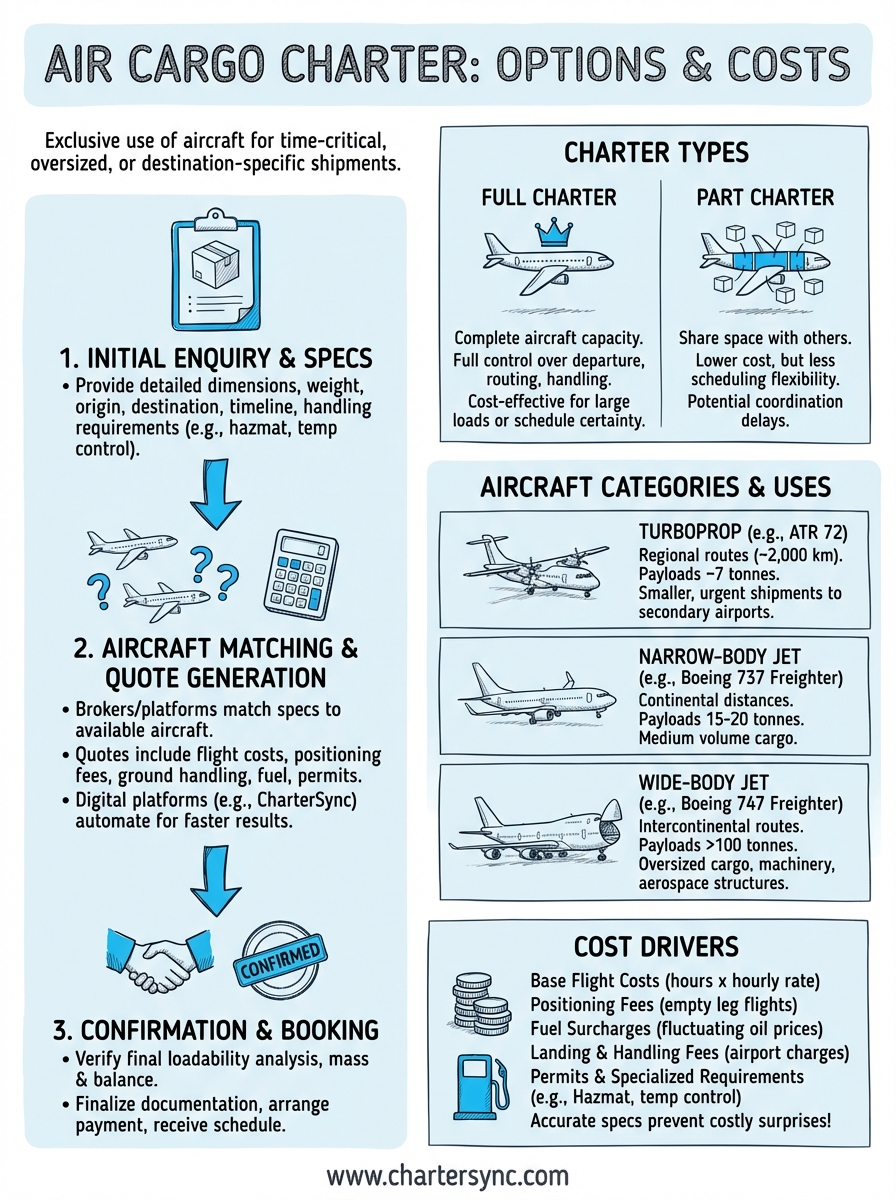
Arranging an air cargo charter follows a structured process that moves from your initial specifications through to confirmed booking. Understanding each stage helps you prepare the necessary documentation and avoid delays that could compromise your shipment timeline. The entire workflow typically involves three distinct phases that determine aircraft suitability, cost, and operational feasibility.
You begin by providing detailed cargo information: dimensions, weight, origin, destination, and required delivery timeline. This includes packing list details, handling requirements (such as temperature control or hazmat classifications), and any access restrictions at departure or arrival airports. The more precise your specifications, the faster you receive accurate aircraft options that match your operational needs.
Charter brokers or platforms analyze your requirements against available aircraft inventory, considering door dimensions, payload capacity, range, and current positioning. You receive quotes that detail flight costs, positioning fees if the aircraft needs to reposition, ground handling, fuel, and permit requirements. Traditional brokers take hours to compile this information manually, while digital platforms like CharterSync automate the matching process to deliver confirmed options within minutes.
Accurate technical matching prevents costly surprises after you've committed to a charter.
Once you select an aircraft, the operator confirms final loadability analysis and mass and balance calculations. You finalize documentation, arrange payment terms, and receive flight schedules with crew assignments and handling instructions at both ends.
You select from two primary charter models depending on your cargo volume and budget constraints. Full charters give you complete aircraft capacity, while part charters let you share space with other shipments heading to similar destinations. Your choice affects not only pricing but also scheduling flexibility and cargo security protocols.
A full charter reserves the entire aircraft for your exclusive use, giving you control over departure times, routing, and handling procedures. You pay for the complete aircraft capacity regardless of whether you fill every cubic metre, making this option cost-effective when your shipment approaches the aircraft's maximum payload or when you need absolute schedule certainty.
Part charters split costs among multiple customers booking space on the same flight. You access charter flexibility at lower cost but sacrifice some scheduling control and may encounter coordination delays if other parties aren't ready when you are.
Part charters work best when your timeline allows coordination with other shipments.
Turboprop aircraft like the ATR 72 handle regional routes up to 2,000 kilometres with payloads around 7 tonnes, suitable for smaller urgent shipments to secondary airports. Narrow-body jets such as the Boeing 737 freighter carry 15-20 tonnes across continental distances. Wide-body aircraft including the Boeing 747 freighter transport oversized cargo exceeding 100 tonnes on intercontinental routes, accommodating machinery that won't fit through standard cargo doors.

Air cargo charter pricing operates differently from scheduled freight rates because you pay for dedicated aircraft capacity rather than per-kilogram charges. Understanding the cost components helps you evaluate quotes accurately and identify where you can negotiate or optimize your charter arrangements. Several variables affect the final price, from flight distance to aircraft availability.
The flight hours from origin to destination form your primary cost, calculated using the aircraft's hourly operating rate multiplied by total flight time. You also pay positioning fees if the aircraft needs to reposition from its current location to your departure airport, essentially paying for empty legs before and potentially after your cargo moves. Operators with aircraft already stationed near your origin point offer better rates because they eliminate or reduce these repositioning expenses.

Positioning fees can add 30-50% to your charter cost when aircraft are distant from your departure point.
Beyond flight time, you cover fuel surcharges that fluctuate with global oil prices, landing and handling fees at departure and arrival airports, and permit costs for international flights. Specialized requirements such as temperature-controlled cargo holds or hazmat certifications add equipment and compliance costs.
Getting reliable pricing for an air cargo charter requires complete cargo specifications upfront. Incomplete or approximate measurements lead to revised quotes after you've committed, potentially doubling your costs when the operator discovers your shipment won't fit the proposed aircraft. You need to provide exact dimensions, total weight, packing configurations, and any special handling requirements before receiving a binding quote.
Prepare your packing list with individual piece dimensions, including height, width, and length for each item. Operators need this data to calculate whether your cargo fits through aircraft doors and positions correctly in the hold. Include photos of oversized items whenever possible, showing any protruding elements or irregular shapes that standard measurements don't capture. Hazmat declarations, temperature requirements, and customs documentation affect aircraft selection and permit costs.
Request loadability analysis that confirms your cargo physically fits the selected aircraft, not just weight calculations. Ask for mass and balance confirmations showing how the operator plans to distribute your shipment within the hold. Digital platforms like CharterSync automate these technical checks instantly, while traditional brokers may take hours to provide manual calculations that still carry verification risks.
Technical verification prevents discovering fitment problems on loading day.
You now understand how air cargo charter works, from initial cargo specifications through to confirmed aircraft booking. The key to successful chartering lies in providing accurate shipment details upfront and verifying technical loadability before you commit to any aircraft. Traditional brokers often require hours of back-and-forth communication to compile quotes, leaving you uncertain about actual availability and cargo fitment until late in the booking process.
Digital platforms eliminate this friction entirely by automating the aircraft matching and technical verification workflow. CharterSync provides instant access to confirmed aircraft options with complete loadability analysis, transparent pricing breakdowns, and real-time tracking from enquiry through final delivery. You receive side-by-side comparisons showing which aircraft best suit your cargo specifications, complete with mass and balance confirmations and permit lead times for every destination worldwide.
Ready to arrange your next air cargo charter without the usual delays and uncertainty? Get instant aircraft quotes on CharterSync and move from enquiry to confirmed booking in minutes rather than hours. Your time-critical shipments deserve faster, more reliable charter procurement.
.png)