.png)
A charter airplane gives you something scheduled flights never can: full control over when, where, and what you fly. Whether you're moving time-sensitive cargo across continents or booking a private jet for a business trip, chartering means hiring an entire aircraft on your terms, no fixed timetables, no shared capacity, no compromises on routing.
But the process behind booking one isn't always straightforward. Costs vary widely depending on aircraft type, distance, payload, and availability. Comparing quotes across operators takes time, and knowing what to look for in a charter company can mean the difference between a smooth operation and an expensive mistake. Most first-time charterers underestimate how many variables affect the final price, and how much leverage the right information gives them.
At CharterSync, we built our platform around making aircraft chartering faster and more transparent, specifically for air cargo operations. That experience has given us a clear view of how the charter market works from the inside. This guide breaks down how to book a charter airplane, what drives costs up or down, and how to evaluate your options, so you can make a confident, informed decision.
A charter airplane is an aircraft you hire exclusively for a specific route, date, and payload, rather than buying capacity within a shared service. You define the origin, the destination, and the schedule, and the operator provides an aircraft built around those requirements. This applies to both cargo and passenger operations, though the technical considerations differ significantly between the two. The core principle stays the same: the aircraft works for you, not the other way around.
With a scheduled airline service, the carrier controls everything: the route, the timing, and who else shares the space. Charter flights remove all of those constraints, giving you dedicated access to the aircraft. This matters most when your cargo has dimensions or weight requirements that don't fit standard freight holds, or when your route falls outside any scheduled network. For oversized, time-critical, or high-value shipments, chartering is often the only option that actually works.
Charter flights give you full control over the aircraft, the route, and the schedule - something no scheduled service can replicate.
Booking a charter airplane typically starts with submitting your cargo specifications or travel requirements to a broker or platform. Operators then assess whether their available aircraft can physically handle the load, checking door dimensions, payload capacity, and range against your needs. Once a match is confirmed, you receive a quote that covers all costs for that specific flight.
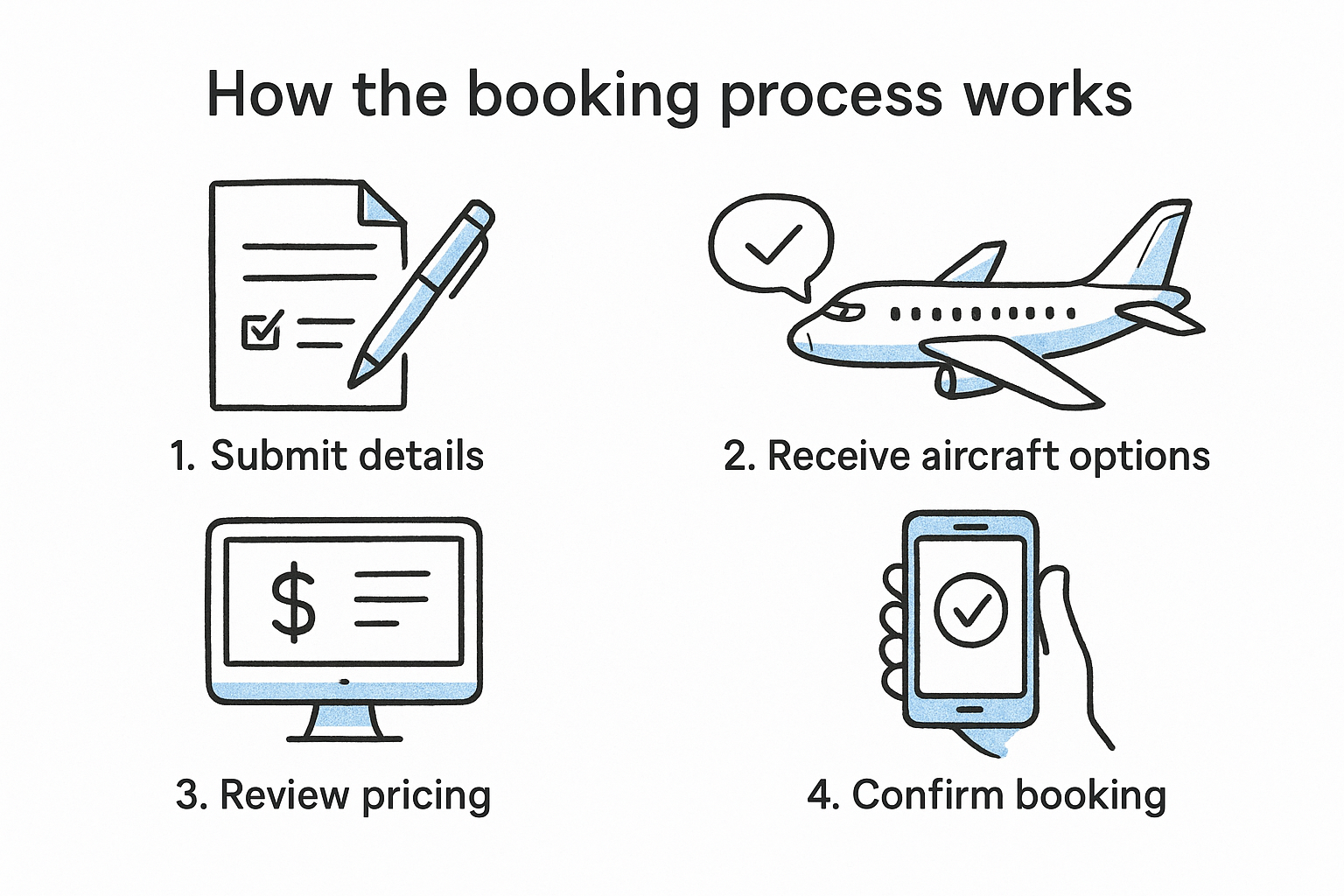
Most bookings follow this sequence:
The critical difference from standard freight is that every detail is verified before you commit, not revised after the fact.
Charter flights aren't the default choice for every shipment, but certain situations make them the only practical option. If your cargo won't fit standard freight holds, your timeline is too tight for scheduled services, or your route simply doesn't exist on any network, a charter airplane fills that gap. Knowing when chartering is the right call saves you time and avoids costly workarounds.
A charter flight becomes necessary the moment your cargo, timeline, or route falls outside what scheduled services can handle.
Some shipments and trips have requirements that standard freight and commercial aviation physically cannot meet. Oversized or heavy cargo, such as industrial machinery, aerospace components, or outsized relief supplies, often needs specific aircraft door dimensions and payload ratings that no scheduled carrier offers. Time-critical deliveries, like automotive production parts or perishable goods, carry deadlines that scheduled frequency and transit times can't guarantee. Remote or unusual routing, such as direct connections between secondary airports, adds another layer where charter becomes not just preferable but essential.
Charter airplane pricing varies based on a combination of factors specific to your flight. Aircraft type and total distance form the baseline of any quote, but the final figure shifts depending on routing complexity, cargo weight, and how far in advance you book relative to your departure date.

The more precisely you define your requirements upfront, the more accurate your quote will be.
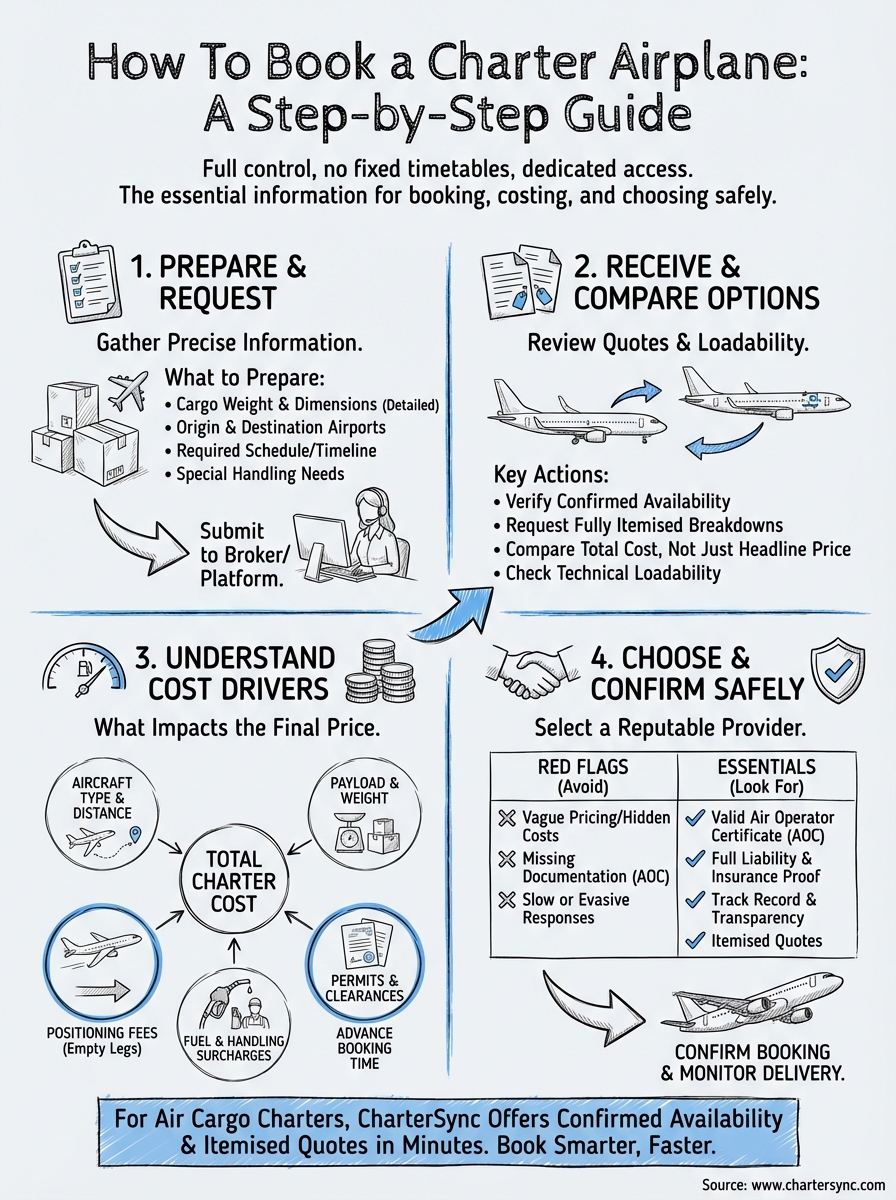
Several variables push your charter cost up or down. Positioning fees apply when the aircraft needs to travel empty to your departure point before the flight begins, which adds to your total cost and is often overlooked at the quoting stage. Permit requirements for certain airspace or restricted destinations also add both time and expense. On top of these, fuel surcharges, ground handling fees at origin and destination airports, and crew costs all factor into the final price.
Understanding these components lets you compare quotes on equal terms rather than accepting the lowest headline figure. A quote that excludes positioning or handling fees will look cheaper upfront but cost you more once those charges surface later in the process. Always ask operators for a fully itemised breakdown before confirming any booking.
When booking a charter airplane, the quality of information you submit upfront determines the accuracy of every quote you receive. Operators need precise cargo or passenger specifications to confirm availability and calculate costs correctly, so vague requests lead to vague, often unreliable, responses.
Submitting accurate specifications from the start cuts down revision rounds and gets you to a confirmed booking faster.
Before approaching any operator or platform, gather the key details first. Cargo weight, dimensions, and nature of goods are the minimum for any freight inquiry. Routing, departure dates, and flexibility in timing all affect which aircraft types qualify and what pricing looks like.
Once you have multiple quotes, look beyond the headline price. Positioning fees, permit costs, and ground handling charges often sit outside the base figure and shift the true cost significantly.
Always request fully itemised breakdowns from every operator before committing. This single step reveals where quotes actually differ and helps you identify the most accurate value, not just the lowest headline number.
Not every charter airplane provider operates to the same standard. Safety certifications and regulatory compliance are the first filters to apply before you approach any operator. In most markets, operators must hold an Air Operator Certificate (AOC), which confirms they meet the minimum requirements set by their national aviation authority. If a provider can't confirm this upfront, that tells you something important about how they run their operation.
Verifying an operator's credentials before booking protects you from risk that no price saving justifies.
Track record and documentation transparency separate reliable operators from those who cut corners. Ask for clear evidence of their AOC, crew qualifications, and insurance coverage before committing to anything.
Vague pricing, missing documentation, and slow responses to direct questions are all warning signs worth taking seriously. A trustworthy operator answers compliance questions without hesitation because they have nothing to hide.
How an operator handles your enquiry often reflects how they handle your shipment. If getting basic answers feels like a negotiation, look elsewhere.
Booking a charter airplane comes down to three things: knowing your requirements in detail, understanding what drives costs, and choosing an operator you can actually trust. When you approach the process with that information ready, you cut out the delays that slow most enquiries down and reach a confirmed booking faster.
The variables are manageable once you know what to look for. Positioning fees, permit lead times, and loadability confirmation all affect your final cost and timeline. Building these into your evaluation from the start puts you in a stronger position than most charterers and prevents surprises after you've already committed.
For air cargo charters specifically, CharterSync gives you confirmed aircraft availability, technical loadability analysis, and fully itemised quotes in minutes rather than hours. Book your next cargo charter on CharterSync and see how much faster the whole process becomes when the right data drives the decision.

.png)