.png)
Global freight booking is becoming more complex as we approach 2026. New technologies, evolving regulations, and shifting markets are transforming how businesses move goods worldwide.
With so much change, the risks are higher than ever. Delays, increased costs, and supply chain disruptions can have a real impact on your bottom line.
This guide offers actionable, expert-backed tips to help you streamline freight booking, minimise risk, and keep your shipments on time.
Use this resource as your go-to for mastering freight booking in 2026. Every section is crafted to deliver practical advice, industry insights, and proven strategies.
You will find step-by-step guidance on planning, choosing the right providers, booking processes, digital tools, risk management, and the latest trends shaping the future of freight booking.
The landscape for freight booking in 2026 is rapidly changing, shaped by global trends, disruptive events, and technological advancements. Businesses must navigate these shifts with agility, as the ability to adapt will be crucial for securing reliable and cost-effective shipping.
Global Freight Trends and Projections
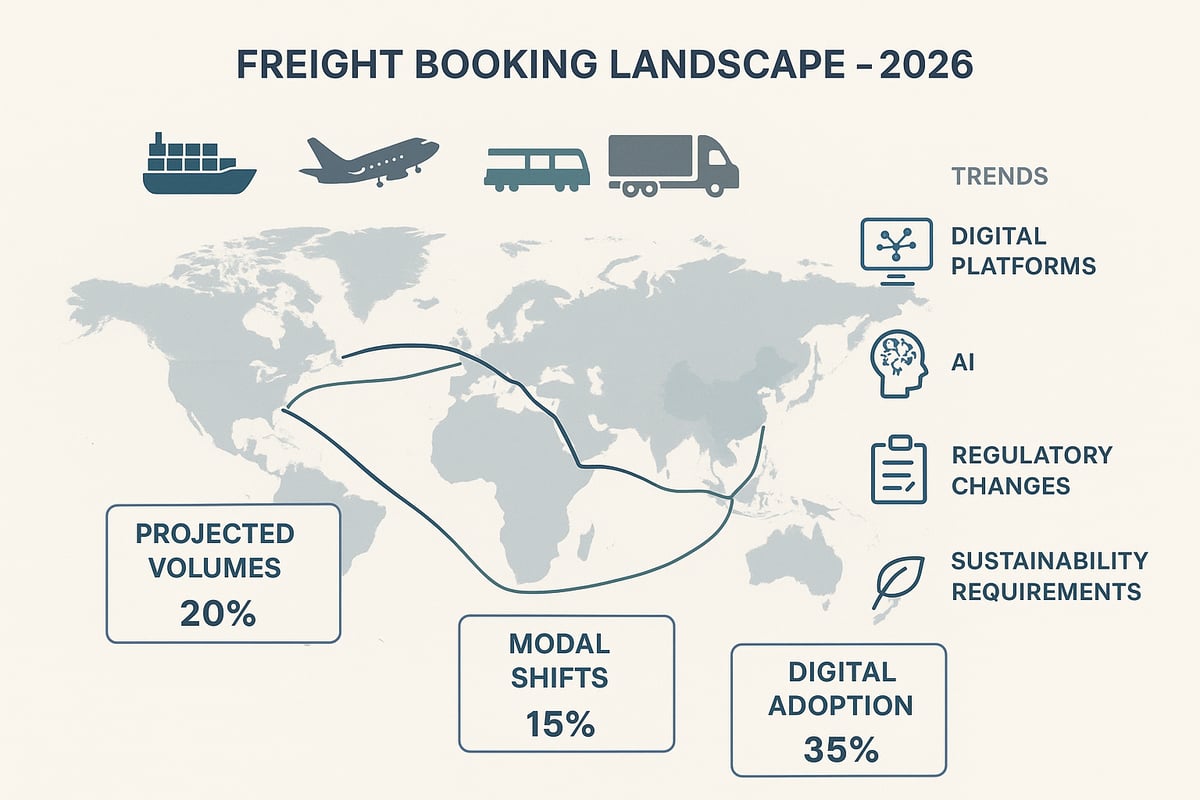
In 2026, freight booking will be influenced by the global economic outlook, with some regions experiencing modest growth and others facing stagnation. Trade lanes are shifting, with Asia, North America, and emerging African markets playing pivotal roles. The World Trade Organization recently downgraded global trade growth forecasts, highlighting the need for businesses to anticipate slower demand and plan their freight booking strategies accordingly. Key markets are investing in infrastructure, while new trade routes emerge to bypass congested or politically unstable regions.
Impact of Recent Global Events
Recent years have brought significant supply chain disruptions, from port closures to geopolitical tensions and volatile fuel prices. These events have underscored the importance of proactive freight booking and flexible logistics planning. Regulatory changes, such as stricter emissions targets and enhanced customs protocols, add further complexity. Businesses are responding by diversifying their shipping routes and building redundancy into their freight booking processes to reduce risk and maintain service continuity.
Evolving Customer Expectations
Today’s customers demand more from freight booking than ever before. Speed, transparency, and flexibility are now baseline expectations. Shippers and consignees want real-time visibility into their shipments, faster lead times, and the ability to adjust bookings as market conditions change. This shift is driving providers to enhance their digital platforms and customer service, ensuring that freight booking is both efficient and customer-centric.
Modal Shifts and Booking Challenges
Freight booking in 2026 will involve complex decisions across shipping modes. Ocean container shipping remains dominant, but congestion and equipment shortages persist. Air freight is vital for time-sensitive or high-value cargo, yet faces capacity constraints and regulatory hurdles. Road and rail are essential for inland transport, but must contend with driver shortages and infrastructure limitations. Each mode presents unique booking challenges, requiring shippers to evaluate costs, lead times, and reliability for every shipment.
Digital Transformation and the Role of Technology
Digitalisation is revolutionising freight booking, with automation, artificial intelligence, and online platforms streamlining the process. More companies are leveraging digital tools for instant quotes, document management, and real-time tracking. This transformation is reducing manual errors and increasing speed. For a deeper dive into how these technologies are reshaping the industry, see How Technology is Transforming Freight Forwarding. As adoption rates rise, digital freight booking is becoming the industry standard.
Key Statistics and Industry Data
Projections for 2026 suggest global freight volumes will remain high, though growth may be uneven. The average booking lead time is expected to shorten as digital platforms enable quicker decisions. Digital adoption rates are rising, with over 70% of freight booking transactions predicted to occur online. These figures highlight the need for companies to embrace technology and refine their freight booking processes to stay competitive.
Regulatory Highlights and Real-World Adaptation
Stringent new customs, emissions, and security regulations are shaping the future of freight booking. Shippers must ensure compliance with evolving requirements, particularly for hazardous or temperature-sensitive goods. For example, an electronics manufacturer may choose carbon-neutral shipping options to meet emissions mandates, while a pharmaceutical company invests in advanced tracking to maintain regulatory compliance. These adaptations underscore the critical role of strategic freight booking in achieving business objectives.
Strategic planning is the foundation of successful freight booking in 2026. As global trade becomes more unpredictable and customers demand faster, greener deliveries, a structured approach is essential. Begin by clarifying your shipment goals, optimising budgets, managing schedules, and ensuring compliance. Each step minimises risk and maximises efficiency.
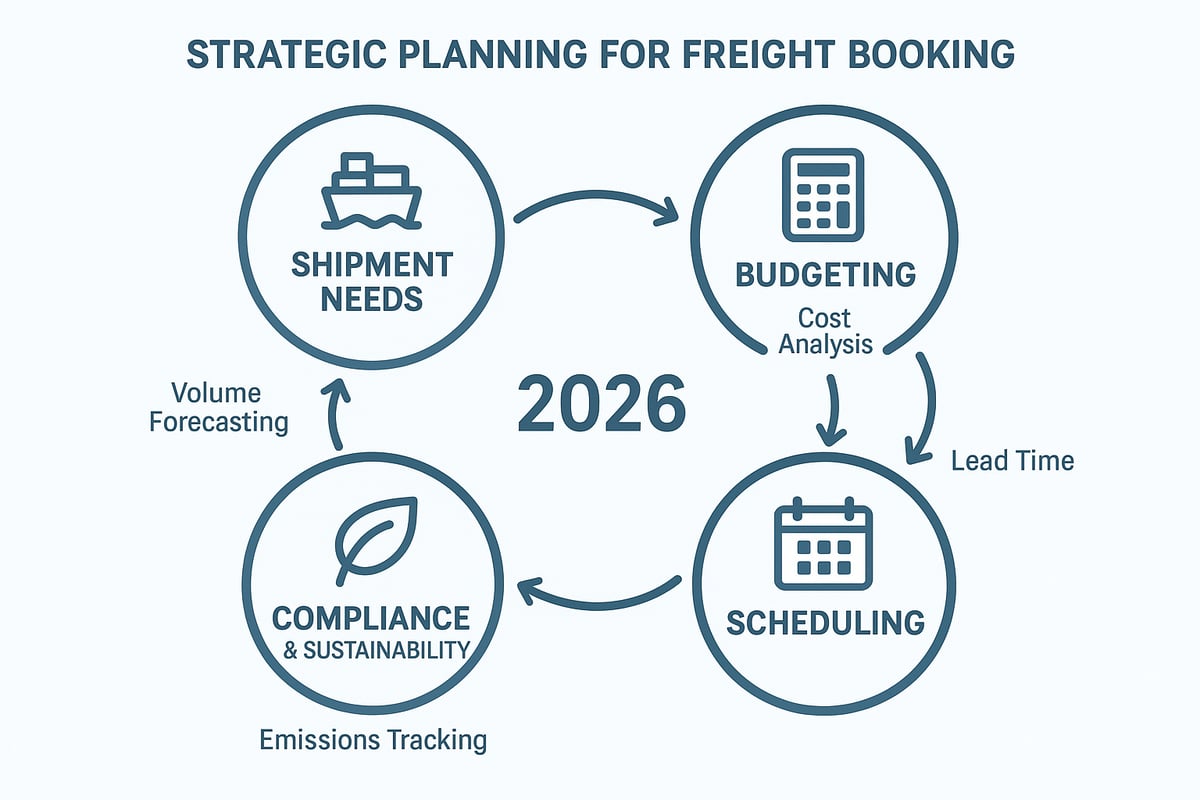
Start your freight booking process by defining what you are shipping, how much, and how quickly it must arrive. Understanding your cargo type, volume, and urgency is critical for choosing the right transport mode and provider.
Set clear priorities. Is cost your main concern, or is speed more important? Some businesses, like automotive manufacturers, rely on just-in-time deliveries and cannot tolerate delays. Others may prioritise sustainability or reliability.
Analyse your historical shipment data to forecast future needs. Use digital demand forecasting tools to spot trends, especially around peak seasons. For example, an automotive manufacturer planning just-in-time deliveries reviews past data and aligns logistics with production schedules.
Factor in seasonality and potential demand spikes. Aligning your freight booking strategies with business objectives ensures every shipment supports your broader goals.
A clear understanding of total landed costs is essential for effective freight booking. This includes freight charges, insurance, duties, and all surcharges. When planning for 2026, compare spot rates with contract rates to identify the most cost-effective options.
Fuel surcharges and market volatility can impact your bottom line. Staying informed on emerging trends, such as those discussed in Freight Forwarders and Fuel Price Trends, helps businesses anticipate and manage these fluctuations.
Leverage volume discounts and consider negotiating long-term contracts. For instance, a retailer may secure annual rates to avoid sudden cost increases. Digital quoting platforms and cost calculators make it easier to compare offers and set contingency budgets for unexpected disruptions.
By monitoring costs and using digital tools, you can optimise your freight booking process and maintain financial control.
Effective scheduling is a cornerstone of reliable freight booking. Calculate the optimal booking windows for each transport mode, considering port congestion, customs clearance, and estimated transit times.
Plan for possible delays due to regulatory changes or adverse weather. Coordinate closely with suppliers and customers to synchronise shipment timelines. For example, a pharmaceutical firm ensures compliance with strict regulations for time-sensitive deliveries, using real-time scheduling tools to stay updated.
Build flexibility into your shipment plans. Utilise digital platforms for live updates and automated notifications. This proactive approach reduces the risk of missed deadlines and helps you adapt quickly to unforeseen challenges.
A well-managed schedule ensures your freight booking process remains resilient, even under pressure.
Sustainability and compliance are increasingly important in 2026 freight booking. Meeting new emissions regulations and environmental targets is no longer optional. Choose eco-friendly carriers and routes to minimise your carbon footprint.
Ensure compliance with updated customs and security requirements, especially when entering new markets. For example, an electronics company may select carbon-neutral shipping options and use digital platforms to track compliance.
Understand the documentation required for each destination. Digital tools can simplify compliance tracking and reduce paperwork errors. Balance your cost, compliance, and environmental goals by integrating these considerations into your freight booking strategy.
Staying ahead on sustainability and regulations protects your brand and ensures smooth, disruption-free shipments.
Selecting the right partners for freight booking is crucial for reliable, cost-effective, and timely shipments in 2026. As the logistics landscape evolves, businesses must adopt a strategic, data-driven approach to choosing freight forwarders, carriers, and digital platforms. This section guides you through evaluating providers, leveraging technology, and building enduring relationships to optimise your freight booking process.
Choosing the right partners for freight booking starts with a thorough evaluation of freight forwarders and carriers. Reliability is non-negotiable. Assess on-time performance, network coverage, and the range of services on offer. Specialisation is also key: some providers excel in FCL, LCL, air, or multimodal freight booking.
Digital capabilities now set leaders apart. Look for online booking, real-time tracking, and robust customer support. Certifications, such as AEO or IATA, and industry memberships indicate compliance and quality standards.
Customer reviews and case studies offer insights into real-world performance. For example, when comparing top ocean carriers, review their on-time delivery rates and transparency. Strong communication is essential to resolve issues quickly and maintain trust throughout the freight booking process.
| Criteria | Why It Matters | Example Questions |
|---|---|---|
| Reliability | Minimises disruption | What is their on-time rate? |
| Network | Global reach | Do they cover all key routes? |
| Digital Tools | Efficiency, transparency | Can you book and track shipments online? |
| Specialisation | Suitability | Do they handle your cargo type? |
| Certifications | Compliance | Are they AEO/IATA certified? |
The rise of digital freight booking platforms is reshaping logistics in 2026. These platforms deliver instant quotes, real-time availability, and fast booking confirmation. For businesses, this means streamlined freight booking and greater control over shipments.
When comparing platforms, assess their integration with TMS or ERP systems, data security standards, and the breadth of their carrier networks. AI-powered platforms can match shipments to optimal routes, saving both time and cost. For example, using a digital platform for multi-modal freight booking can simplify complex, cross-border shipments.
Look for customer support channels and clear dispute resolution processes. As highlighted in Bold Predictions for 2026: Supply Chain Trends to Watch, digitalisation and automation are accelerating, making it essential to choose solutions that evolve with market needs.
Platforms with robust analytics and reporting help you monitor performance and identify opportunities for process improvement. Effective use of digital tools is now a key differentiator in freight booking success.
CharterSync stands out as a leading platform for automated air cargo charter freight booking. Its AI-powered tools instantly match cargo requirements with available aircraft, providing immediate quotes and seamless booking.
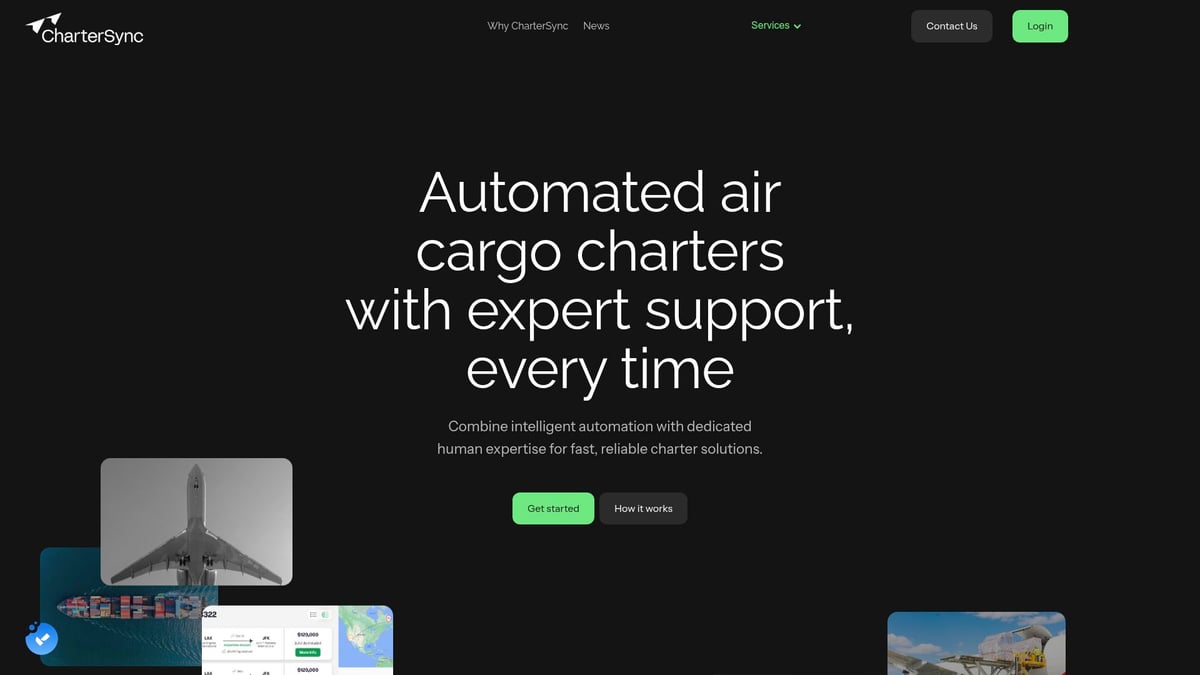
For freight forwarders, CharterSync offers speed, reliability, and full transparency, which are critical for urgent or high-value air freight booking. Real-time tracking and expert human support ensure that time-critical shipments, such as pharmaceuticals or automotive parts, move without delay.
CharterSync specialises in sectors where rapid response is vital. For instance, a freight forwarder recently secured a last-minute charter for sensitive pharmaceutical goods using the platform’s instant matching and approval process.
The platform combines digital convenience with human expertise, making it a trusted choice for complex air freight booking needs. To access CharterSync, visit their website and request a demo or sign up for an account.
Long-term partnerships are a cornerstone of successful freight booking. Strong relationships with providers can secure priority booking, better rates, and collaborative problem-solving.
Effective communication is vital. Set clear SLAs and KPIs to define expectations and performance. Work closely with providers on seasonal surge planning, as in the case of a retailer collaborating with a carrier to prepare for peak demand periods.
Handle disputes and claims efficiently by agreeing procedures in advance. Regular performance reviews help identify areas for improvement and foster continuous collaboration.
Leverage your provider’s expertise to refine your freight booking processes and stay ahead of regulatory changes. Investing in these relationships pays dividends in reliability, cost savings, and adaptability in 2026’s competitive logistics environment.
Navigating the freight booking process in 2026 demands precision, up-to-date knowledge, and the right digital tools. Each stage, from initial data gathering to real-time tracking, is crucial for preventing costly errors and ensuring timely deliveries. This step-by-step guide walks you through best practices that elevate efficiency and reduce risk throughout your freight booking journey.
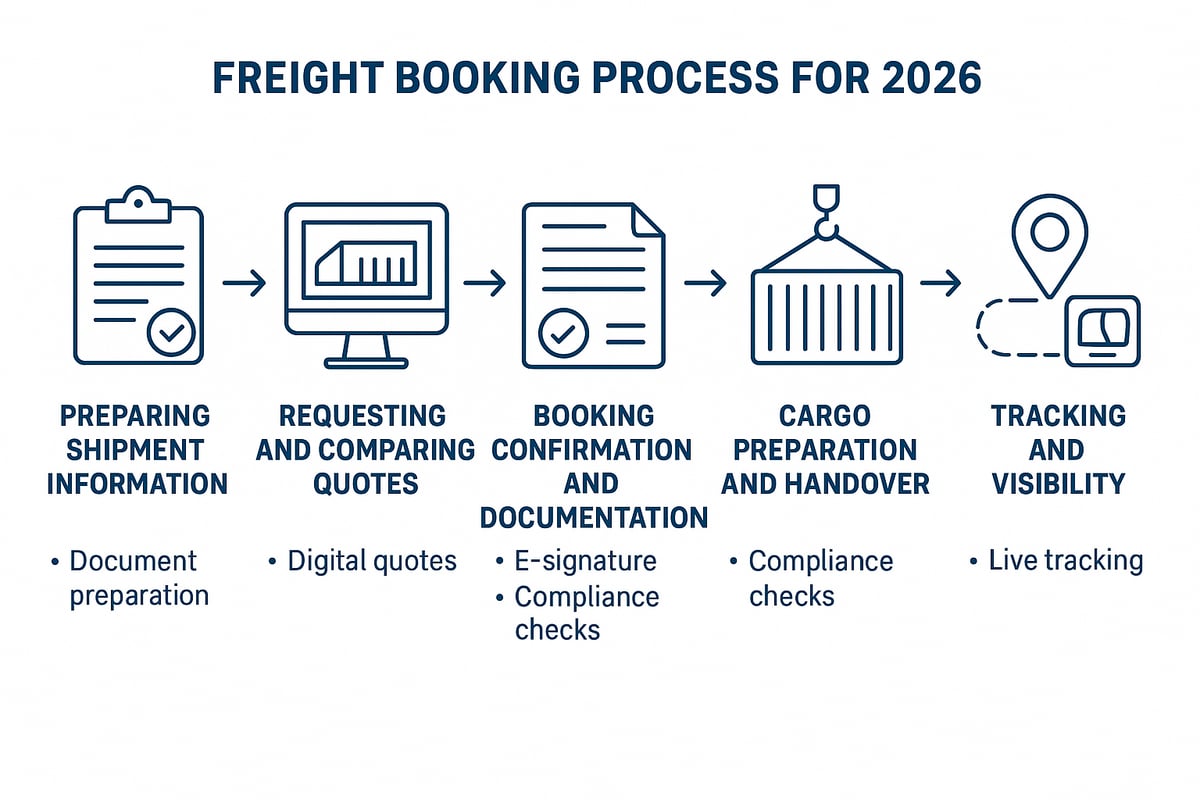
Accurate and thorough shipment information is the bedrock of successful freight booking. Begin by compiling essential cargo details, including a clear description, exact dimensions, weight, declared value, and any special handling requirements. This data determines the shipping mode, packaging needs, and compliance checks.
Gather all necessary documentation early to avoid delays. Typical documents include the commercial invoice, packing list, and relevant certificates. For hazardous or temperature-sensitive goods, extra paperwork and strict protocols may be required. Digital tools can reduce data entry errors and help organise records efficiently.
For example, exporters handling dangerous goods must prepare documentation that complies with airline and international regulations. Early preparation streamlines the entire freight booking process and mitigates the risk of shipment holds or fines.
The next step in freight booking is obtaining and evaluating quotes from various providers. You can request quotes directly, through digital freight platforms, or via agents. Ensure you receive comprehensive quotes that detail base rates, surcharges, validity periods, and terms.
Comparing multiple quotes side by side is vital. Look for clarity on costs, hidden charges, and service inclusions. Digital quoting tools make this process more transparent and efficient, allowing for instant comparisons and faster decision-making.
For instance, a manufacturer weighing ocean versus air rates for an urgent delivery can use online tools to compare total costs and transit times. This approach ensures that your freight booking aligns with both budget and timeline requirements.
Once you've selected the best option, move quickly to confirm your freight booking. The process typically involves accepting the quote, making payment, and finalising contracts. Prompt confirmation secures space and locks in agreed rates.
After confirmation, you will receive booking documents from your provider. Carefully review all details for accuracy, including shipment dates, cargo specifications, and routing. Issue clear shipping instructions and ensure all required paperwork is complete and compliant.
A freight forwarder securing capacity for a high-value shipment, for example, relies on accurate documentation and prompt communication to avoid costly setbacks. Attention to detail at this stage is critical for a seamless freight booking experience.
Proper cargo preparation is essential for compliance and safety in freight booking. Follow packing and labelling requirements specific to your chosen mode—whether ocean, air, or road. Schedule delivery to the port, terminal, or airport within the allocated window, ensuring all regulatory and carrier standards are met.
Sensitive shipments, such as pharmaceuticals, often require temperature control and special documentation. For best practices in preparing these types of cargo, consult resources like Temperature-Controlled Freight Best Practices. Leveraging such guides ensures compliance and reduces risk.
Utilise tracking tools for real-time updates on handover status. Prevent damage and loss by adhering to established protocols. A proactive approach during this phase strengthens the reliability of your freight booking process.
Maintaining visibility is the final, ongoing stage of freight booking. Employ real-time tracking solutions such as GPS, digital dashboards, and automated notifications to monitor shipment progress.
Set up alerts for key milestones, and keep all parties informed of status updates or exceptions. Integrate tracking with your internal systems for seamless data flow. For example, retailers can provide customers with live estimated arrival times, enhancing satisfaction and trust.
Proactive communication and end-to-end visibility are vital for managing disruptions and ensuring the success of your freight booking. By embracing digital tools and clear processes, you can respond swiftly to any issues and keep your supply chain moving smoothly.
The landscape of freight booking is evolving rapidly as digital tools and automation become central to efficient logistics. In 2026, companies that embrace these technologies gain a competitive edge through faster processes, improved accuracy, and greater visibility. Adopting digital solutions is no longer optional, it is essential for those aiming to optimise shipping operations, reduce costs, and meet customer expectations.
Digital transformation is fundamentally reshaping the freight booking industry. By 2026, the majority of bookings are expected to be processed digitally, offering significant benefits such as speed, reduced manual errors, and enhanced transparency. Automation and artificial intelligence (AI) are streamlining complex logistics, allowing companies to manage large shipment volumes with minimal effort.
Emerging technologies, such as digital twins and AI-driven optimisation, are making a notable impact. For example, research on the integration of AI and digital twins in urban logistics shows how these tools can improve efficiency, accuracy, and decision-making across the freight booking process.
Despite the promise, challenges remain, such as integrating new tools with legacy systems and ensuring staff are adequately trained. However, the overall trend is clear: digitalisation is driving measurable improvements in cost savings, customer satisfaction, and operational resilience.
Selecting the right technologies is crucial for success in freight booking. Digital booking platforms are at the core, offering features like instant quoting, automated booking confirmation, and real-time tracking. Transportation Management Systems (TMS) integrate with these platforms, enabling companies to manage shipments, documentation, and compliance from a single interface.
AI-powered quoting tools analyse market rates and recommend optimal carriers, while automation matches shipments to the best available routes. E-documentation and e-signature solutions simplify paperwork, reducing delays and errors.
Mobile apps allow logistics teams to manage freight booking on the go, providing updates and alerts wherever they are. Advanced data analytics tools monitor performance, helping businesses identify trends, measure KPIs, and continuously improve their freight booking processes.
| Technology | Key Benefit | Example Use Case |
|---|---|---|
| Digital booking platforms | Speed, accuracy | Instant booking confirmation |
| TMS integration | Centralised management | Multi-modal coordination |
| AI-powered quoting | Cost optimisation | Dynamic rate analysis |
| Automation | Reduced manual workload | Auto-matching shipments |
| Mobile apps | Flexibility | Real-time status updates |
Collaboration is a cornerstone of effective freight booking in 2026. Digital platforms now offer shared dashboards, document portals, and real-time communication tools, ensuring all stakeholders have access to critical information.
For example, suppliers, freight forwarders, and carriers can work together on a unified platform, reducing miscommunication and minimising costly errors. Audit trails and compliance tracking are built into these systems, making it easier to meet regulatory requirements and deliver a seamless customer experience.
Transparency throughout the freight booking journey leads to proactive problem-solving and a higher level of trust between partners.
Despite clear benefits, some organisations still face hurdles in adopting digital freight booking solutions. Common challenges include resistance to change, system silos, and concerns over data privacy. To address these, companies should invest in comprehensive training programmes and select scalable, user-friendly platforms.
A phased rollout allows teams to adapt gradually, while continuous feedback ensures that solutions meet evolving business needs. Demonstrating clear ROI, such as faster booking times or reduced errors, helps secure buy-in across the organisation.
Ultimately, overcoming these barriers unlocks the full potential of digital freight booking, positioning businesses for long-term success.
Managing risk is fundamental to successful freight booking in 2026. Companies face a landscape shaped by unpredictable global events, regulatory shifts, and evolving technology. Proactive preparation minimises disruption, safeguards cargo, and ensures supply chain continuity.
Every freight booking involves a spectrum of risks. These range from delays and cargo damage to regulatory non-compliance and digital security threats. A structured risk assessment process is essential for anticipating issues before they escalate.
Key risks in freight booking include:
Companies can mitigate these risks by:
Consider the example of an electronics importer shipping high-value goods. By securing robust insurance and working with reliable partners, they reduce exposure to loss. Using digital platforms for risk monitoring also enhances visibility and control.
Disruptions are an unavoidable aspect of freight booking. Common triggers include weather events, strikes, and shifting regulations. Proactive monitoring and response protocols are crucial for minimising impact.
Real-time tracking tools allow teams to detect issues early and reroute shipments when necessary. For instance, a retailer may need to divert cargo during a port closure or respond quickly to customs delays. Communication is key—establish clear escalation processes with providers and inform customers promptly.
Industry reports, such as the Transportation and Logistics Industry Trends February 2025, highlight the growing importance of agility in freight booking. Leveraging digital alerts, flexible booking platforms, and collaborative planning helps companies adapt rapidly to change.
Insurance is an essential safeguard in freight booking. Types of cover include cargo insurance, liability cover, and specific policies for high-value or sensitive goods. When incidents occur, a clear claims process ensures timely resolution.
Steps for managing claims:
For example, a manufacturer shipping machinery may recover costs for lost cargo by following best practices in documentation and provider communication. Minimising disputes depends on clear contracts and transparent terms from the outset.
The regulatory environment for freight booking is more demanding than ever. New security standards, emissions rules, and data privacy laws require ongoing vigilance. Compliance failures can result in costly fines or shipment holds.
Key compliance strategies:
A pharmaceutical company, for example, must ensure temperature-controlled shipments meet updated health regulations. Regular audits and system checks help maintain a secure and compliant freight booking process.
The freight booking landscape is rapidly evolving, with new trends set to reshape how businesses plan, execute, and optimise shipments in 2026. Staying ahead requires understanding the forces driving change and preparing your organisation to leverage emerging opportunities. Below, we explore the four most significant trends predicted to define freight booking over the coming years.
Artificial intelligence and automation are fundamentally transforming freight booking. In 2026, AI-driven systems are expected to power dynamic pricing, optimise routing, and forecast demand with high accuracy. Predictive analytics tools enable logistics teams to anticipate peak periods, identify risk factors, and adjust plans proactively.
For example, a global forwarder might use AI to analyse historical shipment data and market signals, allowing for early bookings during high-demand seasons. This not only reduces costs but also minimises the risk of capacity shortages. Automation is streamlining repetitive tasks, freeing up human resources for strategic decision-making.
Despite these advancements, human expertise remains essential, especially when navigating complex or disrupted supply chains. Industry estimates suggest that by 2026, over 70% of all freight booking transactions will involve some level of automation or AI support. However, the overall demand for freight booking may be tempered by global economic headwinds, as highlighted by the WTO downgrades global trade growth forecast to 0.5% for next year, which underscores the importance of agility and resilience in logistics planning.
Sustainability is rapidly moving from an optional consideration to a core requirement in freight booking. Regulatory frameworks are tightening, with emissions caps and carbon reporting becoming standard across major markets by 2026. Businesses are under growing pressure to select low-carbon carriers and demonstrate measurable progress on sustainability goals.
Innovations in green logistics, such as alternative fuels, electric vehicles, and carbon-neutral shipping options, are increasingly available. Retailers and manufacturers alike are shifting freight booking strategies to prioritise eco-friendly carriers and efficient multimodal routes. For example, a retailer seeking to meet 2026 emissions targets may transition from traditional sea freight to greener rail or barge solutions.
Reporting tools now allow shippers to track and verify their environmental impact throughout the freight booking process. While these advances create new opportunities, they also introduce complexity, requiring logistics teams to balance cost, compliance, and sustainability objectives.
Integrated digital platforms are revolutionising freight booking by connecting every stage of the shipment journey. In 2026, companies are moving towards unified systems that manage bookings, tracking, customs clearance, and analytics from a single dashboard. This integration reduces manual intervention, minimises errors, and accelerates decision-making.
APIs and data standards are making it easier to share information across the supply chain. Real-time visibility tools provide accurate ETAs, automated alerts, and instant status updates, improving customer satisfaction and compliance. For instance, a business might use a platform that combines freight booking, inventory management, and customs documentation, ensuring seamless data flow and rapid response to disruptions.
The push for end-to-end visibility also supports risk management, allowing teams to identify issues early and adapt quickly. As integration becomes the norm, companies that invest in connected systems will be better positioned to compete in a dynamic global market.
Freight forwarders are transitioning from transactional service providers to strategic partners in the freight booking process. As digital platforms automate routine bookings, forwarders are focusing on value-added services such as supply chain consulting, analytics, and compliance support.
The rise of digital-first forwarders and online marketplaces is reshaping the competitive landscape. Traditional forwarders must adapt by upskilling teams, investing in technology, and offering bespoke solutions tailored to customer needs. For example, a forwarder may provide detailed market analysis to help clients optimise their freight booking strategy for volatile markets.
Looking ahead, successful freight booking will rely on close collaboration between shippers, forwarders, and technology providers. The most competitive organisations will combine digital efficiency with industry expertise, delivering flexible, resilient logistics solutions in an ever-changing environment.
Now that you have a clear overview of how automation, digital tools, and expert strategies are shaping freight booking in 2026, it’s the perfect time to put these insights into action. If you want to see firsthand how streamlined, AI powered solutions can transform your air cargo charter process for urgent or complex shipments, I recommend you request a demo. You’ll discover how CharterSync’s intelligent platform combines speed, accuracy, and expert support to simplify even the most challenging bookings. Let’s take your freight operations to the next level together.

.png)