.png)
Modern air travel is changing rapidly as we approach 2026. Travellers expect more flexibility, privacy, and seamless experiences than ever before.
The Access Air Guide 2026 is your definitive resource for navigating the evolving world of private, business, and luxury aviation. Whether you are a traveller or an industry professional, this guide delivers actionable insights and the latest data to help you stay ahead.
With expert advice and practical solutions, the guide empowers you to make informed decisions and elevate every journey. The Access Air Guide 2026 is designed to be your essential companion, offering comprehensive coverage of trends, solutions, and innovations in the access air market.
Inside, you will find a market overview, service types, booking tips, technology updates, luxury travel trends, and a future outlook—everything you need to make the most of your air travel experience.
The access air sector in 2026 is defined by rapid transformation and growing sophistication. As demand for flexibility and premium experiences increases, both business and private aviation have evolved to meet new expectations. This market overview explores the major shifts, leading providers, and customer trends shaping access air today.
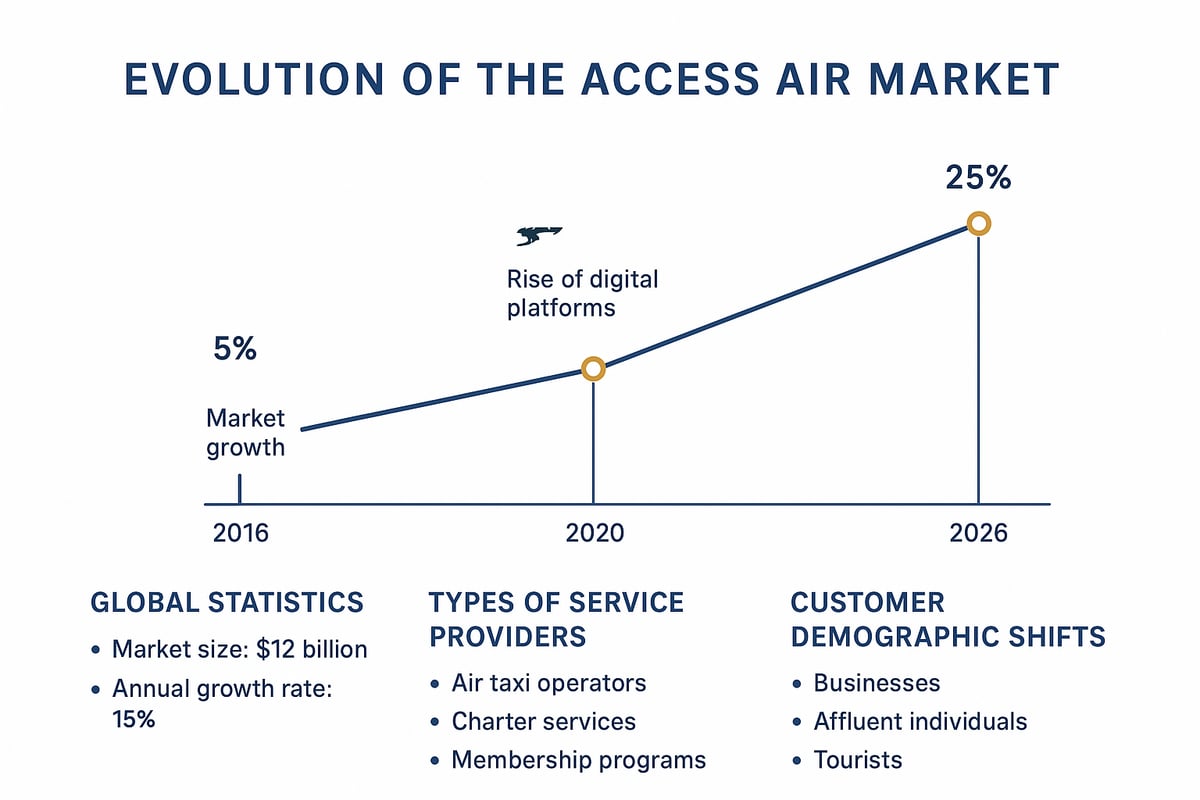
Over the past decade, access air has experienced significant change, with business and private aviation rebounding strongly after the pandemic. The global private air travel market has expanded, with regional trends indicating robust growth in North America, Europe, and parts of Asia.
Key drivers behind this evolution include a heightened demand for flexibility, a strong focus on safety, and a move towards ultra-personalisation. New digital platforms have made on-demand chartering more accessible, while hybrid service models are emerging to bridge traditional and tech-driven solutions.
Regulatory changes have also impacted access air services, particularly in sustainability and safety standards. For example, 2024 and 2025 saw a 15 percent increase in first-time private jet users, reflecting a broader shift towards private travel options. According to recent analysis, private jet market trends in 2025 suggest continued momentum in mid-size jet demand and ongoing investment in greener technologies.
The access air landscape is shaped by a diverse mix of established operators, dynamic brokers, and innovative digital platforms. Leading names such as AccessAir, NetJets, and Flexjet have solidified their market presence through expansive fleets and global reach.
Distinctions among service providers are becoming more pronounced. Full-service operators offer end-to-end solutions, while brokers focus on sourcing the best deals and digital platforms prioritise instant booking and transparency. Market share remains competitive, with alliances and partnerships playing a crucial role in expanding service networks and geographic coverage.
Innovation is central to success in access air. For instance, AccessAir’s JetLab initiative enables business jet interiors to be hired for media and event use, opening new revenue streams. The drive to differentiate is also seen in technology adoption and customer experience enhancements.
Access air attracts a varied clientele, from business executives and celebrities to high-net-worth individuals and emerging affluent travellers. Privacy, convenience, and time savings are the primary reasons clients choose this mode of travel.
Usage data reveals notable trends. There has been a marked increase in trip frequency, with popular routes connecting business hubs and luxury destinations. Seasonal peaks often align with major events and holidays, further boosting demand.
A significant shift is the rise of younger travellers: industry surveys from 2025 show that 30 percent of bookings now come from professionals under 40. As expectations evolve, access air providers are adapting their services to cater to this new generation, prioritising digital engagement and tailored experiences.
Navigating the world of access air means understanding the variety of services available. Whether you are seeking ultimate flexibility, exclusive perks, or innovative experiences, the access air market in 2026 offers tailored solutions to meet every travel need.
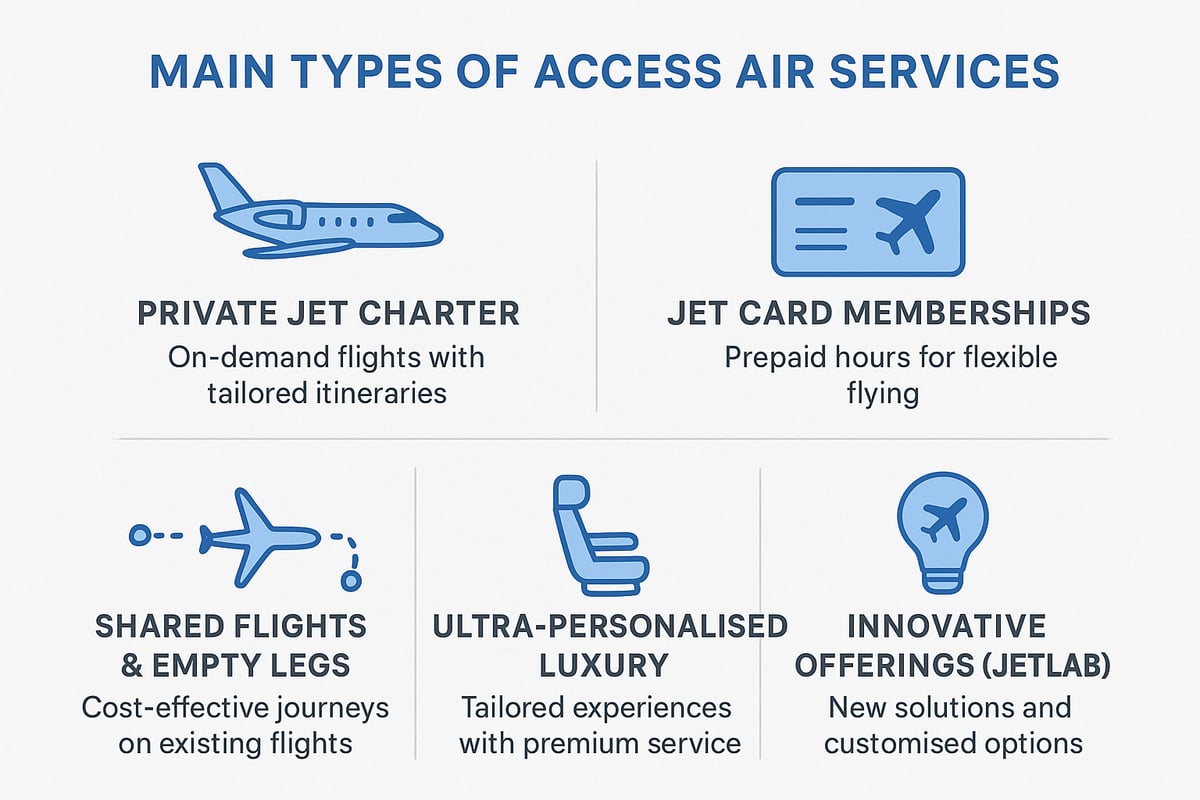
Private jet charter remains the core of access air services, offering travellers the freedom to select their preferred aircraft and schedule. Clients can choose from light jets for short hops, midsize options for regional trips, or ultra-long-range jets for global connections.
Key features of private jet charter include:
Use cases are varied, from urgent board meetings to family holidays and event attendance. For example, AccessAir’s global fleet enables clients to secure an aircraft within hours, showing the market’s commitment to responsiveness. The access air market’s emphasis on flexibility ensures that even last-minute plans are seamlessly accommodated.
Membership and jet card programmes have transformed the access air experience for frequent flyers. These models typically involve an upfront fee, offering guaranteed aircraft availability and fixed hourly rates.
Here is a comparison of leading jet card features:
| Programme | Upfront Fee | Hourly Rate | Perks |
|---|---|---|---|
| AccessAir Card | Yes | Fixed | Priority booking |
| NetJets Card | Yes | Fixed | Exclusive lounges |
| Flexjet Card | Yes | Fixed | Guaranteed upgrades |
Benefits include:
With a 25 percent year-on-year growth in jet card sales from 2024 to 2025, it is clear that the access air sector is attracting a new generation of regular travellers, including corporate clients who value certainty and convenience.
Shared flights and empty leg opportunities bring a cost-effective edge to access air services. Shared charters allow passengers to split costs on popular routes, while empty legs offer discounted seats on repositioning flights.
Advantages of these options:
Platforms aggregate available empty leg deals, making it easier to find spontaneous opportunities. In 2025, empty leg bookings rose by 20 percent, reflecting growing interest in this segment. The access air market’s efforts to promote shared flights also align with sustainability goals.
Luxury and personalisation are hallmarks of modern access air offerings. Today’s travellers expect more than just a flight; they seek bespoke experiences tailored to their preferences.
Personalised services may include:
AccessAir’s approach to ultra-personalisation involves anticipating client needs before they are even voiced. According to AccessAir data, 40 percent of clients now request bespoke experiences. This trend highlights how access air providers are redefining luxury in the skies.
Innovation is reshaping access air, with new offerings designed for unique markets. JetLab by AccessAir, for instance, provides business jet interiors for media, events, and creative professionals. These jets serve as exclusive venues for photo shoots, film production, and high-profile product launches.
The rise of experiential aviation reflects broader industry trends, as bookings for JetLab doubled in 2025. Technology is a driving force behind these changes. As highlighted in Air Cargo Charter in 2025, advancements in digital platforms and automation are transforming how access air services are booked and delivered. This progress ensures that access air remains at the forefront of innovation and customer satisfaction.
Booking an access air journey demands a methodical approach to ensure the best outcome. Whether you are a seasoned flyer or new to the access air sector, understanding how to navigate the process can make a significant difference in convenience, value, and safety.
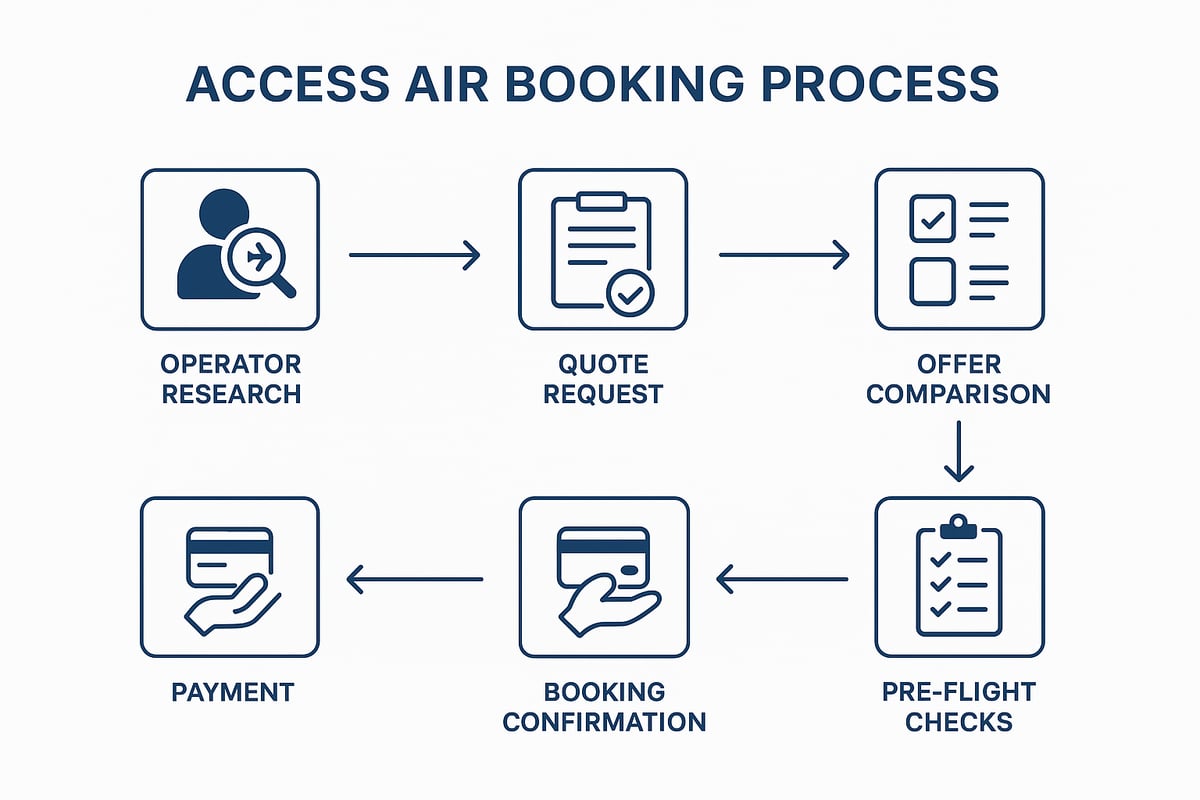
Start by identifying reputable access air operators or platforms. Look for safety records, customer feedback, and fleet diversity. Prioritise operators that are transparent about their credentials and offer a variety of aircraft suitable for your needs.
Requesting a quote is straightforward. You will need to provide details such as passenger numbers, departure and arrival locations, dates, and any special requirements. Leading access air providers respond promptly, typically within a few hours, and present clear information about aircraft options, pricing, and inclusions.
When comparing offers, pay close attention to what is included. Scrutinise for hidden charges, cancellation terms, and additional services. Some access air quotes may appear lower at first glance but include fewer amenities or less flexibility.
Once you have selected your preferred option, the booking confirmation process is simple. Most access air platforms allow secure online payment and issue prompt confirmations. Before your flight, ensure all required travel documentation is prepared, security procedures are understood, and any special requests are communicated to the operator.
Booking Checklist:
By following these steps, you can secure a seamless access air experience from start to finish.
Understanding how access air pricing works is crucial for maximising value. There are three main pricing models: dynamic (fluctuating based on demand), fixed (set rates for routes or hours), and membership-based (jet cards or prepaid hours). Knowing which model suits your travel habits can lead to significant savings.
| Pricing Model | Description | Best For |
|---|---|---|
| Dynamic | Price varies by date, demand, and route | Occasional flyers |
| Fixed | Set price per hour or route | Predictable routines |
| Membership | Prepaid hours, exclusive rates and perks | Frequent travellers |
To optimise costs, consider booking in advance, as peak times can drive prices up rapidly. Leveraging empty leg flights, where aircraft reposition with no scheduled passengers, can offer discounts of up to 75 percent. Group charters also reduce the cost per person, making access air more accessible for families or business teams.
Negotiating add-ons such as catering, ground transport, or upgrades can further enhance your journey without significant extra cost. Early booking is particularly effective, often saving up to 20 percent on popular routes compared to last-minute arrangements.
With these strategies, you can enjoy the advantages of access air while managing your travel budget effectively.
Safety and compliance are foundational pillars of the access air industry. Before confirming a booking, verify that your chosen operator holds valid certifications from relevant aviation authorities. Look for evidence of safety audits, maintenance records, and crew training standards.
All reputable access air providers comply with international and regional regulations, such as EASA in Europe or FAA in the US. Ask for proof of compliance and check whether the operator has passed recent safety inspections.
Insurance is another critical aspect. Standard access air bookings include basic passenger and liability cover, but you may wish to explore additional options for high-value trips or unique risks. Confirm the extent of coverage and request documentation if necessary.
By prioritising safety, regulatory compliance, and robust insurance, you ensure peace of mind for every access air journey.
Innovation is the heartbeat of the access air industry, shaping how travellers and operators interact with private aviation. In 2026, technology is not just an add-on but a core driver of efficiency, user experience, and sustainability. The following sections explore the leading advancements transforming access air for all stakeholders.

Digital booking platforms have revolutionised access air by making private jet charters more accessible and transparent. Travellers can now use sleek apps and online portals to request instant quotes, compare aircraft options, and confirm flights in minutes.
Key features of these platforms include real-time availability, mobile compatibility, and intuitive interfaces. Many top providers, like AccessAir, offer personalisation tools that tailor suggestions to user preferences. These advances streamline the access air experience, removing traditional barriers and making private aviation as easy to book as a commercial flight.
Artificial intelligence is rapidly reshaping access air operations. AI-driven systems match clients with the most suitable aircraft, optimise dynamic pricing, and analyse customer profiles for tailored service offerings.
Automation extends to quoting, documentation, and operational logistics, significantly reducing manual errors and saving time. In 2025, industry data showed that 60 percent of access air bookings were processed via automated platforms. This shift has enhanced both efficiency and the overall client journey, allowing operators to scale up while maintaining high service standards.
Modern travellers expect seamless connectivity, and access air providers are meeting this demand with next-generation in-flight technology. The latest jets feature high-speed Wi-Fi, advanced entertainment systems, and smart cabin controls accessible from personal devices.
Integration of IoT devices ensures optimal passenger comfort, from climate control to lighting and seat adjustments. By 2026, 75 percent of new access air jets include robust connectivity and intelligent monitoring systems, setting new benchmarks for the in-flight experience and operational reliability.
Sustainability is now a central pillar for access air operators, driven by both regulatory mandates and customer expectations. The adoption of sustainable aviation fuels, carbon offset programmes, and eco-friendly aircraft is accelerating across the sector.
Clients are increasingly prioritising greener travel options, with 50 percent rating sustainability as important when choosing access air services. Operators like AccessAir are investing in carbon-neutral operations and exploring electric propulsion. For a deeper look at these emerging trends, see Are Electric Planes the Future?. These efforts align with the industry’s broader commitment to net-zero emissions by 2030.
As digital platforms become integral to access air, cybersecurity is paramount. Leading operators invest in robust end-to-end encryption, secure payment solutions, and comprehensive compliance with regulations like GDPR.
Passenger and operator data are protected through advanced authentication and continuous monitoring. These security measures ensure that the convenience of digital access air services does not come at the expense of privacy or safety. In 2026, trust in data protection is as important as any other aspect of the access air journey.
In 2026, access air redefines luxury aviation with a focus on personalisation and seamless service. Travellers expect more than just a flight; they seek curated experiences that cater precisely to their tastes and requirements. This section explores how access air providers are setting new benchmarks in bespoke service, combining technology, skilled staff, and strategic partnerships to deliver unrivalled value.
Access air operators now offer ultra-personalised onboard experiences, transforming each journey into a bespoke event. Interiors are customised with designer materials, mood lighting, and adaptable layouts to suit individual preferences. Gourmet catering menus, curated by top chefs, cater to dietary needs and culinary desires. Branded amenities, from luxury bedding to fine toiletries, enhance comfort.
Entertainment systems are tailored, allowing passengers to enjoy their favourite films, music, or live-streamed events. Access air ensures that every detail, from the temperature to the scent in the cabin, aligns with the traveller’s wishes. This commitment to customisation sets access air apart in the modern aviation landscape.
Comprehensive concierge services are integral to the access air experience. Providers manage every aspect of travel, from chauffeured airport transfers to seamless luggage handling. Hotel reservations, event ticketing, and personalised itineraries are arranged in advance, ensuring a smooth journey from door to destination.
A recent case study highlights a client who used access air for a business event: their entire trip, from home pick-up to event arrival, was coordinated by a single provider. This end-to-end approach saves time and reduces stress, making access air the preferred choice for discerning travellers.
Access air is also at the forefront of event and media chartering innovations. Offerings such as JetLab provide unique venues for film shoots, product launches, and exclusive gatherings. These business jet interiors are designed for versatility, accommodating creative professionals who require both privacy and sophistication.
Major film productions have turned to access air for on-board scenes, benefiting from the controlled environment and customisable settings. Such innovations enable access air to expand beyond traditional travel, supporting the growing demand for experiential aviation services in 2026.
Utilising advanced CRM systems and data analytics, access air companies anticipate client needs with remarkable precision. By tracking preferences, travel history, and feedback, providers adjust services proactively, delivering surprise-and-delight moments that exceed expectations.
For example, a client’s favourite beverage or reading material may be waiting upon boarding, thanks to detailed profile management. Access air’s commitment to anticipating needs results in high satisfaction rates, with 90% of clients reporting positive personalised experiences. This proactive approach enhances loyalty and distinguishes access air in a competitive market.
Luxury and ultra-high-end travel are experiencing significant growth within the access air sector. There is rising demand for exclusivity, privacy, and unique experiences, driving partnerships with leading hotels and premium brands. In 2026, market research forecasts a 12% annual growth in luxury air travel, fuelled by affluent clients seeking tailored journeys.
Access air providers respond by offering exclusive access to private terminals, bespoke in-flight events, and collaborations with luxury lifestyle companies. These trends indicate a dynamic future for access air, where personalisation and innovation remain central to the industry’s evolution.
Access air’s luxury proposition extends beyond the flight itself. Wellness and health services, such as in-flight spa treatments, fitness options, and medical support, are increasingly requested. Security and privacy measures, including discreet travel arrangements, VIP lounges, and personal protection, ensure peace of mind.
In 2025, there was a 30% rise in requests for wellness amenities on board, reflecting a broader shift towards holistic travel experiences. Access air continues to adapt, providing comprehensive support that addresses every aspect of the client journey, both in the air and on the ground.
As the access air landscape enters a new era, industry professionals and travellers alike are facing unprecedented change. The next few years promise rapid evolution, shaped by technology, sustainability, and shifting customer demands. Let us explore what the future may hold for access air and how you can stay ahead in this dynamic sector.
The access air market is set for robust growth, with business and private aviation expanding globally. Digital and AI-powered services are now standard, streamlining booking and trip management. New customer segments are entering the market, driven by flexible work patterns and a desire for privacy.
Technology is transforming both passenger and cargo chartering. For example, The Future of Air Cargo Charters highlights how intelligent automation and real-time matching redefine efficiency and reliability. As a result, access air is more accessible and customisable than ever.
Access air operators must continuously adapt to evolving regulations. New safety standards and compliance requirements affect how flights are conducted, especially across international borders. Airspace management is growing more complex due to increased traffic and the integration of new aircraft types.
Geopolitical and economic shifts also influence the market. Operators need to stay agile, adjusting to currency fluctuations, trade agreements, and changing passenger expectations. Meeting these challenges is essential for sustainable growth in the access air sector.
Sustainability is a top priority for access air providers. The adoption of sustainable aviation fuels (SAF) is accelerating, supported by growing regulatory pressure. The European Union, for example, has mandated that airlines use 70% SAF by 2050, as detailed in EU mandates 70% sustainable aviation fuel by 2050.
Operators are also investing in carbon offsetting, more efficient aircraft, and electric propulsion research. These initiatives are not only environmentally responsible but also align with customer demand for greener travel. The access air industry is committed to achieving net-zero emissions within the next decade.
Modern travellers expect hyper-personalisation, seamless digital journeys, and the highest levels of service from access air providers. Fully digital booking, instant communication, and bespoke onboard experiences are now the norm.
Research shows that 80% of clients want end-to-end digital solutions by 2027. Operators are responding with improved apps, real-time updates, and personalised service packages. The future of access air hinges on exceeding these heightened expectations.
Partnerships are central to the evolution of access air. Operators are building alliances with technology firms, luxury brands, and hospitality providers to create richer, more integrated experiences.
These collaborations expand route networks, enhance service quality, and introduce new value-added offerings. By working together, industry players can anticipate market shifts and innovate faster, ensuring access air continues to lead in both convenience and luxury.
The access air sector is ripe for disruption. Niche operators, technology startups, and hybrid service providers are emerging, offering new models such as on-demand micro-charters and subscription-based access.
Areas like pricing transparency, experiential travel, and urban air mobility are attracting significant attention. Recent developments in electric vertical take-off and landing (eVTOL) vehicles and digital platforms signal a future where access air is even more agile and inclusive.
To thrive in the evolving access air landscape, both travellers and industry professionals should embrace technology, prioritise personalisation, and demand sustainability. Staying informed about regulatory updates and market trends will be crucial.
Leverage resources like the Access Air Guide 2026 to make informed decisions and capitalise on new opportunities. By doing so, you can ensure your access air journey is not only seamless but also future-ready.
As we look ahead to the evolving landscape of air travel, it's clear that having the right insights and tools will set you apart—whether you're a seasoned traveller or an industry professional. The Access Air Guide 2026 has given you a comprehensive view of current trends, innovation, and ways to optimise your experience. If you're interested in discovering how automated solutions like CharterSync can streamline your air cargo operations and enhance decision making, I encourage you to request a demo. See firsthand how intelligent automation and expert support can transform your approach to air cargo chartering.

.png)